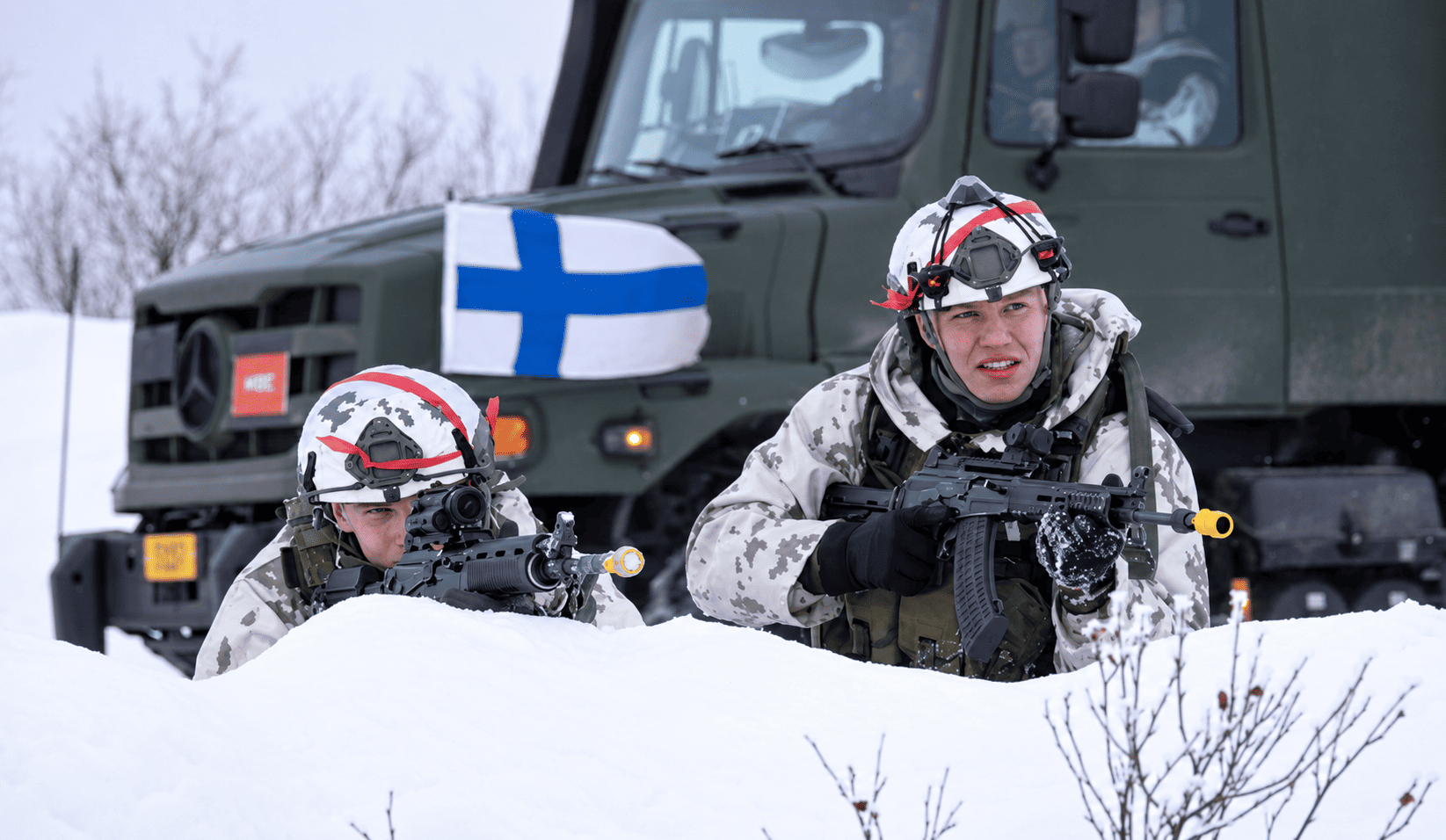
Finland’s Ministry of Defence, Ministry of the Interior and Ministry for Foreign Affairs on October 6, 2026, published the results of Russia’s Futures, a joint foresight project mapping four alternative scenarios for Russia through 2045: Renewing Russia, Fading Russia, Imperialist Russia and Chaotic Russia. The 148-page report, issued in Finnish as Ministry of Defence publication 2026:5, assigns no probabilities to any outcome, but its impact analyses identify a military threat to Finland under all four.
The study is the fourth Finnish interministerial assessment of Russia’s trajectory, after Russia of Challenges (2007-2008), Russia of Changes (2011-2012) and Russia of Power (2018-2019), and the first since Russia’s full-scale invasion of Ukraine and Finland’s accession to NATO on April 4, 2023. Coordinated by the Ministry of Defence over just under two and a half years, it drew on dozens of researchers and officials organized into six thematic groups, including a dedicated military group. Project coordinator Terhi Ylitalo, a ministerial adviser at the ministry, said Finland and Europe must prepare simultaneously for several possible Russian futures. With a roughly 1,340-kilometer land border, the longest any NATO member shares with Russia, Helsinki’s long-range reading of its neighbor bears directly on the alliance’s northern flank.
Inside the Four Russia Scenarios Mapped Out to 2045
The project identified 22 drivers of change and selected 14 as key uncertainties, from the strength of central power and partnerships with China to fossil fuel demand and the armed forces’ relationship with society. Each was projected through four alternative developments to 2045 and combined in a morphological table to build the scenarios. The authors stress these are not forecasts and that reality will likely blend several.
Renewing Russia describes a pragmatic regional power that still sees itself as a great power but has, at least for now, abandoned building spheres of influence and reshaping Europe’s security order. A more cooperation-minded generation holds power, the war in Ukraine ended in what the report calls a tolerable peace, and Ukraine and Moldova have joined the European Union. Sanctions have been gradually lifted and technology cooperation with China is deep. This is not a disarmed Russia: the armed forces reform has succeeded, nuclear modernization is complete, and Russia ranks among the world’s leading nuclear powers. Political dialogue with NATO has resumed, with limited cooperation on arms control and counterterrorism.
In Fading Russia, the West contained Russian imperialism. Ukraine and Moldova have joined both the EU and NATO. Russia is a declining, resentful regional power whose leadership has weakened as the elite fragments, and it depends asymmetrically on China, including for military technology. Sanctions were eased after Russia paid war reparations, yet growth stays weak. Its military power has not recovered to its pre-2022 level, so scarce resources flow mainly to the nuclear deterrent, raising the role of nuclear weapons in Russian policy. NATO itself has Europeanized as Washington shifts toward the Asia-Pacific.
Imperialist Russia: Expansion Under a China-Led World Order
Imperialist Russia is the only scenario in which Moscow’s war aims succeed. Russia is an authoritarian, expansionist regional great power for which war is both a source of status and a tool of regime survival. It has achieved its central objectives in Ukraine, now run by a pro-Russian puppet government, while Moldova and Georgia have been forced into close cooperation with Moscow. The enabling conditions are external: the United States withdrew from Europe and ended support for Ukraine, pro-Russian populist governments hold power in several EU states, and Russia has degraded NATO’s crisis decision-making and the credibility of collective deterrence.
The scenario includes a military clash between Russia and NATO in the Baltic Sea during the preceding decade, which reinforced Moscow’s anti-Western propaganda. Russia has replaced the Collective Security Treaty Organization (CSTO) with a broader Eurasian military alliance built as a counterweight to NATO, reinforced its presence in Belarus and Ukraine, and challenges NATO’s posture in the Baltic states and the Nordic region.
The report is precise about the source of that power: it rests primarily on the absence of a counterforce and on Moscow’s ability to mobilize society, not on a significant increase in Russia’s own military potential. Chinese support provides access to high-technology weapon systems, the force is professional and motivated, and nuclear threats have become an established instrument of information influence. Beijing’s goal of absorbing Taiwan before the People’s Republic’s 2049 centenary restrains it from overextending elsewhere, leaving Moscow room to act. For Finland, the impact analysis warns this world could at worst endanger the country’s existence, citing an elevated threat of total war against small states near Russia, weaker defense owing to limited NATO and EU support in crises, and rising procurement costs.
Chaotic Russia and the Risk to Nuclear Command and Control
Chaotic Russia describes a nuclear-armed state that has lost its normal capacity to function yet remains expansionist and risk-acceptant. A transfer of power has failed, central authority has dispersed among competing clans, and regional actors fight armed power struggles. The country’s size, its arsenal and repression-enforced cohesion prevent disintegration, for now. Its wars change character: regional leaders and warlords wage smaller local wars, seize raw materials, export mercenaries and run trafficking networks, while Russia sustains conflicts in Ukraine, Moldova and Georgia.
The military assessment is stark. Corruption pervades the armed forces, trust between citizens and the military has collapsed, and wartime recruitment structures now channel state funds to rival power groups. Without Chinese support, Russia falls steadily behind in military technology. Aging nuclear systems are poorly replaced, insufficient testing makes their reliability questionable, and Russia can no longer sustain the arsenal it held in the early 2020s. Nuclear command remains with the central authority, but the risks surrounding control of the weapons have grown. China, no longer treating Russia as a credible strategic partner, funds warlords along the shared border, buys Siberian raw materials directly from regional leaders and expands its Arctic military presence.
Europe fares poorly. The security order has crumbled, the United States has withdrawn, the military weight of NATO’s Article 5 has diminished, and shifting coalitions have emerged alongside the alliance as Russian actors launch operations in the Baltic Sea region and the Arctic. Finnish risks include pressure on border security, refugee flows, cross-border organized crime, weapons of mass destruction (WMD) materials falling into the wrong hands, and the reactors, arsenal and nuclear waste on the Kola Peninsula.
What Finland’s Cross-Scenario Measures Mean for NATO Deterrence
The report closes with seven measures it judges necessary whatever path Russia takes. Russia’s aggression must be contained, Ukraine supported in greater quantity and quality, and the possibility of Ukrainian NATO membership kept open. Sanctions must block Western technology, capital and know-how from reaching Russia’s war machine and be lifted only gradually, on evidence of real change in Russian policy.
On defense, Finland is to develop its capability within NATO deterrence and defense, EU defense cooperation, Nordic cooperation and bilateral ties with the United States, while staying ready to form coalitions of like-minded states. The report urges a stronger European pillar of NATO and a European strategic deterrent, and backs French and British efforts to strengthen their nuclear deterrents so Europe can sustain its own counter-deterrent to Russia’s nuclear forces. Finland and its allies must be able to fight an intensive, long-duration war drawing on lessons from Ukraine, and NATO must raise its readiness against activity below the threshold of war. The authors add that Russia’s weakening or a change of leadership would not automatically improve Finnish or European security.
The remaining measures widen the frame. Finland and the EU are to pursue a consistent, knowledge-based Russia policy built on EU-led contacts that are limited and strictly conditional, and to prevent dependencies that expose them to coercion. The report also flags an erosion of Russia expertise since the rupture in relations and calls for secure funding for research and Russian-language skills, arguing that reading signals from Moscow demands specialist knowledge.
Analysis: The report’s central contribution for defense planners is that the threat to Finland changes form across scenarios but never disappears. In Renewing Russia, the risk is a modernized force combined with Western complacency, with the authors warning that the threshold for invoking Article 5 could rise. In Fading Russia, it is a resentful state leaning harder on nuclear weapons. In Imperialist Russia, it is the threat of total war against small neighbors; in Chaotic Russia, fragmented forces, loose WMD materials and spillover violence. That spread decouples Finnish capability requirements, from long-war endurance to a European nuclear counter-deterrent, from any single forecast about Kremlin politics. It also exposes a common denominator: both scenarios most dangerous to Finland assume a US withdrawal from European security. A stronger European pillar inside NATO is therefore less a hedge than the one variable Europe controls directly.
English translations of the report and its roughly 300-page annex on drivers of change will be published later, opening the material to allied planners. The ministry says several follow-on work streams have been preliminarily agreed, some in international cooperation, without detailing scope or timing. The scenarios join two other recent Finnish futures studies: the Government Report on the Future of September 2025, which set out its own four Russian pathways to 2045, and the Finnish Defence Research Agency’s Era of Unrest study of August 18, 2026, built around two scenarios for 2040. How directly the scenarios will shape Finland’s next defense policy documents and its NATO capability commitments remains unspecified.