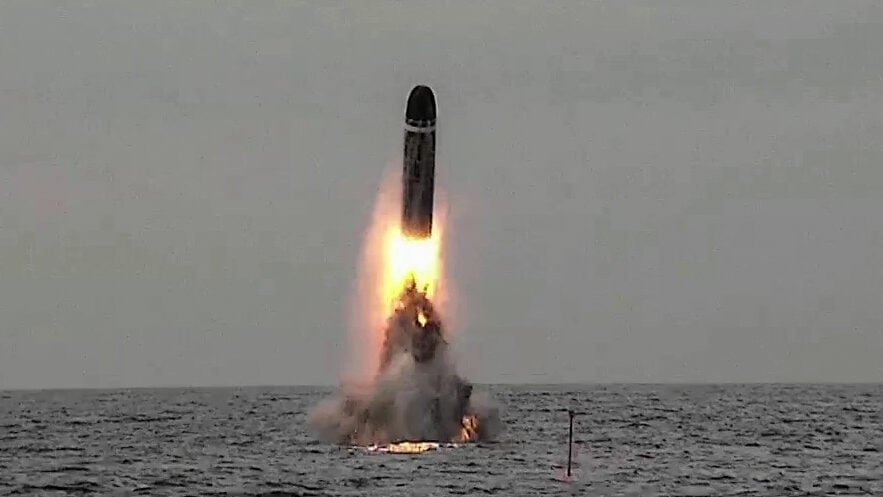
France test-fired its M51.3 submarine-launched ballistic missile (SLBM) from a submarine for the first time on October 6, 2026, launching an unarmed round from the nuclear-powered ballistic missile submarine (SSBN) Le Vigilant off Brittany. The French Ministry of the Armed Forces said the missile came down in the North Atlantic several hundred kilometers from any coastline, in line with France’s international commitments. President Emmanuel Macron watched from the frigate Auvergne and posted the launch on X: “To be free, one must be feared. And to be feared, one must be powerful.”
The firing served two purposes. It certified Le Vigilant for a return to deterrence patrols after a major overhaul, and it was the first sea-based flight of the M51.3, which entered operational service on October 24, 2025, after a qualification flight from the Directorate General of Armaments (DGA) site at Biscarrosse on November 18, 2023. It also came seven months after Macron ordered more nuclear warheads and introduced a doctrine of forward deterrence, and weeks after he vowed that hybrid attacks attributed to Russia would not go unanswered.
M51.3 Ballistic Missile Firing Returns Le Vigilant to the Deterrence Cycle
Le Vigilant, the third of four Le Triomphant-class SSBNs and in service since 2004, has just completed its periodic unavailability for maintenance and repair (IPER), the overhaul each French SSBN undergoes roughly every ten years. Naval Group led the roughly 4 million work-hour program for the French Navy’s Fleet Support Service (SSF), covering propulsion, diving safety, the hull and the deterrence weapon system. The boat returned to the Île Longue base near Brest in July 2025 for the final phase.
A boat leaving such a refit must prove that hull, crew, fire control, launch tubes and missile interfaces operate as one system before it sails on patrol. DGA Essais de missiles, the agency’s test directorate, tracked the flight with assets including the trials ship Monge. The result carries particular weight for this hull. Le Vigilant was the first of three Le Triomphant-class boats retrofitted for the M51, and on May 5, 2013, an M51 fired from it in the Bay of Audierne self-destructed shortly after launch, the only failure recorded in the missile’s flight-test history.
Publicly available specifications indicate each boat of the class measures 138 meters, displaces more than 14,000 tonnes submerged and carries 16 M51 missiles, with two alternating crews sustaining the patrol tempo. France has kept at least one SSBN at sea without interruption since 1972. With only four hulls, a multi-year overhaul removes a quarter of the force from the rotation and squeezes the margin between patrol, training and maintenance. Le Vigilant’s return restores that margin as Paris asks the sea-based leg to underwrite a wider European role.
Range, Warheads, and Penetration: What Sets the M51.3 Apart
The M51 is a three-stage, solid-propellant intercontinental missile built by ArianeGroup under DGA management and in service since 2010. Publicly available specifications indicate a length of about 12 meters, a diameter of 2.3 meters and a launch mass of 52 to 56 tonnes. Open-source figures credit the family with a range of 8,000 to 10,000 kilometers; the ministry says the M51.3 improves range, accuracy and penetration over the M51.1 and M51.2 it will replace. Navigation pairs inertial guidance with stellar updates. Exact M51.3 performance remains classified.
Each missile carries multiple independently targetable reentry vehicles, reported at up to six, though France does not disclose loadings or yields. The M51.3 introduces the second-generation oceanic nuclear warhead (TNO-2), developed by the French Alternative Energies and Atomic Energy Commission (CEA) since 2013. Having ended explosive testing in 1996 and ratified the Comprehensive Nuclear-Test-Ban Treaty in 1998, France certifies the TNO-2 through the CEA’s Simulation program.
Penetration matters most. French doctrine threatens an aggressor’s centers of power with unacceptable damage, and for Russia that target set includes a capital ringed by a dedicated ballistic missile defense system; the ministry presents the M51.3 explicitly as an answer to such defenses. Range governs patrol geometry. The M51 family outranges the roughly 6,000-kilometer M45 it succeeded and sits in the same class as the Trident II D5 carried by US and British SSBNs, which the US Navy credits with a nominal 7,360 kilometers. That reach lets French boats hold distant targets at risk from protected patrol areas close to home.
Forward Deterrence: How the Test Fits Macron’s Nuclear Doctrine Shift
Macron’s March 2, 2026, address at Île Longue changed two long-standing features of French nuclear policy. He ordered an increase in the number of warheads, the first expansion since the end of the Cold War, and announced that France would no longer publish the size of its arsenal. The Stockholm International Peace Research Institute (SIPRI) had estimated the stockpile at about 290 warheads, under the ceiling of fewer than 300 set during Nicolas Sarkozy’s presidency.
He also unveiled forward deterrence, which allows the temporary deployment of elements of the Strategic Air Forces (FAS) to allied countries while keeping the final decision on nuclear use exclusively French. Macron said talks had opened with the United Kingdom, Germany, Poland, the Netherlands, Belgium, Greece, Sweden and Denmark, and presented the framework as complementary to NATO’s nuclear posture. He stopped short of offering a formal nuclear umbrella of the kind the United States extends through the alliance.
The two legs of the French force play distinct roles in that design. Rafale B fighters armed with the ASMPA-R supersonic air-launched nuclear missile can move forward and signal visibly. The four SSBNs cannot be deployed to partner territory, but they provide the survivable second-strike capability on which any French commitment to allies ultimately rests. Macron’s October 6 post reused the formula he delivered at Île Longue in March, and he called the launch a technical success confirming the credibility and long-term viability of the deterrent. Since Brexit, France has been the only nuclear-armed member of the European Union.
Analysis: The firing is less a missile test than a demonstration of the force structure forward deterrence depends on. Rafale B deployments to allied airfields would give partners a visible symbol, but the offer is only as credible as the sea-based leg behind it: modern, available and survivable. By flying the M51.3 from an operational boat fresh out of overhaul, Paris has shown that its newest missile works from the platform that delivers it and that the fourth hull is back in the rotation. It also gives the warhead increase a delivery system with headroom: open-source estimates suggest French missiles do not all carry full loads, so more warheads could in principle be absorbed without new missiles or boats.
The ministry has not said when Le Vigilant will resume patrols or when the M51.3 transition will be complete across the fleet. The M51.4, contracted to ArianeGroup on August 28, 2025, is expected to enter service next decade aboard both the Le Triomphant class and its successor, whose lead boat, L’Invincible, Macron said will go to sea in 2036. The open questions are political as much as technical: how large the undisclosed warhead increase will be, which of the eight partner countries formalize forward deterrence arrangements, and when the first temporary FAS deployment to allied soil takes place.