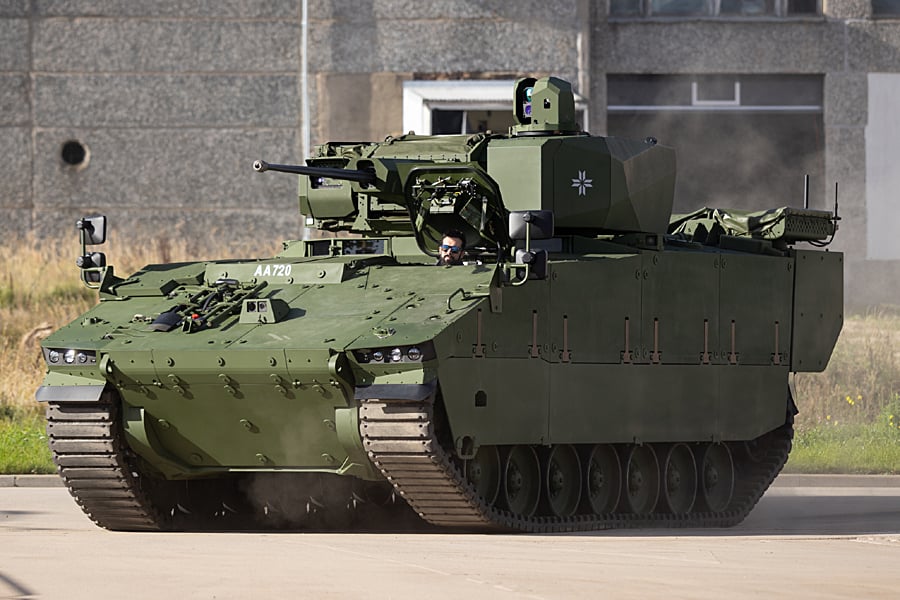
General Dynamics European Land Systems-Santa Bárbara Sistemas (GDELS-SBS) has formally delivered the first HUNTER infantry fighting vehicle (IFV) assembled in Latvia to the National Armed Forces of Latvia, the company announced on October 7, 2026. Accepted by Latvian forces in September 2026, the ASCOD-based vehicle is the first of 84 IFVs due before 2029 under a contract that reserves at least 30 percent of program work for Latvian industry.
The handover comes roughly 20 months after the Latvian Ministry of Defense signed a €373 million contract on January 30, 2025, for an initial 42 ASCOD IFVs with logistic support. Riga doubled the order to 84 vehicles in June 2025, lifting the program’s reported value to nearly €800 million. HUNTER replaces the Combat Vehicle Reconnaissance (Tracked), or CVR(T), family Latvia acquired from the United Kingdom and will equip the Land Forces Mechanized Infantry Brigade, giving a Baltic state that borders Russia and Belarus its first dedicated tracked IFV.
Inside the HUNTER Infantry Fighting Vehicle: Firepower, Protection, Mobility
HUNTER is a Latvia-specific configuration of the ASCOD 2 Common Base Platform, the tracked family behind Spain’s Pizarro, Austria’s Ulan and the British Army’s Ajax series. It carries a crew of three and six dismounts with full combat equipment, according to the Latvian Ministry of Defense.
Firepower comes from what open sources identify as the Elbit Systems UT30 Mk 2 unmanned turret, which GDELS ordered in April 2025 under an approximately $100 million contract for an undisclosed NATO European customer widely identified as Latvia. Publicly available specifications indicate a dual-feed Mk44 Bushmaster II 30 mm cannon with airburst munition support, a 7.62 mm coaxial machine gun and integrated anti-tank guided missiles; the missile selected for HUNTER has not been publicly confirmed. Independently stabilized commander and gunner sights enable a hunter-killer cycle, letting the commander cue the next target while the gunner engages the current one. Because the turret does not penetrate the hull, all three crew members sit under hull armor, preserving internal volume for the dismount section.
The Latvian Ministry of Defense specifies STANAG 4569 Level 4 protection for the vehicle, rated against 14.5 mm armor-piercing rounds, with modular appliqué armor available on the hull. Reporting has linked the Latvian turret package to Elbit’s Iron Fist hard-kill active protection system, which neither GDELS nor the ministry addressed in the delivery announcement.
Publicly available specifications list an MTU 8V199-series diesel, quoted between 816 hp and 1,100 hp depending on variant, driving a Renk HSWL 256B transmission, with a road speed of 70 km/h and a range of about 500 km. Soucy supplies composite rubber tracks for all 84 vehicles, and Spain’s Piedrafita provides the suspension. Rubber tracks cut vibration, noise and weight compared with steel links, easing crew fatigue and maintenance on long road marches. Against the roughly eight-tonne CVR(T) Scimitar, armed with a clip-fed 30 mm RARDEN cannon and no dismount capacity, HUNTER represents a generational jump in protection, firepower and infantry lift.
Valmiera Assembly, Local Industry, and the HUNTER Counter-UAS Roadmap
Hulls are fabricated at the GDELS plant in Trubia, northern Spain, and completed in Seville, where the first vehicle underwent factory testing and initial Latvian crew training before its presentation in April 2026. Final assembly and life-cycle support run through a strategic alliance with Patria Latvia at the Defence Partnership Latvia armored vehicle facility in Valmiera, opened in May 2024. Latvia also signed a memorandum with Spain and Austria in late 2025 to form an ASCOD user group, a channel to share upgrade, training and spare-parts costs with larger operators of the same Common Base Platform.
After the April handover of the platform, the program moved into integration and validation in Latvia: turret integration, system verification, crew training, field trials with the customer and formal acceptance. GDELS says it designed, built, integrated and tested the first Latvia-specific platform in 14 months.
“We are not only acquiring modern equipment, but we are also developing national industrial and technological capacities,” Defense Minister Raivis Melnis said. GDELS-SBS chief executive Alejandro Page presented the symbolic key to Melnis and Lt. Gen. Kaspars Pudāns, Commander of the National Armed Forces.
The next capability increment is already in test. GDELS is integrating a Counter-Unmanned Aircraft Systems (C-UAS) concept covering identification, detection and interception, shifting the IFV from a platform that needs protection against air threats to an active element of air defense. The company credits HUNTER’s open and modular architecture, which also hosts the Latvian C4I suite, with allowing new technologies to be integrated without major platform redesign. The C-UAS sensors, effectors and fielding timeline have not been disclosed.
Analysis: Speed is the program’s defining metric. Moving from signature to an accepted, locally assembled IFV in roughly 20 months contrasts with the troubled development of the ASCOD-derived Ajax, and Riga achieved it by pairing a mature common hull with an off-the-shelf turret and an existing domestic assembly line. That model gives Latvia a sustainment base for wartime repair on NATO’s eastern flank. The C-UAS effort points to the program’s real test: survival in the drone-saturated battlespace seen in Ukraine.
Next milestones include the delivery cadence from Valmiera, conversion of mechanized infantry battalions, and confirmation of the missile, active protection and C-UAS configurations. Earlier ministry statements targeted completion of first-batch deliveries in 2027; the contract now calls for all 84 vehicles to be delivered before 2029.