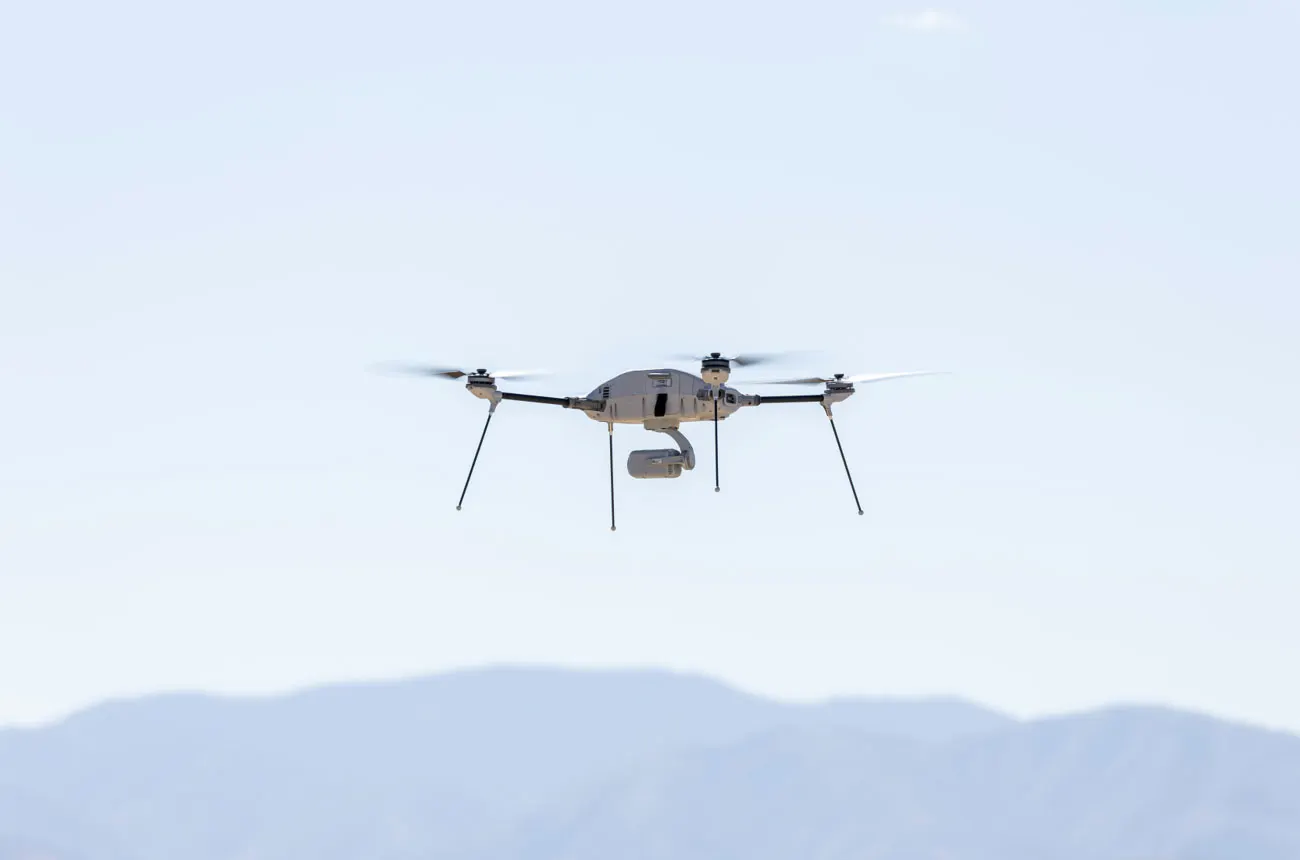
Lockheed Martin will provide an Indago 4 unmanned aircraft system (UAS) to support Peru’s response to the 2026-27 El Niño emergency, the company announced in Lima on November 20, 2026. The package covers the air vehicle, its ground control system, and training for Peruvian personnel so that national teams can operate it on their own. The 3.73 kg quadcopter offers 50 to 70 minutes of endurance and a 10 km datalink range, and is configured for aerial damage assessment and tethered communications relay.
The transfer comes less than three weeks after Peru declared a 60-day state of emergency on November 3, 2026, covering 1,380 of the country’s 1,891 districts, roughly 73%, across 24 departments and the Constitutional Province of Callao. The National Institute of Civil Defense (INDECI) provides technical oversight of the response. Peru’s multisector El Niño study commission, ENFEN, maintained its Coastal El Niño alert on November 13, assessing that the event, which began in March 2026, will stay at extraordinary strength until February 2027. According to Lockheed Martin, Peruvian disaster authorities specifically requested rapid aerial assessment and communications support.
Lockheed Martin Indago 4 Specifications and Payload Options
The Indago 4 is a tactical quadcopter developed by Lockheed Martin Procerus Technologies in Vineyard, Utah, and now marketed within the company’s Skunk Works small uncrewed aerial systems portfolio. Publicly available specifications list an air vehicle weight of 3.73 kg and a maximum payload of 2.27 kg, roughly 60% of flight weight. Endurance runs 50 to 70 minutes depending on battery type and payload, against 35 to 45 minutes for the predecessor Indago 3. Datalink range is 10 km, cruise airspeed 25 mph (about 40 km/h), and rate of climb 4 m/s. Deployed, the airframe spans 108.6 by 110.5 cm; folded, it packs into 38.4 by 22.9 by 17.8 cm, and the company quotes a two-minute setup time. A complete system with two batteries, radio, hand controller, and charger weighs about 9 kg.
Mission systems include three payload interfaces, an open architecture with a Payload Development Kit for third-party sensors, on-edge computing for AI and machine-learning processing, and Northstar vision-based navigation software for GPS-degraded or denied environments. Standard sensors include the ION 30X MK2 daylight camera with 30x optical zoom and the Noctis dual infrared payload with a 640 by 512 thermal sensor. Control runs through a Tomahawk Robotics Grip S20 hand controller and VCSi Touch ground software optimized for the Android Team Awareness Kit (ATAK). Lockheed Martin has not disclosed which payloads or battery configuration are included in the Peru package.
Tethered Relay and ISR Missions for Peru’s Flood Response
The company says the system is configured for two mission sets identified by Peruvian authorities. The first is intelligence, surveillance, and reconnaissance (ISR) for post-disaster assessment and predictive risk analysis: rapid aerial imagery of high-risk areas, including land dams, flood zones, and compromised infrastructure. In Peru’s Andean valleys, huaicos, the debris flows triggered by intense rain, can block rivers and form unstable impoundments; early imagery of those sites gives authorities time to order evacuations before a breach.
The second mission is a tethered communications relay. A tether kit supplies continuous power and a data connection from the ground, removing the battery limit on endurance. Fitted with a communications payload in place of the camera, the aircraft becomes a persistent elevated node supporting local Wi-Fi and cellular service for response teams. Precedent exists: the earlier Indago 3T tethered variant, marketed for persistent ISR and airborne relay, carried a Silvus SC4400 mobile ad hoc network radio at a 50 m hover to act as an advantaged network node. The announcement does not confirm whether the tether kit ships with the initial delivery.
Dan Valenti, program director for UAVs and Attritables at Lockheed Martin, said the effort is intended to “strengthen Peru’s sovereign operational capabilities” and improve disaster preparedness. The release does not identify the receiving agency, the number of personnel to be trained, the delivery schedule, or the commercial terms, and it does not state whether the system is donated or loaned.
Analysis: A single quadcopter will not change Peru’s response capacity at national scale. Its value lies in the relay role. Lockheed Martin says the system will help Peruvian pilot teams re-establish communication links in impacted communities, and a tethered node can restore coordination for response teams without waiting for infrastructure repair. For Lockheed Martin, the gesture follows Peru’s April 2026 contract for 12 new F-16 Block 70 fighters, and Kristen Leroux, vice president and regional executive for Lockheed Martin Canada and Latin America, tied it to long-term collaboration on resilience, security, and industrial development. Training Peruvian operators during a declared emergency builds institutional familiarity that positions the Indago family for any follow-on small UAS requirement from civil defense or the armed forces.
Key unknowns remain the delivery date, the receiving organization, and the exact payload set. The current decree runs into early January 2027, while ENFEN expects the episode to persist into mid-2027. An extension of the emergency, or a Peruvian move to acquire additional Indago systems once it ends, will show whether this deployment stays a one-off corporate contribution or opens a procurement track.