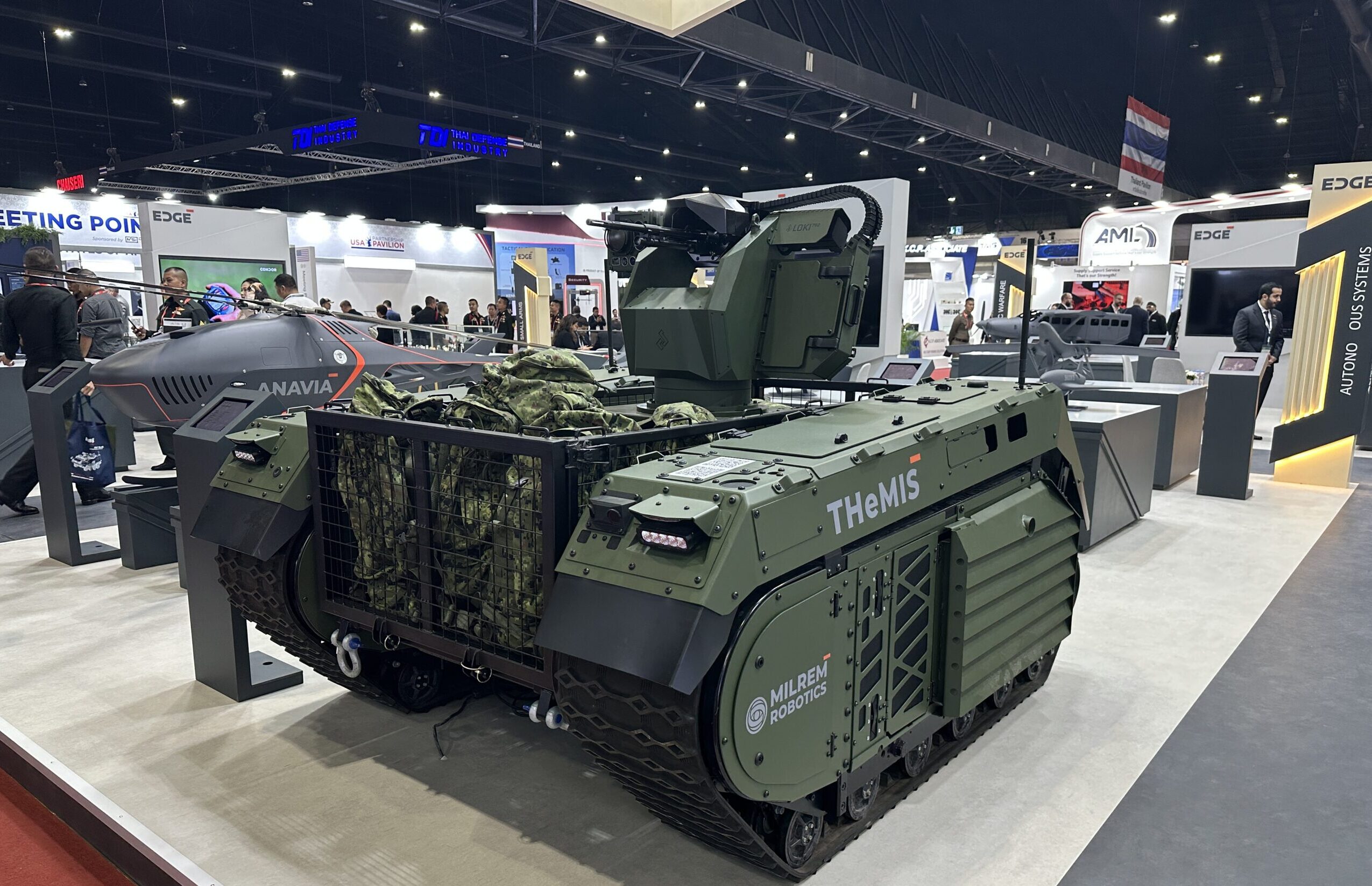
Hanwha has acquired two THeMIS unmanned ground vehicles (UGVs) from Estonia’s Milrem Robotics for separate initiatives in South Korea and Australia, the companies announced on October 7, 2026. The agreement also sets up a framework for the South Korean group to market, produce, sell and sustain the tracked robot across Australia and New Zealand.
The deal extends a partnership dating to February 2025, when Hanwha Aerospace and Milrem signed a memorandum of understanding at IDEX 2025 in Abu Dhabi to co-develop tracked robotic combat vehicles (RCVs). On May 14, 2026, the two firms signed a teaming agreement at BSDA 2026 in Bucharest to pursue Romania’s UGV program. It also follows the July 16, 2026, decision by South Korea’s Defense Acquisition Program Administration (DAPA) to select Hanwha’s own Arion-SMET for the Republic of Korea Army’s first multipurpose UGV program.
THeMIS UGV Specifications and the Korean Research Track
In South Korea, one THeMIS will support multiple research and development projects in which Hanwha participates, helping develop and evaluate autonomous ground capabilities. Neither company has named those projects or their sponsors. Hanwha Aerospace confirmed in November 2025 that it was jointly developing a THeMIS-K variant tailored to Korean Army requirements, but the announcement does not say whether the new vehicle feeds that effort.
The platform is mature. Publicly available Milrem specifications list the THeMIS at 2.50 m long, 2.10 m wide and 1.16 m high, with a weight of 1,815 kg and a rated payload of 750 kg. A diesel engine and electric generator feed a hybrid powertrain rated for up to 15 hours of hybrid operation and up to 1.5 hours on battery alone, the low-signature mode that matters most for reconnaissance and screening. Top speed is 20 km/h. The tracked chassis climbs 60% grades, holds 30% side slopes, crosses 90 cm gaps and pivots in place.
Line-of-sight control extends to 1.5 km, with optional LTE or SATCOM links for beyond-line-of-sight operation and AES-256 encryption with frequency hopping on the datalink. The open architecture has carried payloads ranging from Kongsberg’s Protector RS4 and RS6 remote weapon stations to MBDA’s IMPACT missile system and the R400 Slinger counter-UAS turret from Australia’s Electro Optic Systems. Milrem says 20 nations have acquired the THeMIS, including eight NATO members, and that it has been deployed in Ukraine and in Mali during Operation Barkhane.
For Hanwha, the tracked hybrid complements the Arion-SMET, a fully electric 6×6 wheeled vehicle of roughly 2 tonnes. Its initial production phase is valued at about 49.6 billion won ($33.5 million), and service entry is expected between 2027 and 2028 under the Army TIGER 4.0 modernization drive. A long-endurance tracked platform gives Hanwha a test bed for terrain and mission profiles that a battery-electric wheeled vehicle does not cover.
How Hanwha Plans to Localize THeMIS in Australia and New Zealand
The second THeMIS goes to Australia, where the scope is industrial rather than experimental. The framework covers building an Australian supply chain, establishing local maintenance and upgrade capacity, and integrating payloads and subsystems to regional customer requirements. Milrem will contribute localization planning, technology transfer, technical know-how and engineering expertise.
Hanwha already has an industrial footprint to absorb that work. Its Hanwha Armoured Vehicle Centre of Excellence (H-ACE) in Geelong, Victoria, opened in August 2024 to build the AS9 Huntsman self-propelled howitzer and AS10 ammunition resupply vehicle under LAND 8116 Phase 1, and completed a second construction stage in February 2026 to produce 129 Redback infantry fighting vehicles under LAND 400 Phase 3. A THeMIS line would extend that base from crewed armor into robotics.
The agreement also includes an option to integrate the Milrem Intelligent Function Integration Kit (MIFIK) onto Hanwha’s unmanned and manned platforms. MIFIK adds autonomous navigation and mission execution to existing vehicles, a potential route toward optionally crewed Hanwha platforms, though none has been named.
Demand signals have not yet become funded programs. The Australian Army has converted the Adelaide-based 1st Armoured Regiment into a test and experimentation unit for robotic and autonomous systems, and in May 2026 that regiment and New Zealand Army personnel formed Battlegroup ANZAC during Exercise Black Prince 3 to test such systems at scale. Neither Canberra nor Wellington has announced an acquisition program for a tracked multirole UGV in the THeMIS class, and the companies disclosed no contract value, quantities or delivery timeline.
Analysis: The agreement reads less as a sale than as a localization template. Hanwha is replicating in Australia the model it is pursuing in Romania: pair its own wheeled robots with an operationally deployed tracked platform from Milrem, then wrap both in local production and sustainment offers suited to procurement systems that reward sovereign content. For Milrem, Hanwha supplies the manufacturing base and supplier network that in-country work demands. The risk is sequencing. Capacity is being positioned ahead of a defined Australian requirement, and Army experimentation has so far drawn on local designs from BAE Systems Australia, Thales Australia and others. If a THeMIS-class requirement emerges, Hanwha will hold a strong sovereign production case; if not, the framework remains a marketing arrangement.
Near-term milestones include identification of the Korean research projects using the THeMIS, any decision to exercise the MIFIK option, and the first concrete steps toward an Australian supply chain. Romania’s UGV competition, which the two firms entered together in May, will offer an early test of the paired wheeled-and-tracked offer against rivals including Türkiye’s Otokar.