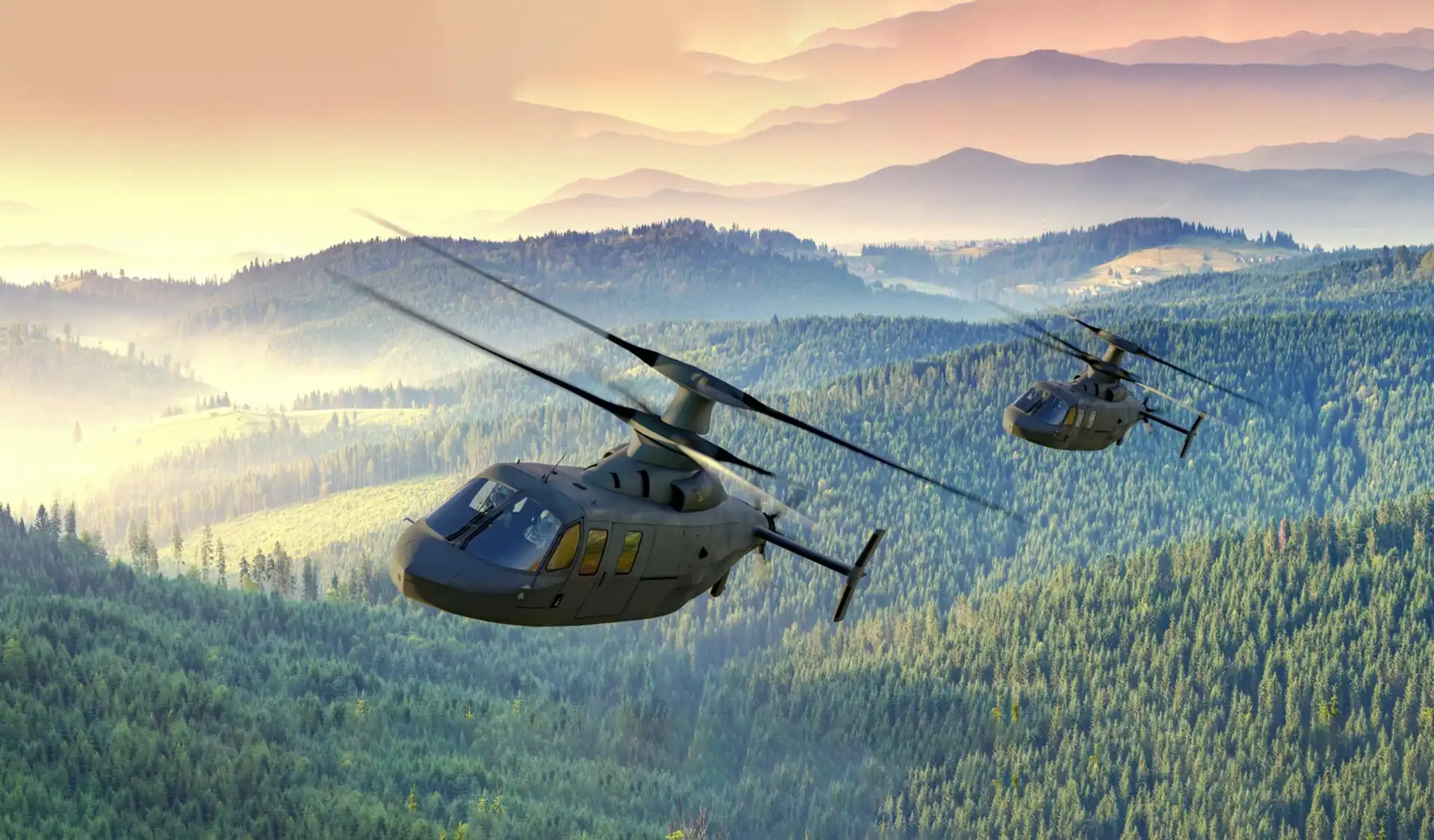
Lockheed Martin offered South Korea an X2 technology transfer covering up to 90 percent of its X2 intellectual property on November 17, 2026, with Korea Aerospace Industries (KAI) as prime contractor. The offer targets the Republic of Korea Army’s High-Speed Medium Utility Helicopter (HSMUH) program, for which Lockheed’s working concept is a roughly 29,000-pound aircraft carrying two pilots, two crew chiefs and 12 passengers. The company outlined it in Seoul at the Freedom 250 U.S.-ROK Defense Partnership event, where Sikorsky displayed its S-97 Raider demonstrator.
HSMUH is the Army’s planned successor to its UH-60P Black Hawk fleet. In the meantime, Korean Air is upgrading 36 UH/HH-60 helicopters under a separate performance improvement program, whose system development phase DAPA launched in September 2025 at KRW 994.3 billion ($715 million). Korean reporting has pointed to fielding from the late 2030s, and KAI has previously outlined a KRW 8 trillion ($5.9 billion) investment through 2040 in its high-speed utility helicopter effort. Lockheed’s move sharpens a three-way contest for partnership with KAI: Bell signed a memorandum of understanding (MOU) with the Korean manufacturer on April 27, 2026, to study solutions based on its MV-75 tiltrotor, and Airbus is also engaging KAI on the program.
Inside the X2 Technology Transfer Offer and KAI’s Prime Role
Dylan Landis, principal of business development at Lockheed Martin, told reporters the company has invested “north of a billion dollars” in the X2 technology base and is “prepared to transfer up to 90 percent of the intellectual property” generated by the program. The stated goal is to let Korean firms design, develop, produce and sustain the aircraft domestically.
The proposal is not an off-the-shelf sale. “The idea is that KAI will be the prime contractor,” Landis said. “They will have the ultimate responsibility to both design and produce it.” He described KAI as the prime the Army has put forward and said the company is conducting a feasibility study. Lockheed and KAI have discussed HSMUH for most of 2026; Sikorsky executives pitched joint X2 development at the Global Defense Supply Chain Forum in July and again at a September 9 seminar in Seoul attended by officials from the Defense Acquisition Program Administration (DAPA).
Lockheed has not committed to a figure for its own investment. Landis said that decision is on hold until the Army finalizes its requirements. The company intends to bring small and medium enterprises into the supply base alongside Korea’s major defense firms and is mapping their capabilities now to move quickly once requirements are set. The offer builds on a KAI relationship that produced the T-50 trainer and FA-50 light combat aircraft, and follows Sikorsky’s November 6, 2026, selection to supply four S-92A+ helicopters for the Republic of Korea Air Force presidential fleet.
Stacked Rotors vs MV-75 Tiltrotor: Sizing the Korean X2 Design
Landis stressed that “X2 is a capability, not a configuration,” and said Lockheed will not lock in a design before requirements are final. The working concept still indicates the scale: at roughly 29,000 pounds (13.2 metric tons), it would be more than three times the 9,000-pound Raider.
The X2 architecture pairs two rigid, counter-rotating coaxial main rotors with a rear pusher propeller that supplies forward thrust, removing the tail rotor while retaining hover and vertical takeoff. Lockheed claims the stacked rotors deliver a 60 percent increase in lift over conventional designs, an argument aimed at confined landing zones and variable-altitude operations in the Korean Peninsula’s mountainous terrain. Publicly available data indicate the original X2 demonstrator reached 250 knots in level flight in 2010, and Sikorsky has previously cited cruise speeds above 200 knots and a turning radius roughly half that of the Black Hawk for X2-based designs.
Bell’s competing pitch rests on a different architecture. The MV-75 is the tiltrotor derived from the V-280 Valor and selected by the U.S. Army under its Future Long-Range Assault Aircraft (FLRAA) program to replace the UH-60. Sikorsky’s coaxial Defiant X lost that competition, and the Army cancelled the Future Attack Reconnaissance Aircraft (FARA) program in February 2024, ending the Raider X effort. Engine selection, mission systems, target speed and range, and unit cost for the Korean design have not been disclosed.
Analysis: The 90 percent figure reflects Lockheed’s competitive position as much as its generosity. Without a U.S. Army production program for X2, Korea would become the launch customer funding a military X2 aircraft, while Seoul would gain the design authority it has pursued since the KUH-1 Surion, developed with Eurocopter as technology partner. Bell offers a platform already chosen by the U.S. Army, with the interoperability and lower technical risk that implies. KAI’s decision will test whether Seoul weights industrial sovereignty above fleet alignment with its principal ally. Any transfer at this scale would also require U.S. export approval, and Lockheed has not said which technologies sit in the withheld 10 percent.
The next milestone is the Army’s final HSMUH requirement, which will drive KAI’s feasibility study, Lockheed’s investment decision and any configuration choice. KAI has not announced a preferred partner, and Bell and Airbus remain in contention. Until then, the scale of Lockheed’s investment and the terms of any transfer remain open.