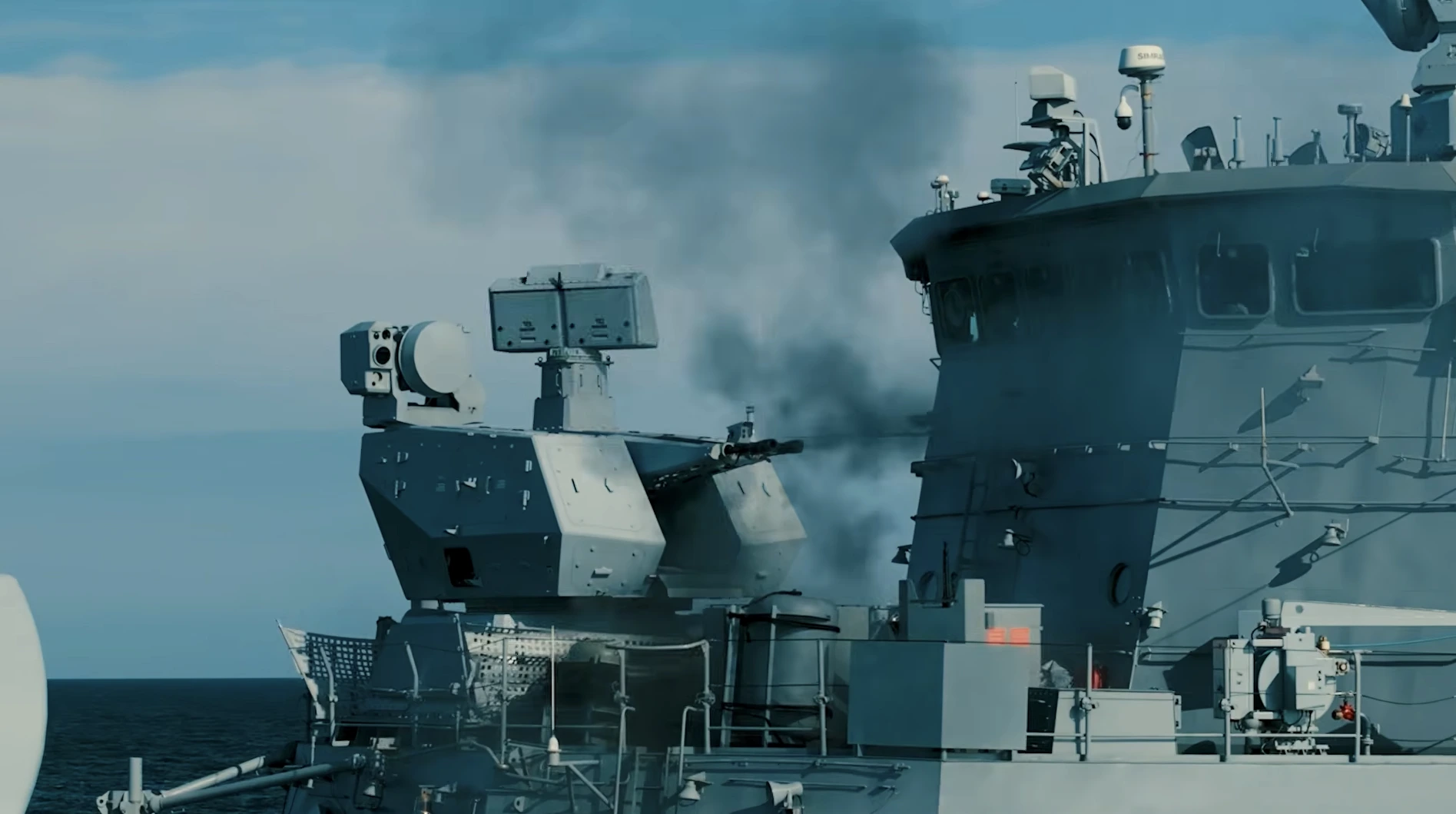
Turkish defense group ASELSAN said in a press release on November 23, 2026, that its Gökdeniz close-in weapon system (CIWS) destroyed a high-speed jet-powered target drone in a live-fire demonstration off Türkiye’s northern coast. The twin 35mm mount fired in semi-autonomous mode from a ship sailing at 5 to 10 knots, with the operator’s role limited to authorizing fire by a single button press. In a post on X the same day, ASELSAN said Gökdeniz destroyed multiple UAVs approaching from different directions and altitudes, including very low-flying ones, before international delegations, and that six navies have selected the system in addition to the Turkish Naval Forces.
ASELSAN did not disclose the date of the firing, the host ship, the engagement range or which countries sent observers. Its press release describes the destruction of one target, while the X post refers to multiple UAVs; the company has not said how many targets were engaged in total. The announcement comes three weeks after the company unveiled a containerised Gökdeniz at Euronaval 2026 in Paris, and as navies continue to absorb the lessons of the Red Sea, where Houthi one-way attack drones have forced warships since late 2023 to expend surface-to-air missiles costing far more than their targets. A gun-based last layer able to handle simultaneous, multi-axis drone raids addresses that cost-exchange problem directly.
How Gökdeniz Engaged a Jet-Powered Target Drone in Semi-Autonomous Mode
In the semi-autonomous mode used for the firing, Gökdeniz detects and tracks targets on its own and automatically sets their priority when several must be engaged, leaving the crew a single decision: whether to fire. The target drone flew a low-altitude, maneuvering profile intended to reproduce the behavior of UAVs and cruise missiles. ASELSAN says the system also offers a fully autonomous mode that runs the whole engagement sequence, including firing against multiple targets, with no operator input, cutting reaction time in close-in defense.
Gökdeniz CIWS Design: Twin 35mm Guns and ATOM Airburst Rounds
Gökdeniz is the naval derivative of ASELSAN’s KORKUT self-propelled air defense gun system and was unveiled at IDEF 2019 in Istanbul, having previously been designated Korkut-D. The mount carries a twin 35mm gas-operated cannon of Oerlikon lineage, produced under licence in Türkiye by MKE, firing NATO-standard 35x228mm ammunition at a combined 1,100 rounds per minute (2 x 550 rpm) with 360-degree traverse. An automatic linkless feed holds both high-explosive incendiary (HEI) and airburst rounds at the same time, letting the operator switch ammunition type according to the threat.
The system’s lethality rests on ASELSAN’s ATOM 35mm airburst munition. ATOM is a time-programmable, base-fuzed round whose fuze is set at the muzzle using the measured muzzle velocity, then ejects a cloud of tungsten sub-projectiles ahead of the target. Publicly available specifications indicate a muzzle velocity of 1,020 m/s for ATOM and an effective range of 4,000 m against aerial targets. Against small UAVs with low radar cross-sections and erratic flight paths, that fragment pattern compensates for residual tracking error in a way single-impact rounds cannot.
Target acquisition relies on an onboard tracking radar and electro-optical sensors, with fully autonomous, manual and stand-alone modes; the last is intended to keep the mount fighting if the ship’s combat management system is degraded. ASELSAN states that qualification firings included a sea-skimming profile and a target flying faster than 180 m/s. By comparison, publicly available specifications indicate the US Phalanx Block 1B fires 20mm rounds at roughly 4,500 rounds per minute and relies on direct hits, so Gökdeniz trades raw rate of fire for a heavier airburst effect at longer reach. ASELSAN has not published ready-round capacity, which governs how many successive raids a mount can absorb before reloading.
Six Export Navies and a Containerised Variant Widen the Market
In Turkish service, Gökdeniz equips the Istanbul-class frigates and the Hisar-class offshore patrol vessels. The first unit was integrated aboard TCG Istanbul after factory acceptance testing in 2023, and the Defence Industry Agency (SSB) announced a live firing from the frigate on January 9, 2026.
Five foreign navies are publicly linked to the system. Turkmenistan was the launch export customer with the corvette Deniz Han, the Pakistan Navy selected the system for its Babur-class (MILGEM) corvettes, and the Philippine Navy fitted it to its Miguel Malvar-class corvettes built by HD Hyundai Heavy Industries. Ukraine’s Türkiye-built Ada-class corvette Hetman Ivan Mazepa has been shown testing its Gökdeniz mount during sea trials. Romania followed on June 20, 2026, when it commissioned the Hisar-class corvette Contraamiral August Roman, Türkiye’s first warship export to a NATO and European Union member. ASELSAN has not published the full customer list behind its six-navy figure.
The containerised configuration shown at Euronaval on November 3, 2026, packages the mount with its own power supply and operator station so it can be fitted to commercial ships, tankers or coastal sites without permanent installation. ASELSAN presented it alongside a containerised Göksur vertical launch system. No orders or delivery timelines have been announced for either.
Analysis: The demonstration was staged for buyers. Multi-axis, low-altitude drone raids are the scenario navies from the Red Sea to the Black Sea now plan against, and a 35mm airburst mount offers a per-engagement cost measured in rounds rather than interceptors. With Romania, Gökdeniz now sits inside a NATO fleet on the Black Sea, giving ASELSAN an allied reference user as European navies weigh gun-based answers to drone saturation. The weight of the claim remains limited by what has not been released: the number of targets engaged, engagement ranges and kill rates.
The next signals to watch are the full customer list behind ASELSAN’s six-navy figure, a first order for the containerised variant, and integration on further Hisar-class ships and the planned TF-2000 air defense destroyer, where Gökdeniz is expected to sit alongside Göksur. Until ASELSAN publishes engagement data from the latest firing, the demonstration confirms capability claims rather than quantifying them.