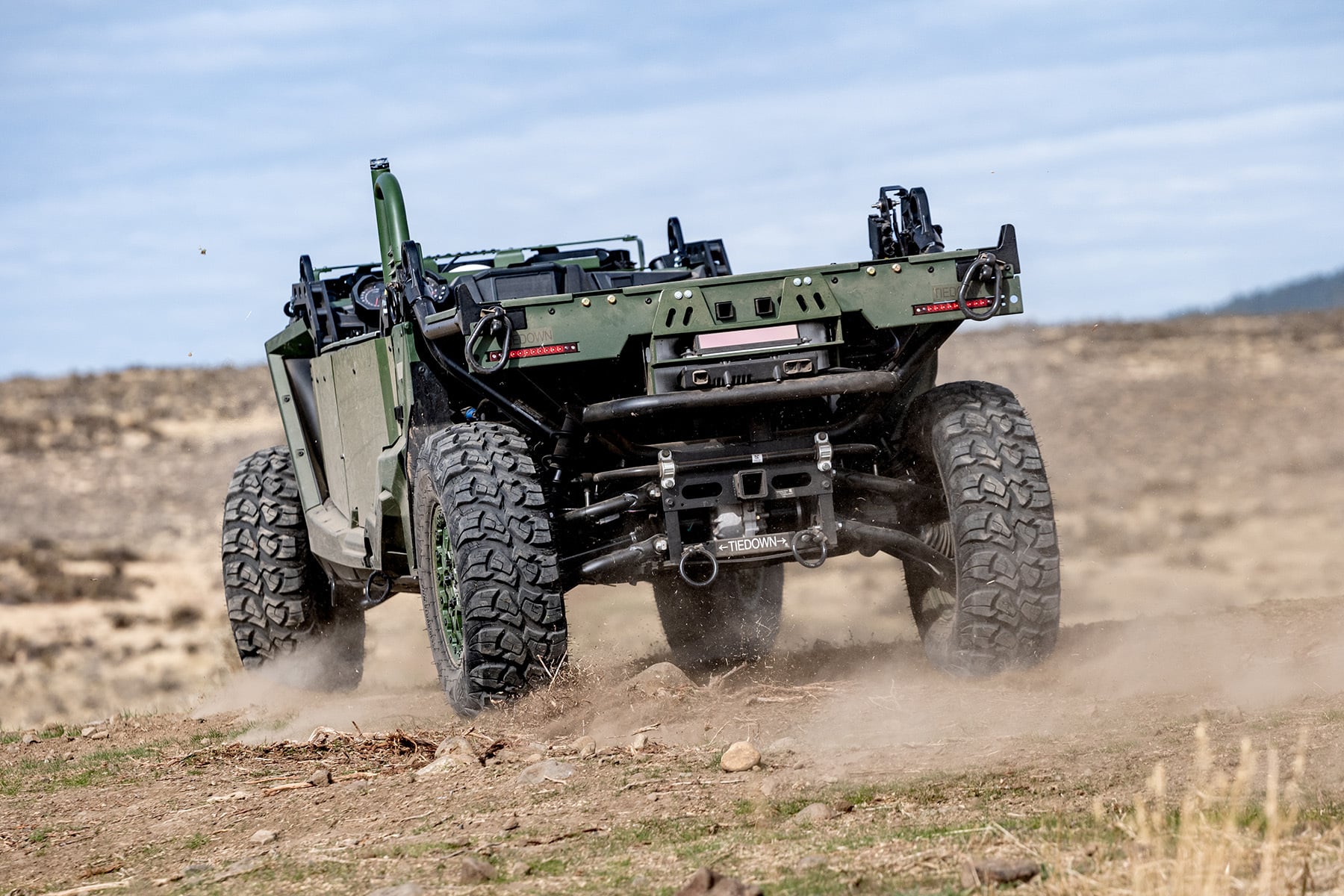
Overland AI unveiled IBEX on October 7, 2026, a fully autonomous ground vehicle (AGV) built on the Polaris MRZR light tactical vehicle that the U.S. Marine Corps has selected for integration into its Marine Air Defense Integrated System (MADIS), according to the company. The Seattle-based firm rates IBEX at a 2,000-pound payload, speeds above 35 mph in full autonomy, a 250-mile cruising range on diesel or JP-8, and 5 kW of exportable power.
IBEX is the vehicle Overland AI built under its Accelerate the Procurement and Fielding of Innovative Technologies (APFIT) production agreement, a $19.7 million Other Transaction Authority (OTA) award announced on June 29, 2026, through the Office of the Under Secretary of War for Research and Engineering with Program Manager Ground Based Air Defense (PM GBAD). The agreement covers more than a dozen AGVs plus OverDrive autonomy software, the OverWatch command-and-control (C2) interface, spares, and training. At award, the company declined to name the platform. On October 6, it disclosed a $4.5 million modification extending the agreement to the U.S. Army’s 75th Ranger Regiment under U.S. Special Operations Command (SOCOM), which it describes as bringing the contract to $25 million.
IBEX Autonomous Ground Vehicle: Payload, Range, and Power Specifications
IBEX doubles the carrying capacity of ULTRA, Overland AI’s in-house flagship AGV unveiled in April 2025 and rated by the company at 1,000 pounds of payload, a 35 mph top speed, and a 100-mile cruising range. IBEX matches ULTRA on speed but stretches cruising range to 250 miles at 20 mph on a single tank, a 2.5-fold gain that extends resupply reach across dispersed positions. Overland has not specified the terrain behind that figure; Polaris rates the crewed MRZR Alpha at 300 miles at 30 mph on paved surfaces.
Publicly available specifications indicate the MRZR Alpha uses a 1.5-liter, four-cylinder common-rail turbo-diesel producing 118 hp and 199 lb-ft of torque, mated to an eight-speed automatic transmission and qualified on D1, D2, JP-5, JP-8, and F-24. The four-seat Alpha carries a rated 2,000-pound payload, the same figure Overland quotes for IBEX, and the 5 kW export output matches the factory-integrated option on the MRZR Alpha XP, against 1 kW on the baseline Alpha. Overland has not confirmed which variant underpins IBEX, nor released its sensor suite, curb weight, or dimensions.
The export power figure carries the most operational weight. At the forward edge, radars, electronic warfare (EW) emitters, radios, and drone chargers compete for scarce generator capacity. Overland describes each AGV as a power node, a communications node, and a compute node, letting a section of vehicles spread energy and processing across a position rather than concentrating them on one crewed platform.
MRZR Chassis Commonality and the Sustainment Logic Behind IBEX
IBEX shares parts and fuel compliance with the MRZR, which the Marine Corps and SOCOM already field, fuel, and maintain. That choice separates it from purpose-built uncrewed ground vehicles that need dedicated spares pipelines and new maintenance training before reaching a unit.
“IBEX is a new platform built on the MRZR’s proven chassis, engine, and drivetrain, so it can be deployed on day one and maintained with the parts and fuel units already have,” said Greg Okopal, co-founder and chief operating officer of Overland AI.
IBEX is designed for transport inside the V-22 Osprey. Polaris certifies the baseline MRZR Alpha for internal carriage in the V-22, CH-47, and CH-53; Overland has claimed only V-22 compatibility for IBEX. Under Expeditionary Advanced Base Operations (EABO), Osprey transportability determines whether an AGV moves with Marines between island positions or stays behind.
IBEX runs the same OverDrive autonomy stack, OverWatch interface, and SPARK hardware kit as ULTRA. The company says its vehicles operate in Denied, Degraded, Intermittent, and Limited (DDIL) environments without remote control or teleoperation, and that the stack has already supported resupply, counter-unmanned aircraft systems (counter-UAS), breaching, and EW missions with Army, Marine Corps, and SOCOM units.
How IBEX Fits Into the MADIS Counter-UAS Architecture
MADIS is the Marine Corps’ mobile short-range air defense system, built on the Joint Light Tactical Vehicle (JLTV) to defeat small drones, helicopters, and low-flying aircraft. Publicly available program descriptions indicate the Increment 1 configuration pairs two JLTVs carrying a 30mm cannon, Stinger missiles, radar, and electronic attack equipment. The first full MADIS systems reached Marine units in Japan in June 2026. Light MADIS, the interim counter-UAS system, already rides on Polaris light tactical vehicles.
The initial role is logistical. Company leadership told reporters in June that the AGVs would first resupply the other vehicles in the MADIS system rather than replace the JLTV, with further roles possible later. The Marine Corps has not said whether IBEX will eventually carry MADIS sensors or effectors. The fiscal 2026 budget allocated $231 million for MADIS Family of Systems procurement, and the fiscal 2027 request seeks 42 MADIS pairs.
Analysis: IBEX reflects a deliberate trade: Overland has set aside ULTRA’s bespoke design freedom in exchange for a vehicle the Marine Corps can sustain without opening a new logistics line. For an expeditionary force planning to fight from dispersed, austere positions inside an adversary’s weapons engagement zone, that trade matters more than any single performance figure. Autonomy that does not depend on a continuous datalink also shrinks the emission signature that teleoperated systems create, a vulnerability exposed by the electromagnetic contest over Ukraine. Scale remains the constraint: a dozen vehicles will not change MADIS employment, and the power-node concept only pays off once AGVs operate in numbers alongside each MADIS pair.
First deliveries are expected roughly nine months after the June award, placing initial IBEX vehicles with PM GBAD in early 2027. Overland has not disclosed unit cost, the split between IBEX and ULTRA in its production orders, or whether the Ranger funding covers IBEX. The next markers are Marine Corps operational testing in the resupply role, any decision to mount sensors or effectors on the vehicle, and whether the fiscal 2027 MADIS buy carries a dedicated AGV line.