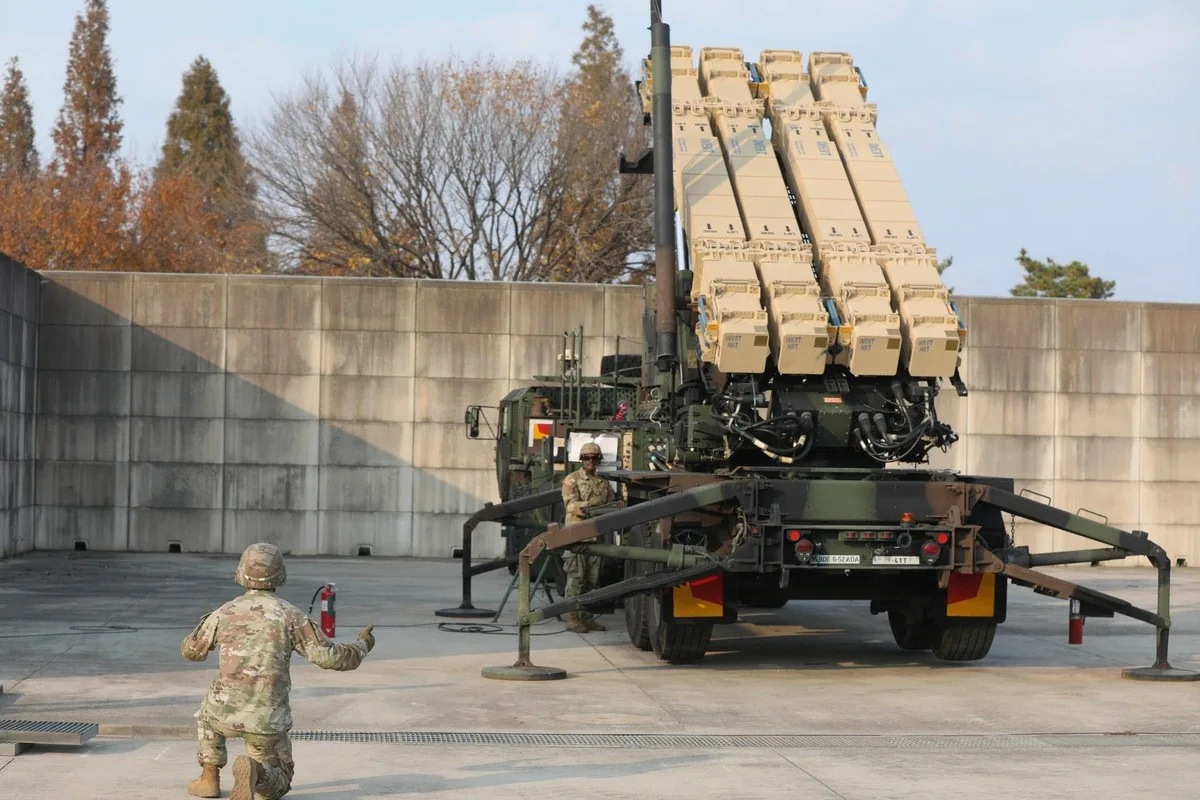
In South Korea, Delta Battery, 6-52 ADA, has become the first operational U.S. Army Patriot battery certified on the Integrated Air and Missile Defense Battle Command System (IBCS), Eighth Army said November 18, 2026. The battery, part of the 6th Battalion, 52nd Air Defense Artillery Regiment, 35th Air Defense Artillery Brigade, can now separate its radars from its launchers, and the battalion’s other Patriot units are set to certify on IBCS in the coming weeks. Eighth Army did not disclose the date of the final evaluation.
The milestone places IBCS inside a forward-deployed Patriot unit facing an active ballistic missile threat. The Army declared initial operational capability for IBCS on April 27, 2023, with 3rd Battalion, 43rd Air Defense Artillery Regiment at Fort Bliss, Texas, weeks after the Pentagon approved full-rate production. The service has since pursued accelerated fielding to U.S. European Command and U.S. Indo-Pacific Command, while Poland, the first international customer, declared full operational capability for its IBCS-enabled Patriot batteries in December 2025. Korea, where the 35th ADA Brigade defends U.S. and allied installations within range of North Korea’s short-range ballistic missiles, offers some of the shortest warning times in the Army’s air defense posture.
IBCS Patriot Battery Certification: Decoupling Sensors From Shooters
According to Eighth Army, Delta Battery transitioned from legacy, siloed weapon networks to the IBCS Integrated Fire Control Network (IFCN), validating its ability to decouple sensors and launchers from the battery’s fire control unit. In a legacy Patriot battery, the AN/MPQ-65 radar, the Engagement Control Station and the M903 launchers operate as a closed loop: the radar’s coverage defines what the battery can engage, and the loss of that radar effectively takes the fire unit offline.
IBCS breaks that dependency. Publicly available program descriptions indicate the architecture rests on three elements: the Engagement Operations Center (EOC), which replaces the Patriot Engagement Control Station as the engagement node; the IFCN relays that link sensors and shooters across dispersed positions; and plug-and-fight kits fitted to radars and launchers so they function as network nodes rather than battery-owned components. The system fuses tracks from multiple sensors into a single integrated air picture, allowing an engagement to be cued by whichever radar holds the best track and executed by whichever launcher holds the best geometry.
That is the best sensor, best shooter capability Eighth Army cited: radars and launchers can be emplaced farther apart without breaking the kill chain. Dispersion complicates adversary targeting of the battery itself, and a single radar outage, whether from jamming, maintenance or attack, can be absorbed by the network instead of silencing a fire unit.
Eighth Army did not release the certification’s evaluation criteria, the interceptor mix assigned to the battery, or whether the unit operates the Lower Tier Air and Missile Defense Sensor (LTAMDS), the planned AN/MPQ-65 replacement. Those details remain unconfirmed.
Fielding IBCS Across the 35th ADA Brigade and Beyond
Eighth Army said additional Patriot units in the battalion will certify on IBCS in the coming weeks, preparing the formation for distributed command and control operations. Once several batteries share the IFCN, the battalion can pool sensors and launchers across fire units and manage its sector as one defended area rather than as separate batteries. The Iron Horse Battalion is headquartered at Suwon Air Base and stations batteries across the peninsula, including at Camp Humphreys.
The Army tied the certification directly to the 35th ADA Brigade’s “Fight Tonight” readiness, the standing requirement for forces in Korea to be ready to fight without notice. Certifying in theater means the unit validated the new architecture without rotating home, keeping Patriot coverage in place over the critical assets it defends.
At the force level, the Army operates 15 active-component Patriot battalions, with three more planned, one per year from fiscal 2029 through 2031, according to a Congressional Research Service report dated August 27, 2026. The same report put the estimated procurement cost of a four-battery Patriot battalion equipped with IBCS and LTAMDS at $1.792 billion. Northrop Grumman, the IBCS prime contractor, received a $1.4 billion production contract in December 2021 and builds the system’s major end items in Madison, Alabama.
Analysis: The value of the certification lies in where it happened. IBCS has spent years in development and test, and its payoff scales with network size: a single networked battery gains dispersion, while a networked battalion, and eventually a brigade, can share sensors across the peninsula and connect to other Army and joint sensors. Proving the conversion inside a no-notice readiness theater lowers the risk for every Patriot battalion that follows. Korea also raises a question the release does not address: how IBCS-equipped U.S. batteries will exchange tracks and coordinate engagements with Republic of Korea Air Force Patriot units, which are not publicly reported to operate IBCS.
The next milestone is certification of the remaining 6-52 ADA batteries, which Eighth Army expects within weeks. Beyond that, the indicators to watch are a battalion-level distributed operations event, the arrival of LTAMDS in Korea-based units, and the extension of IBCS to the 35th ADA Brigade’s other Patriot formations. No timeline has been published for those steps.