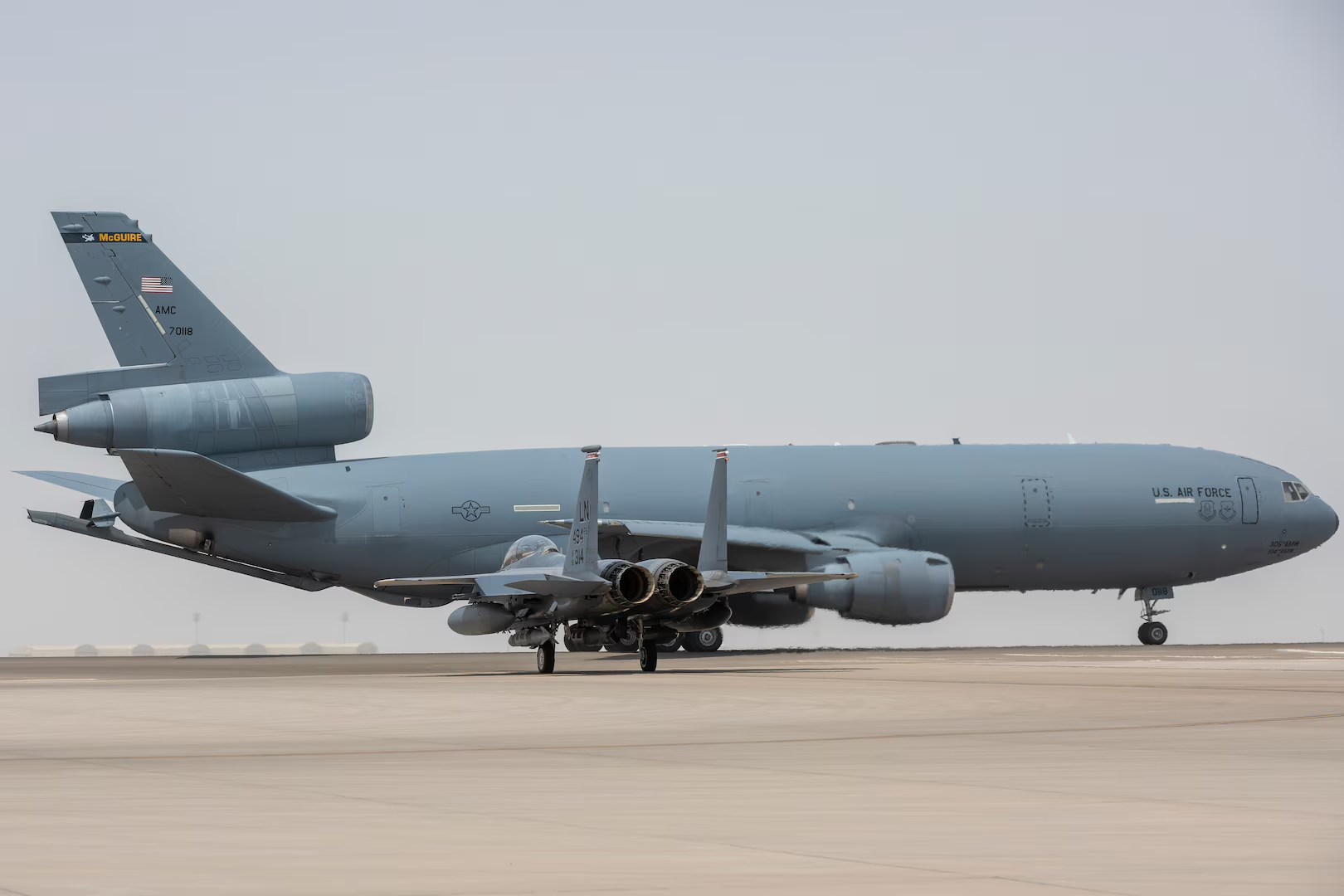
The US Air Force is canvassing industry to regenerate up to four retired KC-10 Extender aerial refueling tankers for transfer to an unnamed partner nation in North Africa under the Excess Defense Articles (EDA) program. The Air Force Life Cycle Management Center (AFLCMC) posted the sources-sought notice, FA8625-27-R-B001, on October 7, 2026, with industry responses due October 28, 2026.
The request comes just over two years after the last KC-10, serial 79-1948, left Travis Air Force Base, California, for the 309th Aerospace Maintenance and Regeneration Group (AMARG) at Davis-Monthan Air Force Base, Arizona, on September 26, 2024, ending a career that began in 1981. The Boeing KC-46A Pegasus replaced it. Congress has since weighed in: the Fiscal Year 2026 National Defense Authorization Act (NDAA), signed in December 2025, requires the Air Force to preserve retired KC-10s in their September 30, 2025, storage condition while still allowing disposal under federal property law.
KC-10 Extender Regeneration Scope and the Excess Defense Articles Path
Issued by the AFLCMC Mobility Aircraft directorate at Wright-Patterson Air Force Base, Ohio, the notice is framed as a Foreign Military Sales (FMS) program for four air refueling aircraft, a three-to-five-year sustainment package, Contractor Logistics Support (CLS), and training. The Air Force wants firms able to execute six tasks: regeneration, a one-time flight clearance, depot-level return to service, worldwide ferry delivery, in-country CLS, and operational and maintenance training.
The sequence describes a full reactivation pipeline, not a simple hand-over. A one-time flight clearance generally permits a stored aircraft a single ferry flight to a depot, where maintainers restore it to mission-capable condition. Delivery to North Africa follows, with contractor logistics and training teams then deployed in the recipient country. The notice does not identify which stored airframes are candidates for the work.
Access is restricted. The full Request for Information (RFI) contains Controlled Unclassified Information (CUI) and is released only to firms that provide a name, company, and Commercial and Government Entity (CAGE) code. The Air Force stresses that the notice is market research under Part 10 of the Federal Acquisition Regulation, not a Request for Proposal, and that the government will not award a contract on the basis of the notice alone.
EDA transfers rest on Section 516 of the Foreign Assistance Act of 1961, which allows surplus US equipment to go to partners at reduced cost or as a grant. The recipient pays for refurbishment and delivery, and the statute requires advance notification to Congress before significant military equipment changes hands.
Boom, Drogue, and 356,000 Pounds of Fuel: The KC-10 Profile
McDonnell Douglas, now part of Boeing, derived the KC-10A from the DC-10-30CF trijet and delivered 60 to the Air Force; one was lost in a 1987 accident. Three General Electric CF6-50C2 high-bypass turbofans, each rated at 52,500 lb of thrust, support a maximum takeoff weight of 590,000 lb, a top speed of 619 mph (Mach 0.825), and a 42,000 ft ceiling.
Fuel defines the aircraft. Three wing tanks and three tanks beneath the cargo floor hold more than 356,000 lb, almost twice the load of a KC-135 Stratotanker and well above the roughly 212,000 lb publicly listed for the KC-46A. The Extender can also carry 170,000 lb of cargo on 27 pallet positions about 4,400 miles unrefueled, or up to 75 passengers, letting one aircraft both tank a fighter detachment and move its support package.
For a foreign operator, the refueling architecture matters most. The KC-10 combines a fly-by-wire boom rated at up to 1,100 gallons per minute with a centerline hose-and-drogue system rated at 470 gallons per minute, so boom-receptacle jets such as the F-16 and probe-equipped types such as the Rafale or MiG-29M can refuel on the same sortie. Part of the fleet also received wing-mounted refueling pods; the notice does not say whether the four candidates carry them.
The design brings a training burden. The KC-10 flies with a pilot, copilot, flight engineer, and boom operator, a crew mix a first-time operator would have to build from scratch, which explains why training sits inside the requested scope.
Egypt and Morocco Lead the Field of Likely North African Recipients
The notice does not name the recipient. Fleet composition narrows the field: Algeria’s air force is built largely on Russian-sourced equipment, and neither Tunisia nor Libya operates a fighter force sized for wide-body tanker support. That leaves Egypt and Morocco, both major US security partners and F-16 operators.
Egypt, one of the world’s largest F-16 operators, fields no dedicated tanker, according to publicly available fleet data, and its Vipers can take fuel only through a boom receptacle. Egyptian F-16s have refueled from US Air Force KC-10s during combined exercises, including in 2023. In September 2024, Cairo announced its first two C-130J-30 Super Hercules, a type that can be configured for probe-and-drogue refueling. China has meanwhile used exercises to fill the gap: during the China-Egypt Eagles of Civilization 2026 drill, which opened August 23, 2026, a People’s Liberation Army Air Force (PLAAF) YY-20A tanker refueled an Egyptian Rafale B, according to imagery released by the Egyptian military spokesperson on August 31. A YY-20A had refueled Egyptian MiG-29M/M2 fighters during the 2025 edition.
Morocco operates 23 F-16C/D Block 52+ jets and has 25 F-16 Block 72 aircraft on order under a package approved in 2019 at an estimated $3.787 billion. Lockheed Martin announced on October 6, 2026, the first flight of the first Royal Moroccan Air Force Block 72, a two-seat F-16D, which now continues flight testing ahead of delivery. Rabat’s organic refueling capacity rests on KC-130H Hercules tankers equipped for probe-and-drogue only, which cannot service its current and incoming boom-receptacle Vipers.
Analysis: The transfer would close a specific capability gap rather than add generic tanker mass. Chinese YY-20A tankers refuel through hose-and-drogue pods and cannot service boom-receptacle F-16s, so four KC-10s would give either Cairo or Rabat a capability Beijing’s exercise presence cannot replicate, while binding the recipient’s Vipers more tightly to US sustainment. The EDA route trades a low acquisition price for life-cycle risk: the DC-10 left production in 1989, few operators still fly the type, and a tanker regenerated after years in storage will lean heavily on parts reclaimed from sister airframes at AMARG.
After responses close, the notice goes inactive on November 12, 2026. The Air Force must then select an acquisition approach, and any transfer requires EDA processing and congressional notification before aircraft leave Davis-Monthan. Open questions include the recipient’s identity, the condition of the four airframes, whether they carry wing pods, and the cost the partner will pay for regeneration, ferry, and three to five years of contractor support.