The U.S. Air Force has awarded SNC a $124 million prototype contract under the Counter Air Missile Program (CAMP), the company announced on November 18, 2026, for a ground-launched, low-cost, supersonic offensive counter-air missile. SNC is teamed with Massachusetts startup Specter Aerospace, which will supply air-breathing propulsion and vehicle systems expertise. The Air Force Life Cycle Management Center (AFLCMC) Armament Directorate manages the effort.
The award makes SNC at least the second missile developer on CAMP. Castelion disclosed on November 17 that it received two prototype contracts on September 22 covering its own ground-launched missile, launch pod, and containerized launcher, while Anduril announced on November 12 that it will build a containerized launcher designed to fire missiles from multiple vendors. CAMP extends the affordable mass logic of the Air Force’s low-cost cruise missile efforts to the air superiority mission, a domain long served by high-cost, low-volume weapons.
Inside the Counter Air Missile Program Ground-Launched Prototype Phase
CAMP’s first increment is the Ground Launched Counter Air Enterprise Test Vehicle (GLCA ETV), run by the Armament Directorate’s Disruptive Futures Division at Eglin Air Force Base, Florida. The service issued the formal solicitation on July 1, 2026, with proposals due August 3, and structured awards as prototype other transaction agreements, allowing several vendors to proceed in parallel.
Requirements published in the November 2025 request for white papers set the economic boundaries. The Air Force asked for a unit price below $500,000 across a production run of at least 1,000 missiles, with a mature design able to support output of 1,000 to 3,500 rounds per year. Phase 1 is a 24-month effort, and the service expects at least one flight test within nine months of award to demonstrate ground launch, range, speed, and handling qualities. Deliverables include a prototype launcher, a flight-tested missile, and a complete product-level technical data package, with the government seeking a high degree of ownership of the technical data rights.
Architecture is equally prescriptive. Candidate missiles must conform to the Armament Directorate’s Modular Weapon M-Series framework, with seeker, warhead, guidance and control, and propulsion subsystems linked through standard interfaces. SNC describes the ground-launched prototype as the foundation for a formal Program of Record and says its open, modular design supports a later air-to-air variant, a path the Air Force built into CAMP from the outset.
How SNC and Specter Aerospace Pair Ramjet Propulsion With Open Architecture
SNC acts as lead system integrator and brings its open systems architecture, while Specter Aerospace contributes the airframe and air-breathing propulsion. Specter chief technology officer Arun Chundru tied the selection to the company’s practice of “developing the airframe and air-breathing propulsion system together.”
Founded in 2013 and formerly known as FGC Plasma Solutions, Specter specializes in plasma-assisted combustion, which uses electrically energized plasma to ignite and stabilize combustion in high-speed airflow. The approach targets a persistent ramjet weakness: reliable ignition and flame stability across a wide speed and altitude envelope. A ramjet compresses incoming air through forward motion alone and needs a booster to reach operating speed, but it sustains thrust over a far longer portion of flight than a solid rocket motor of similar size. For a counter-air weapon, that means more energy retained in the endgame against a maneuvering target, the attribute that defines a missile’s no-escape zone.
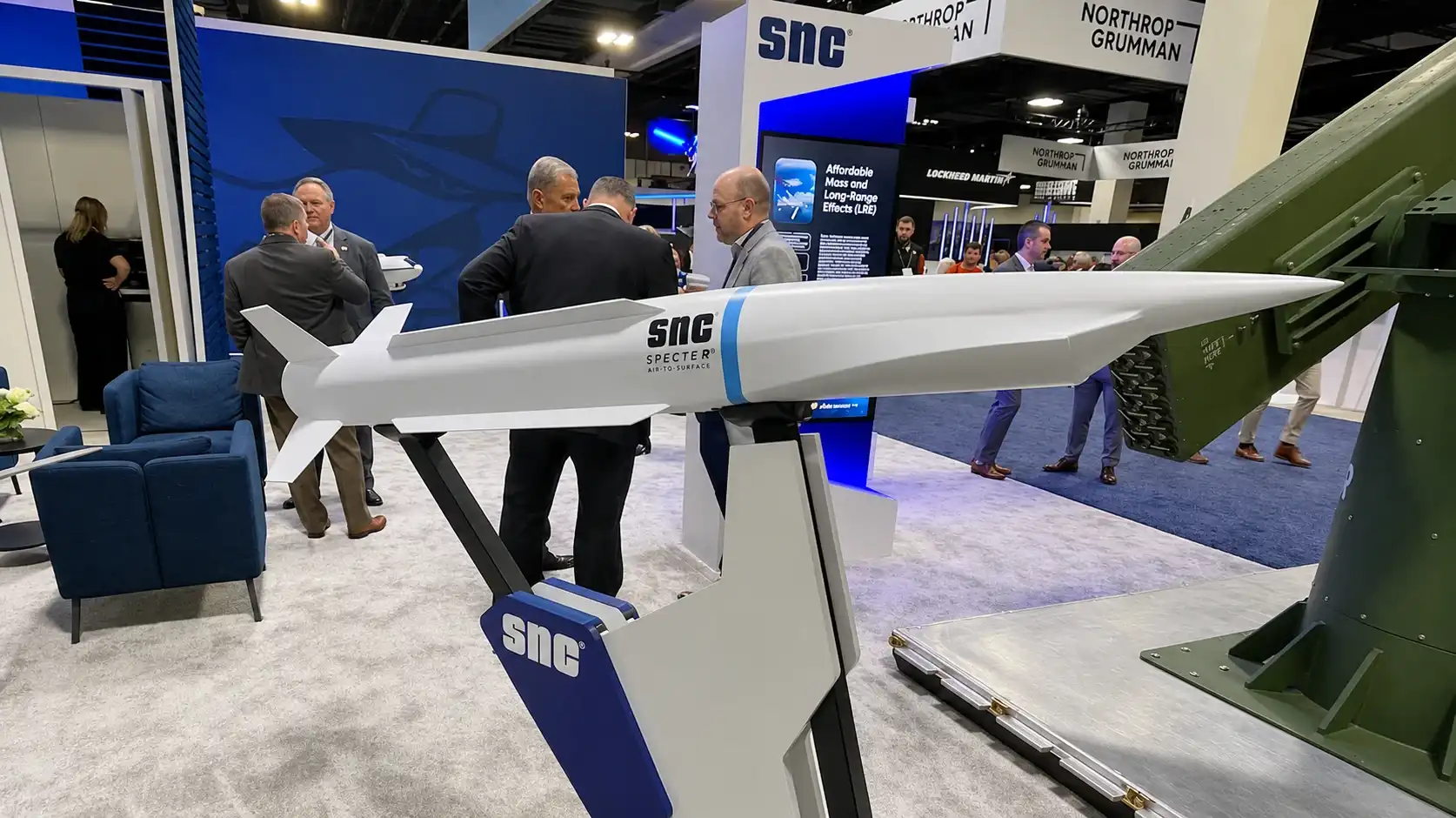
The partnership predates CAMP. SNC and Specter signed a memorandum of understanding on February 20, 2026, to develop a low-cost, ramjet-powered supersonic missile, showed a scale model at the Air & Space Forces Association Warfare Symposium in Aurora, Colorado, on February 24, 2026, and targeted flight tests in the third quarter of 2026. Neither company has confirmed whether those tests occurred or whether the CAMP prototype derives directly from that design. Speed, range, seeker type, warhead, and dimensions remain undisclosed, as do the award date and period of performance.
Analysis: CAMP applies to counter-air the cost-exchange logic the Air Force has already adopted for strike. Fiscal 2027 budget documents plan the purchase of nearly 28,000 Family of Affordable Mass Missiles (FAMM) cruise missiles over five years, and CAMP is positioned as the counter-air complement to that effort. A supersonic ground-launched missile priced under $500,000 would give the service a long-range means of contesting enemy aircraft from dispersed positions without committing high-end air-to-air weapons to every engagement. Funding several competitors in parallel, with broad government data rights and standardized M-Series interfaces, also signals an intent to keep the design open to second sources, a structure that departs from the single-prime model of most legacy missile programs.
The next milestone is the first flight test, which the Air Force expects within nine months of award, followed by iterative design cycles across the roughly two-year Phase 1. Key unknowns include the final number of CAMP missile awardees, funding beyond the prototype phase, and the timing of a Program of Record decision. Anduril’s launcher work, scheduled over an initial 10-month period, will determine how quickly competing designs from SNC and Castelion can be integrated and fired from a common containerized system.