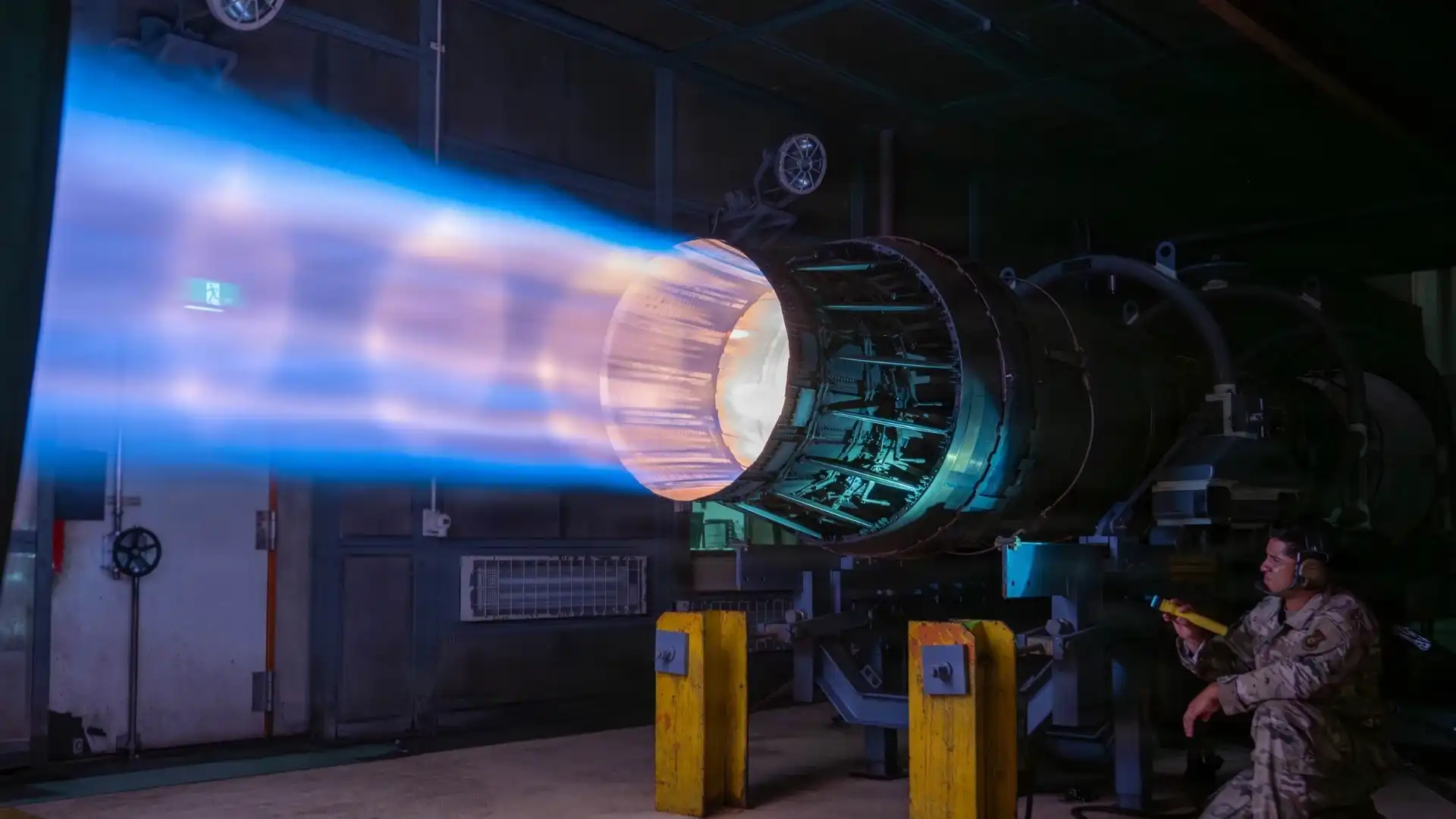
The US Air Force has selected 58 companies for a multiple-award indefinite-delivery/indefinite-quantity (IDIQ) contract for advanced propulsion enterprise work with a cumulative ceiling of $16.1 billion, the Pentagon announced on November 20, 2026. The vehicle runs through November 2041. Each awardee received $1,000 in fiscal 2027 research, development, test and evaluation (RDT&E) funds, for a total of $58,000 obligated at award. Air Force Materiel Command (AFMC) at Wright-Patterson Air Force Base, Ohio, is the contracting activity, and all awards were competitive.
The award stands up the Advanced Propulsion Acquisition Contract (APAC), which the Air Force Life Cycle Management Center (AFLCMC) Propulsion Directorate outlined in a March 13, 2026, notice. It lands as the service runs several propulsion lines at once: the Next Generation Adaptive Propulsion (NGAP) program, under which the Air Force raised Pratt & Whitney’s and GE Aerospace’s contract ceilings to $3.5 billion each in January 2025 and which could feed the F-47 sixth-generation fighter; engine options for Collaborative Combat Aircraft (CCA) Increment 2; and low-cost powerplants for drones and missiles. APAC gives the directorate a pre-competed pool to fund that work through task orders instead of standalone procurements.
Inside the Air Force Propulsion Contract: Scope, Ceiling and Funding
According to the award notice, the contract “provides for the continuing enhancement of propulsion technology across all areas and lifecycle phases of propulsion development.” The March notice framed the same scope across technology maturation, concept development, production, fielding, operations and sustainment. In practical terms, APAC can carry anything from component-level research to upgrades and sustainment concepts for engines already in the inventory. Work will be performed at each awardee’s own facilities.
The $16.1 billion figure is a shared ceiling, not a commitment. All 58 vendors draw from the same cap, and the government is not obligated to spend it. The $58,000 obligated at award amounts to roughly 0.0004% of that ceiling. An even split would yield about $278 million per company over 15 years, but multiple-award IDIQ vehicles rarely distribute work that way; task orders tend to cluster among a smaller set of performers whose capabilities match specific requirements.
Funding is the principal unknown. The March notice stated that no dedicated funding existed and that no contracts would be awarded until it did, and it indicated that APAC would draw on future Air Force, interagency and outside agency money without naming program lines. The Air Force has not disclosed what funding is now in place or which requirements will be competed first. The notice also anticipated on-ramp opportunities for new entrants after two years. The announcement did not state how many offers the service received. It also names only 57 companies, although the $58,000 obligation at $1,000 per awardee indicates 58 awards.
Engine Primes, Startups and Integrators in the Advanced Propulsion Pool
The awardee list cuts across the entire propulsion industrial base. Established engine manufacturers include GE Aerospace (listed as General Electric Co., Cincinnati), RTX (East Hartford, Connecticut), Rolls-Royce North American Technologies (Indianapolis), Honeywell International (Phoenix), Williams International (Pontiac, Michigan) and Safran Defense & Space (Arlington, Virginia). Aerojet Rocketdyne (Huntsville, Alabama) covers rocket and missile propulsion, while Boeing, Lockheed Martin, Northrop Grumman and Dynetics bring airframe and weapons integration experience.
A large share of the pool consists of non-traditional and venture-backed firms focused on high-speed and attritable propulsion. They include Hermeus of Atlanta, which is pursuing turbine-based combined cycle propulsion for high-Mach aircraft, along with Velontra, Astro Mechanica, Mach Industries, Volund Manufacturing, Beehive Industries, Whisper Aero, Jetoptera and Zulu Pods. Small turbojet specialists JetCat Defense and Bet Shemesh Engines also made the cut; the latter, based in Bet Shemesh, Israel, is the only awardee listed outside the United States.
The remainder spans engineering services and test (Amentum, Booz Allen Hamilton, Southwest Research Institute, Standard Aero), additive manufacturing (Sintavia) and a dense cluster of research firms around Dayton. Ohio hosts at least 10 awardees and Huntsville at least six, consistent with the concentration of propulsion expertise around Wright-Patterson and the Army and missile defense ecosystem in northern Alabama.
Analysis: APAC is less a purchase than a pipeline. By pre-qualifying 58 vendors, AFLCMC can compete propulsion task orders inside a vetted pool rather than launching a separate acquisition for each requirement, a structure suited to the volume of smaller engine efforts that the CCA, drone and munitions portfolios are generating. The breadth of the list also points to a deliberate effort to widen a propulsion base long centered on two fighter engine makers. The ceiling, however, is only as meaningful as the money routed through it. With $58,000 obligated and no disclosed funding line, APAC’s real weight will be set by appropriations and by program offices choosing to use it.
The next markers are the first APAC task orders and the funding sources behind them, which will show whether the vehicle supports CCA Increment 2 engine work, NGAP-adjacent technology maturation or fleet sustainment first. Fiscal 2027 appropriations will determine how quickly orders flow. The two-year on-ramp for new entrants, and whether the Air Force publishes task order values, will indicate how competitive the pool remains through 2041.