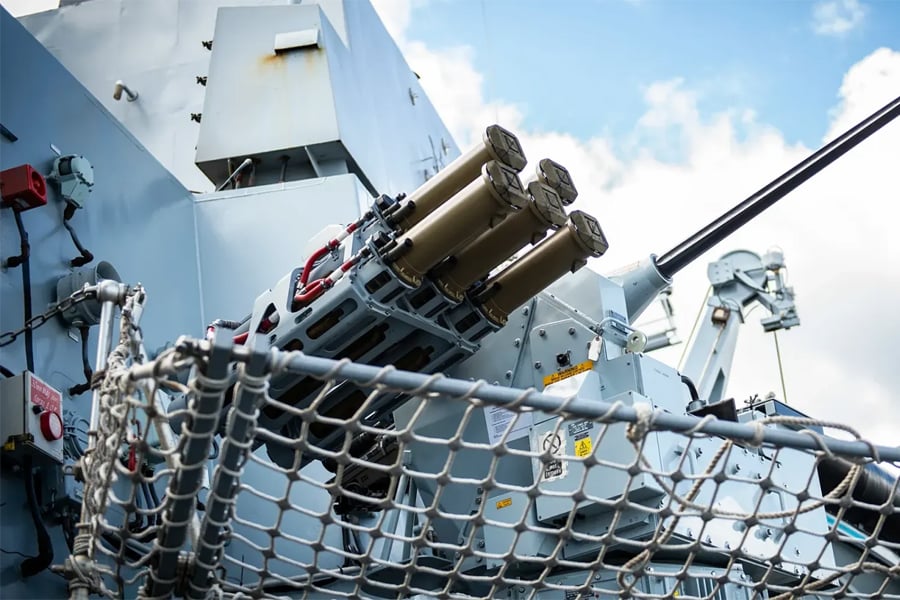
Thales UK has signed a contract with Indra to integrate the Lightweight Multirole Missile (LMM) into SILAEM (Sistema Lanzador Embarcado, or Shipborne Launcher System), a very short-range air defense (VSHORAD) system under development for the Spanish Navy, the company announced on October 7, 2026. Working alongside its Spanish subsidiary, Thales UK will also supply the weapon integration kit and the technical expertise required to mate the missile with the Indra-led system, which Thales describes as the first VSHORAD capability for Spanish naval forces.
The contract follows an agreement between Indra and Thales España announced in late September 2026. SILAEM is a Special Modernization Program (PEM) that the Spanish Ministry of Defense awarded to Indra in December 2025, with €51 million in funding. It covers the design, qualification, installation and testing of a short-range missile launch system in two versions: a stand-alone configuration and one integrated with SCOMBA, the Spanish Navy’s national combat management system. The ministry wants SILAEM to give point defense against missiles and drones to the fleet’s most valuable assets, notably the F-80 Santa María-class frigates, the Maritime Action Ships (BAM), combat supply ships and amphibious vessels.
How Indra Builds the Spanish Navy VSHORAD Around SILAEM
Indra acts as prime contractor and system integrator. The Spanish group will develop SILAEM and contribute high-precision fire control radars that, according to the company, can detect, track and lock onto complex targets with a minimal radar footprint and strong resistance to electromagnetic interference. Per the program description, the system pairs an X-band fire control radar for acquisition and tracking with a launcher turret, laser-guided missiles and a command and control layer. Indra has not publicly identified the radar model.
Jose Carlos Hidalgo, director of Indra’s Weapons and Ammunition business unit, and Guillermo Roselló, director general of defense at Thales in Spain, signed the Spanish-side agreement. Thales UK, which designs and manufactures the LMM in Belfast, Northern Ireland, carries the missile integration work.
The ministry’s requirement is demanding for a system of this class. SILAEM must engage missiles, unmanned aircraft systems (UAS), uncrewed surface vessels (USVs) and fast patrol boats; detect them by day and night; pass range and track data to fire control; follow several incoming missiles simultaneously; and defeat consecutive threats through multiple launchers or reduced reload times. That threat set mirrors the Red Sea, where Houthi forces have fired drones and missiles at merchant and naval shipping since late 2023, and the Black Sea, where Ukrainian explosive USVs have struck Russian warships.
The two-version architecture carries operational weight. The SCOMBA-integrated variant lets the combat system cue SILAEM from the ship’s main sensors, while the stand-alone variant offers a route to fit point defense on hulls where full integration would be slow or costly.
Thales LMM Specifications: Laser Beam Riding at Mach 1.5
Publicly available specifications indicate the LMM weighs 13 kg, measures 1.3 m in length and 76 mm in diameter, and uses a two-stage solid rocket motor to reach about Mach 1.5. Thales quotes a range beyond 6 km for surface launch, with some open-source figures citing up to 8 km, and a minimum range of roughly 400 m. The 3 kg warhead combines blast-fragmentation and shaped-charge effects, triggered by a laser proximity fuze or on impact, so a single round type can engage a drone in flight, a fast inshore attack craft or a lightly armored vehicle.
The standard LMM carries no seeker. It rides a coded laser beam projected by the launch platform’s guidance unit, using receivers in the missile’s tail. Unlike infrared-homing rounds such as MBDA’s Mistral, the LMM does not depend on the target’s heat signature, which defeats flares and helps against small electric drones. The trade-off is that the fire control director must hold the beam on the target until intercept. At Mach 1.5, a 6 km shot implies roughly 12 seconds of flight with that guidance channel committed. The program’s fire-and-forget wording sits uneasily with beam riding, and the number of guidance channels per ship will define how SILAEM handles saturation raids.
The missile’s operational record supports Indra’s choice. The Royal Navy, which designates the weapon Martlet, has declared full operating capability on its AW159 Wildcat HMA2 helicopters, and Ukrainian forces have employed LMM against drones. In March 2025, the UK placed a £1.6 billion contract with Thales for more than 5,000 LMMs for Ukraine, an order expected to triple production in Belfast.
Analysis: SILAEM follows a sovereign-integration model: Spain keeps the radar, fire control and command chain national and buys a proven interceptor off the shelf, drawing on a production line the Ukraine order has already scaled. It also fills a gap. Outside the Aegis-equipped F-100 frigates, close-in protection across the fleet has relied on guns. The open question is the missile threat. A 13 kg, Mach 1.5 beam rider with a 3 kg warhead is optimized for drones and small craft, and its performance against supersonic sea-skimming anti-ship missiles has not been publicly demonstrated. SILAEM looks more like a counter-drone and counter-swarm layer than a substitute for a dedicated close-in weapon system.
Several details remain undisclosed: the value of the Thales UK contract, the number of ships and launchers to be fitted, missile quantities, the radar model and the integration schedule for the two configurations. The next milestones are qualification firings of the integrated system, the first shipboard installation and the first production order for missiles.