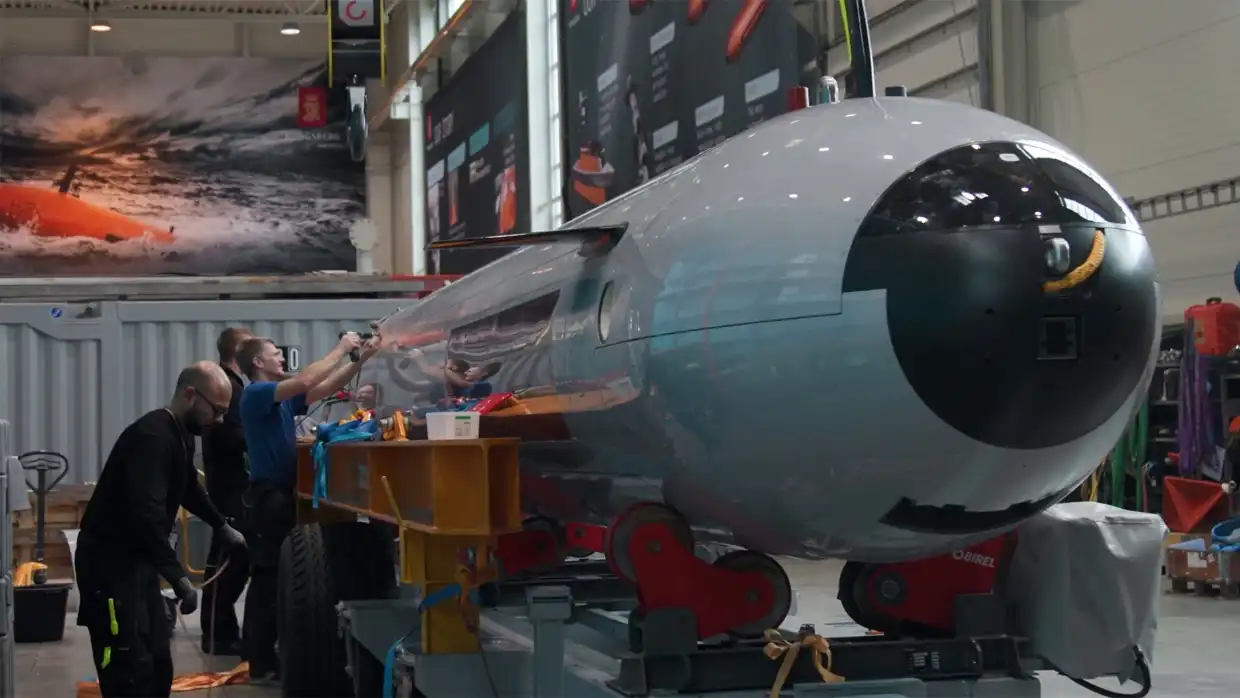
Norway’s Kongsberg and Spain’s Navantia signed a memorandum of understanding (MoU) at the Euronaval trade show in Paris on November 4, 2026, to pursue the integration of HUGIN autonomous underwater vehicles (AUVs) and advanced sonar technologies into conventional submarines. Kongsberg announced the agreement on November 9. The announcement gives no contract value, schedule, host submarine class, or HUGIN variant.
The MoU arrives as Madrid reworks the future of its S-80 Plus submarine program. A Spanish government decree published on October 30 cited 14 S-80 systems with serious obsolescence problems as part of a modernization effort covering the four Series I boats. The Spanish Navy is also working on a second series covering a fifth and sixth boat. The MoU extends to future designs, modernization programs, and new production batches, which fits both efforts, although Kongsberg’s announcement cites only Spanish Navy and NATO operational standards and does not name the S-80.
HUGIN AUV Dimensions and the 533 mm Torpedo Tube Problem
The MoU covers integrating HUGIN vehicles into conventional submarines, implementing advanced sonar technologies on those boats, and joint innovation initiatives. Camilla Kiss, Executive Vice President of Kongsberg and President of its Discovery division, said Kongsberg will contribute autonomous and sonar expertise while Navantia leads integration. Kongsberg says the work targets anti-submarine warfare, intelligence operations, and complex missions.
HUGIN has served in military roles since 2001, and the family spans very different sizes. HUGIN 1000, delivered to the Norwegian, Finnish, and Polish navies, measures 4.5 meters long and 0.75 meters in diameter. HUGIN Superior measures about 6.6 meters by 875 millimeters, weighs about 2,200 kilograms, is rated to 6,000 meters, and carries the HISAS 1032 Dual Rx synthetic aperture sonar with a 1,000-meter swath. HUGIN Endurance, at about 11 meters, 1.2 meters in diameter, and 8,000 kilograms, offers up to 15 days and 2,200 kilometers on lithium-ion batteries. HUGIN Edge, under 4 meters and about 300 kilograms, is rated to 1,000 meters and runs more than 24 hours.
Navigation is the feature most relevant to a submarine host. HUGIN’s Sunstone inertial system combines synthetic aperture micronavigation and terrain-referenced navigation to limit reliance on external position updates, which a covert host cannot readily provide. In a 2024 mission, HUGIN Endurance covered 1,200 nautical miles with a reported position error of 0.02 percent of distance traveled.
Physical fit is the harder question. The S-80 Plus launches weapons through six 533-millimeter bow tubes, narrower than the HUGIN 1000, Superior, or Endurance hulls. Kongsberg’s published data gives HUGIN Edge a height of 35 centimeters but lists no width, leaving its tube compatibility unconfirmed. The announcement does not say whether the partners envision tube launch, external carriage, a dedicated payload section, or a new vehicle.
S-80 Plus Upgrades and Rival AUV Concepts Shape the MoU
Publicly available specifications indicate the S-80 Plus is about 81 meters long, with a 7.3-meter hull diameter and a submerged displacement near 3,000 tonnes, although published figures vary. Navantia developed its combat system with Lockheed Martin support, and Lockheed Martin supplied the sonar array suite, so any Kongsberg sonar insertion would have to interface with an installed architecture.
Isaac Peral (S-81) was commissioned on November 30, 2023, and Narciso Monturiol (S-82) is scheduled for administrative delivery in the last week of November 2026. Cosme García (S-83), the first boat built with the BEST bioethanol air-independent propulsion system, is due in late 2028, with Mateo García de los Reyes (S-84) planned for early 2030. The first two boats will receive that system at their first major overhaul.
The agreement extends an existing relationship. The companies signed an MoU in March 2022 on the Royal Norwegian Navy’s F-310 Fridtjof Nansen-class frigates, extended it in September 2023 to cover Naval Strike Missile integration in Navantia designs, and formalized long-term F-310 support in a framework agreement signed in Bergen on May 13, 2026.
Competing programs are already addressing submarine-borne autonomy. Saab’s A26 incorporates a Multi-Mission Portal for uncrewed underwater vehicle launch and recovery, and Poland ordered three A26 boats on June 29, 2026, after a competition Navantia also contested. L3Harris holds a Defense Innovation Unit contract for a Torpedo Tube Launch and Recovery system built around the Iver4 900, a vehicle about 2.5 meters long and under 105 kilograms. Navantia has also signed two 2026 MoUs with Germany’s TKMS, aiming for a joint submarine framework by year-end.
Analysis: The MoU gives Navantia access to an AUV line with long NATO service history as uncrewed payload capacity becomes a differentiator in conventional submarine competitions. The engineering constraint sits at the host interface rather than in the vehicle’s autonomy. The demonstrated torpedo tube precedent involves a vehicle far smaller than the large HUGIN types, so survey-class endurance aboard an S-80 would likely require a smaller HUGIN derivative or hull-level changes. That points toward a second-series design or a major overhaul rather than a near-term retrofit. Spanish Navy leaders have also said they want a more national second series, which could constrain Norwegian content.
An MoU is not a procurement commitment, and Kongsberg’s announcement cites no Spanish Navy requirement or funding line. The next markers are the S-82 handover, the definition of the S-80 second series, and the TKMS and Navantia framework targeted for the end of 2026. The companies have yet to identify a HUGIN variant, a launch and recovery method, or a demonstration date.