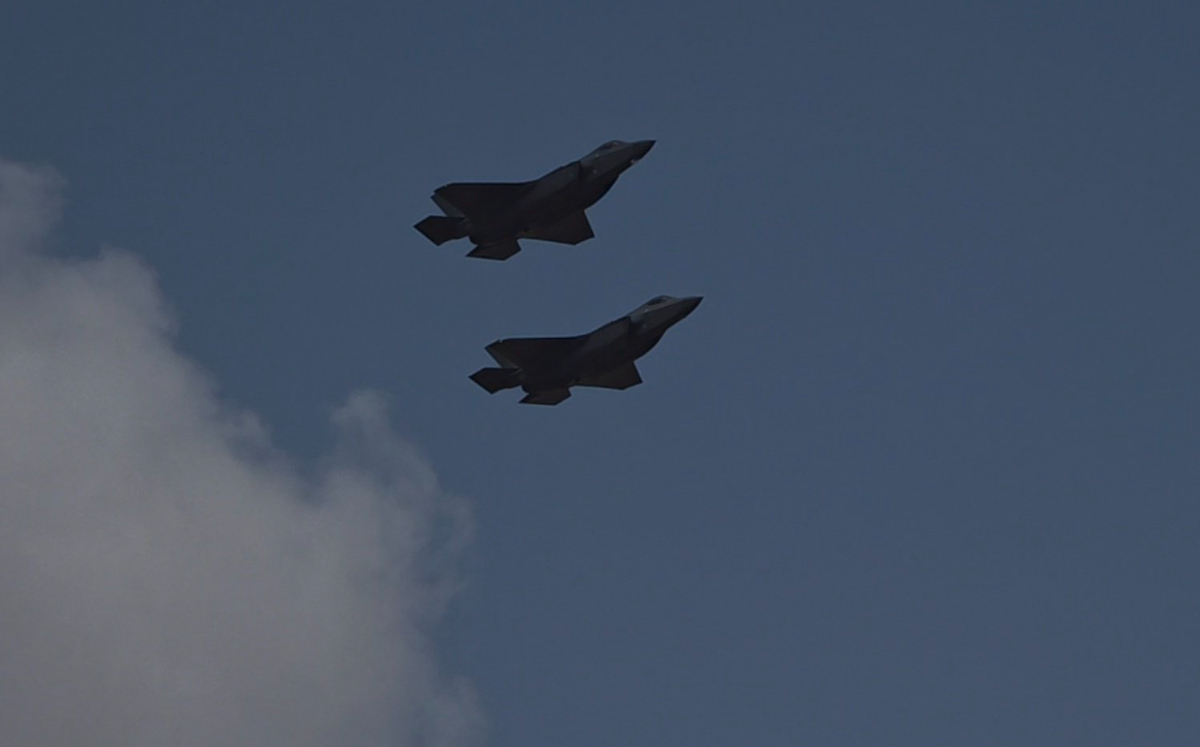
U.S. Air Force F-35A Lightning II stealth fighters from the 48th Fighter Wing flew alongside Royal Moroccan Air Force F-16s on October 7, 2026, opening the four-day Marrakech Air Show at the Marrakech Royal Moroccan Air Force Base. The flyby put the fifth-generation jet over the flagship aerospace event of a country reported since 2025 to be seeking up to 32 F-35s, a purchase Washington has neither approved nor publicly acknowledged.
One day earlier, on October 6, 2026, Lockheed Martin reported the maiden flight of Morocco’s first new-build F-16 Block 72 at its Greenville, South Carolina, production line, the first of 25 aircraft the State Department cleared in March 2019 for an estimated $3.787 billion. The Royal Moroccan Air Force is consolidating a mixed fleet of F-16C/D Block 52+, Mirage F1 and F-5E/F aircraft around the Viper, while neighboring Algeria has begun fielding Russia’s Su-57.
Morocco F-35 Reports Frame the U.S. Air Force Marrakech Contingent
The 48th Fighter Wing at RAF Lakenheath, England, is the largest U.S. fighter wing in Europe and operates both the F-35A, with the 493rd and 495th Fighter Squadrons, and the F-15E Strike Eagle. According to the U.S. Department of War, the F-35A flyby is the centerpiece of a U.S. contingent of about 45 personnel. Two support aircraft sit on static display: an HC-130J Combat King II personnel recovery aircraft from the Alaska Air National Guard’s 176th Wing at Joint Base Elmendorf-Richardson, and a KC-135 Stratotanker from the Utah National Guard’s 151st Wing. Utah has been paired with Morocco under the National Guard State Partnership Program since 2003.
Brig. Gen. Matthew J. French, Air National Guard assistant to the commander of U.S. Air Forces in Europe and Air Forces Africa, framed the deployment around the approaching 250th anniversary of U.S.-Moroccan relations and described Morocco as the oldest U.S. ally. Morocco recognized American independence in 1777 and became a major non-NATO ally in 2004. U.S. Ambassador Duke Buchan III said Washington remains committed to “delivering cutting-edge aerospace capabilities” to its Moroccan partners.
Reports since 2025 have described talks on up to 32 F-35s, with unofficial estimates of about $17 billion for a package covering aircraft, training and long-term sustainment. Neither government has confirmed negotiations, and no Defense Security Cooperation Agency notification to Congress has been published.
F-35A Versus F-16 Block 72: What Each Jet Brings Rabat
Publicly available specifications indicate the F-35A is powered by a single Pratt & Whitney F135-PW-100 producing about 43,000 pounds of thrust in afterburner, carries 18,250 pounds of internal fuel, exceeds a 590-nautical-mile combat radius on internal fuel and tops out at Mach 1.6. Two internal bays carry four weapons in a low-observable configuration, typically two AIM-120 AMRAAMs and two 2,000-pound-class munitions, and the 25 mm GAU-22/A cannon is internal with 182 rounds. The sensor suite fuses the AN/APG-81 active electronically scanned array (AESA) radar, the AN/AAQ-37 Distributed Aperture System, the AN/AAQ-40 Electro-Optical Targeting System and the AN/ASQ-239 electronic warfare suite, networked through the Multifunction Advanced Data Link and Link 16.
Morocco’s Block 72 is a 4.5-generation multirole fighter built around the AN/APG-83 Scalable Agile Beam Radar. The 2019 package listed 29 Pratt & Whitney F100-PW-229 engines, 26 APG-83 radars, Link 16 MIDS-JTRS terminals, 40 Joint Helmet Mounted Cueing Systems and 40 AIM-120C-7 missiles, and the jets are slated to receive L3Harris’ Viper Shield electronic warfare suite. A separate $985.2 million program brings the 23 existing F-16C/D Block 52+ jets to the comparable F-16V standard. Deliveries once projected for 2024 slipped; Lockheed Martin has said the configuration shared with Taiwan needed post-flight-test changes.
Both jets carry AESA radars and Link 16, so the gap is signature and sensor fusion rather than radar generation. The Block 72 carries weapons and fuel externally, preserving payload but forfeiting any low-observable margin against modern Russian-supplied surface-to-air systems. A small F-35A force could operate inside contested airspace, build the targeting picture and cue a larger Viper fleet at stand-off range, the high-low model Poland, Romania and Greece are building with their own F-35 and F-16 fleets.
Algeria’s Su-57 and the Fifth-Generation Gap in North Africa
Algeria publicly acknowledged in February 2025 that it had acquired the Su-57, and Russia’s United Aircraft Corporation said in November 2025 that two aircraft had been delivered to an unnamed foreign customer, widely assessed to be Algeria. The size of the order remains unconfirmed, with reported figures ranging from six aircraft to more than a dozen. Publicly available specifications indicate the Su-57E pairs twin AL-41F1 engines with the N036 Byelka AESA radar and internal weapons bays. Algeria also flies Su-30MKA fighters and has reportedly received Su-35s, backed by a 2025 defense budget of about $25.1 billion against roughly $13.3 billion for Morocco.
Rabat has answered with U.S. hardware. Beyond the Vipers, it ordered 24 AH-64E Apache Guardians in 2020 and received the first six in March 2025, and it fields M1 Abrams tanks, M142 HIMARS launchers and Javelin missiles. An F-35 sale would still require State Department approval, congressional notification and consultations tied to Israel’s qualitative military edge, which Morocco’s 2020 normalization with Israel may ease but does not remove. The United Arab Emirates’ 50-jet package, notified in 2020, stalled the following year over technology-security conditions.
Analysis: The flyby is a sequencing signal, not a sale. By flying the F-35A at Marrakech the day after Morocco’s first Block 72 took off, Washington is showing Rabat a path from the Viper now to a fifth-generation jet later, keeping Moroccan airpower inside the U.S. ecosystem as Algeria fields the Su-57. The binding constraints are release authority and affordability: an estimated $17 billion package would exceed Morocco’s annual defense budget, and the technology-security terms that derailed the Emirati deal would likely apply here as well.
The next markers are the Block 72 flight-test campaign and a first delivery date, which neither Lockheed Martin nor Rabat has announced, followed by any publicly confirmed Letter of Request for the F-35 and the congressional notification it would trigger. Aircraft numbers, variant, financing and timeline all remain unconfirmed.