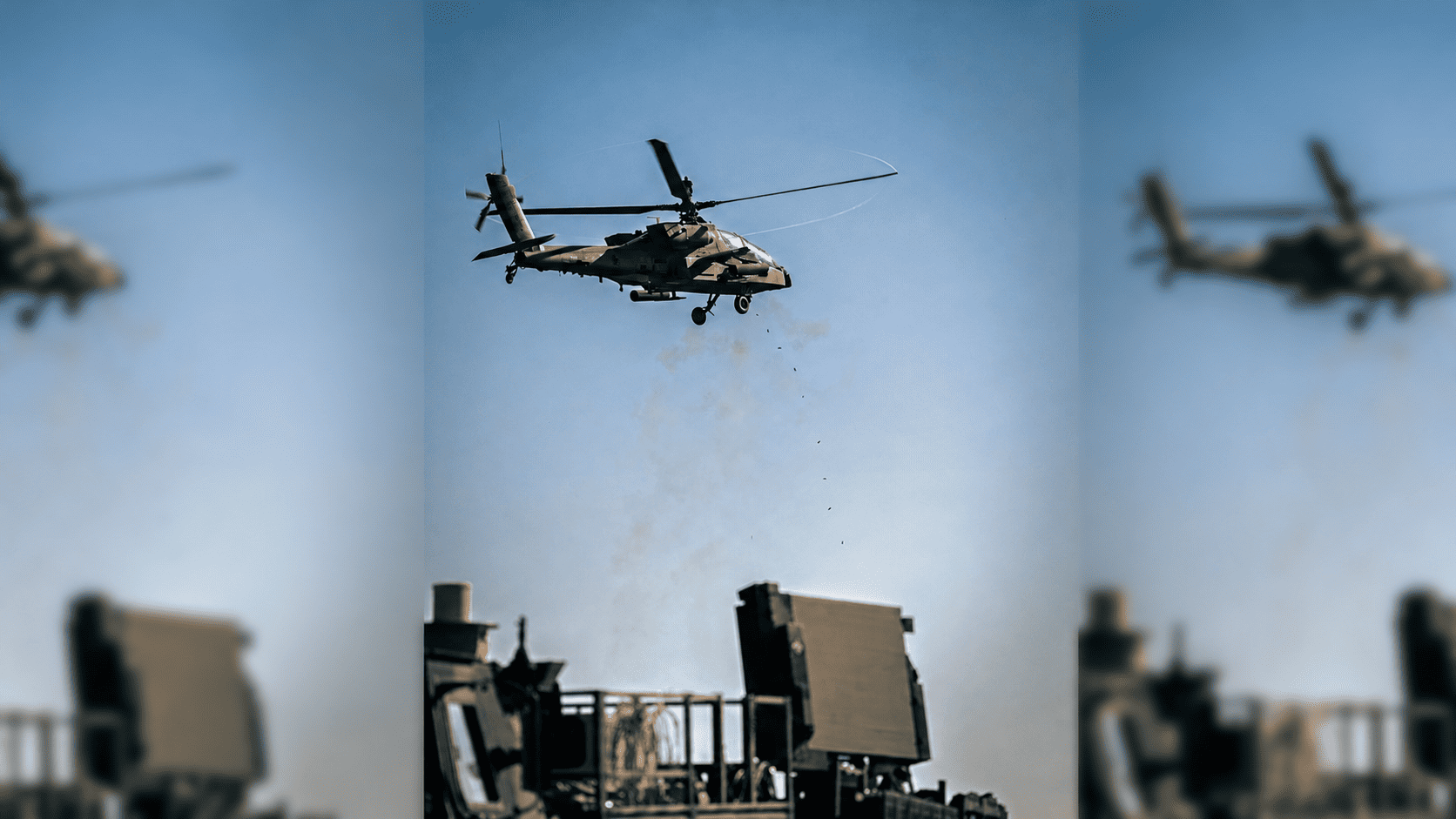
U.S. Army AH-64E Apache crews destroyed three Griffon Aerospace Outlaw target drones at Grafenwoehr Training Area, Germany, on October 6, 2026, after air defenders using a ground-based AN/MPQ-64 Sentinel radar detected the targets and relayed their tracks through a tactical operations center. Operation Skyfall II paired the 5th Battalion, 4th Air Defense Artillery Regiment (5-4 ADA), 52nd Air Defense Artillery Brigade, with the 2nd Battalion, 159th Aviation Regiment (2-159), 12th Combat Aviation Brigade.
Skyfall II builds on the first Operation Skyfall in March 2026, when Apache crews engaged drones using ground-based sensor data, a first for the Army in the European theater. Both events grew out of Project Flytrap, the U.S. Army Europe and Africa counter-unmanned aircraft system (C-UAS) experimentation series launched in 2025. The pace reflects the Russia-Ukraine war, where both sides use helicopters to hunt slow attack drones, and an Army transformation agenda that has put manned attack aviation under pressure to prove its relevance.
How Army Apaches Closed the Sensor-to-Shooter Loop at Grafenwoehr
The sequence started on the ground. Air defenders from 5-4 ADA set up on one side of the range, where their Sentinel radar scanned the airspace while Griffon contractors launched an Outlaw on a set pattern overhead. The battalion pushed the radar track to the tactical operations center, which passed the target position and a vector to the aircraft.
Lt. Col. John Verwiel, the 5-4 ADA commander, said the battalion sends each track’s position in time and space so that both the pilot and the operations center know exactly where the target is, letting the center vector the helicopter toward an engagement. He called the ground-air integration one element of a layered defense. The Army has not said whether tracks reached the cockpit by digital datalink or voice relay.
Chief Warrant Officer 4 Jarrad Walter, the pilot, and Chief Warrant Officer 4 Cody Schoonover, the gunner, then attacked with the Apache’s 30 mm cannon in 20-round bursts. Their first target was damaged but kept flying, so the crew circled back to finish it. The pair accounted for the three Outlaws destroyed during the event, each in a separate engagement.
Walter said crews must meet Army counter-drone standards but are otherwise free to develop their own tactics, which he argued makes them harder for an adversary to predict. The Army said formal tactics, techniques and procedures for detecting and engaging drones are still being refined.
Sentinel A4 Radar and M230 Cannon: The Hardware Behind the Intercepts
The AN/MPQ-64 Sentinel is a mobile 3D radar providing continuous low-altitude alerting, tracking and cueing data; the Army said its longer detection range gives Apache crews earlier warning and improves their survivability. Accounts from the range identified the sensor as the Sentinel A4, the Lockheed Martin variant that replaces the traveling-wave tube of the Raytheon-built Sentinel A3 with an X-band digital active electronically scanned array (AESA) using gallium nitride transmitters, adds rocket, artillery and mortar detection, and feeds the Integrated Air and Missile Defense Battle Command System (IBCS). Publicly available specifications credit the A3 with 360-degree coverage to roughly 40 kilometers; no A4 range figure has been published. On June 30, 2026, the Army awarded Lockheed Martin a $2,998,742,163 Sentinel A4 production and engineering contract running through June 29, 2031.
Publicly available specifications for the AH-64E Apache Guardian indicate two General Electric T700-GE-701D turboshafts of about 1,994 shaft horsepower each, a maximum speed near 158 knots and an M230 chain gun firing 30×113 mm rounds at roughly 625 rounds per minute from up to 1,200 rounds, enough for about 60 of the 20-round bursts used at Grafenwoehr.
The Army has not disclosed which round the crews fired. In December 2025 at Yuma Proving Ground, Arizona, an Apache first fired the proximity-fuzed XM1225 Aviation Proximity Explosive (APEX) round at drones. It requires no changes to the M230 or fire control system, and a proximity burst would reduce the need for the direct hits that left the first Outlaw damaged but airborne.
Griffon Aerospace specifications for the current MQM-170C Outlaw G2 target list a 10.8-foot (3.3-meter) wingspan, a 150-pound maximum takeoff weight and speeds of 60 to 126 knots, broadly comparable to propeller-driven one-way attack drones. The Army did not specify the variant flown.
What Operation Skyfall II Means for Army Aviation and NATO
For the aviation battalion, the event was as much about doctrine as gunnery. Maj. Tyler Jamison, the 2-159 operations officer, said the value of Skyfall lies in integration with air defenders and the protection warfighting function for NATO, adding that the partnership with 5-4 ADA “has helped us operationalize what it means to destroy a drone.” Lt. Col. Comador Ferguson III, the battalion commander, said the war in Ukraine is on everyone’s mind and framed the open question as whether the Apache is “a relevant platform” against enemy drones.
That question carries institutional weight. The May 2025 Army Transformation Initiative directed the service to reduce and restructure manned attack helicopter formations and to divest the AH-64D, shrinking the active Apache force. A credible counter-drone mission ties attack aviation to force protection, which Army leaders have prioritized while cutting legacy programs.
The 52nd Air Defense Artillery Brigade is the tactical air and missile defense integrator for U.S. Army Europe and Africa across the U.S. European Command and U.S. Africa Command areas. Its 5-4 ADA fields the Stryker-based Maneuver Short-Range Air Defense (M-SHORAD) system, designated Sgt. Stout. The Army said Skyfall II showed how ground-based air defense units and aviation assets can give senior commanders additional defensive fires options in contested conditions, consistent with the Project Flytrap finding that no single system defeats the drone threat.
Analysis: The cannon kill is the least novel part of Skyfall II; the Yuma trial and the March event already showed that an Apache can destroy a slow propeller drone. What matters is the handoff: an air defense brigade’s sensor cued an aviation brigade’s shooter, turning the Apache into a networked effector inside an air defense architecture. If that handoff moves onto IBCS as Sentinel A4 production ramps up, attack helicopters could form a mobile layer between short-range guns and missile interceptors, spending cannon rounds rather than scarce missiles on cheap drones. The constraints are a shrinking Apache fleet, airspace deconfliction with friendly fires, and night or saturation conditions not yet described in testing.
Key unknowns remain: the ammunition fired, the data path into the cockpit and performance against simultaneous targets. Whether Apache drone defense becomes a written mission for the 12th Combat Aviation Brigade will depend on further Skyfall iterations and on how the Army sizes its remaining attack aviation force.