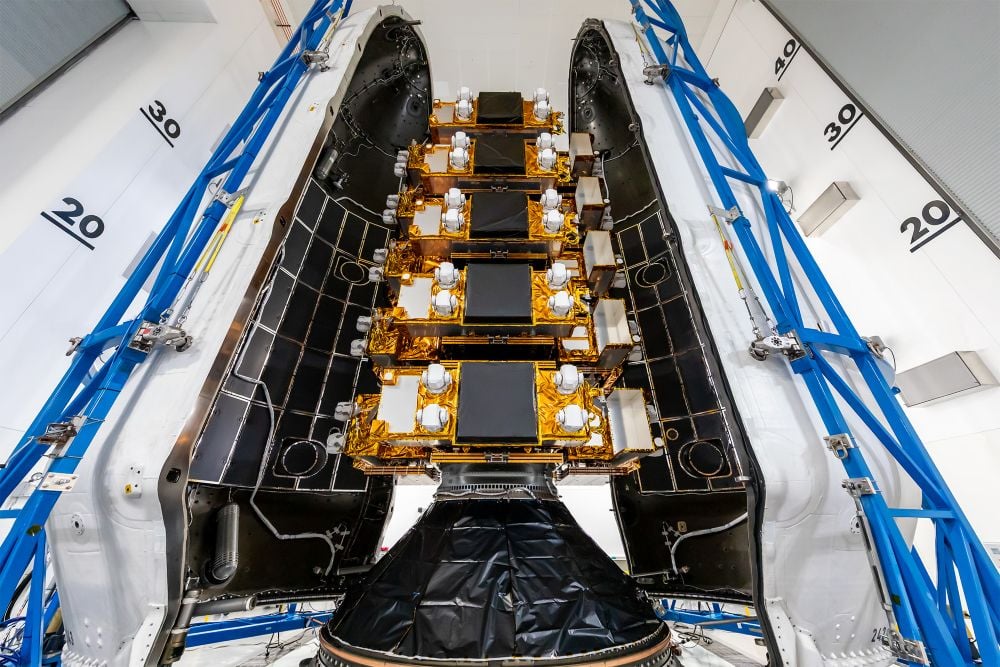
Twenty-one Northrop Grumman-built data transport satellites reached low Earth orbit on October 10, 2026, aboard a SpaceX Falcon 9 that lifted off from Space Launch Complex 4 East at Vandenberg Space Force Base, California. The mission, designated T1TL-A, places the company’s first orbital plane into the Space Development Agency’s (SDA) Tranche 1 Transport Layer (T1TL), the communications backbone of the Proliferated Warfighter Space Architecture (PWSA).
The flight is SDA’s fourth Tranche 1 launch and its second since the agency ended a nine-month pause in July to correct faults on the first 42 satellites, built by York Space Systems and Lockheed Martin and launched on September 10 and October 15, 2025. With York’s second plane added on July 16, 2026, Tranche 1 now has 84 satellites on orbit, all Transport Layer vehicles. Tranche 1 is planned at 154 operational satellites, 126 for data transport and 28 for missile warning and tracking, plus four missile defense demonstrators, and is meant to deliver the architecture’s initial warfighting capability.
Tranche 1 Transport Layer Payloads: Link 16, Ka-Band and Optical Crosslinks
Northrop won the T1TL work on February 28, 2022, under an agreement with a potential value of $692 million for 42 satellites. Lockheed Martin received approximately $700 million and York approximately $382 million for 42 satellites each.
SDA’s original solicitation defined a common baseline for all three vendors: a Ka-band space-to-ground link, four optical communications terminals for inter-satellite links, a Link 16 tactical data link payload, and a battle management, command, control and communications (BMC3) compute and storage module. Link 16 is the operational centerpiece. The payload broadcasts in L-band to Multifunctional Information Distribution System (MIDS) terminals already fielded on US and allied aircraft, ships and ground units, letting a satellite push tactical data beyond line of sight to existing user equipment. SDA officials said in 2022 that the Link 16 requirement made Tranche 1 spacecraft 15 to 20 percent larger than their Tranche 0 predecessors.
Northrop paired its payload and integration work with commercial hardware. In 2022 it selected Airbus U.S. Space & Defense to supply 42 Arrow buses, a 300 to 500 kilogram class platform built on the Merritt Island, Florida, line that produced the OneWeb constellation, along with Mynaric CONDOR Mk3 optical terminals and Innoflight encryption. Public information does not confirm whether that supplier mix held through final integration.
Laser crosslinks carry the heaviest load, letting a satellite hand data across the mesh to a node with a ground or user link in view, which cuts latency and reliance on fixed ground stations. SDA has said the full Transport Layer will operate between 750 and 1,200 kilometers in altitude.
Checkout Risk, Launch Delays and Northrop’s 150-Satellite PWSA Backlog
SDA Director Gurpartap Sandhoo said in July that the initial York and Lockheed satellites suffered software and hardware faults during checkout, and that propulsion problems left some York spacecraft short of their intended orbital planes. Lockheed had yet to contact one of its satellites, and as of March SDA had not established the optical mesh. SDA has since dropped its monthly launch cadence in favor of launching planes as they are ready, accepting short schedule slips to avoid months-long checkout delays. Sandhoo has said York’s second plane cleared checkout two to three times faster than its first.
Northrop’s path to orbit also slipped. The Falcon 9 triggered an automatic abort just before liftoff on October 5, and SpaceX reset the attempt several times to allow additional vehicle checks and range deconfliction. Sandhoo has also cited optical terminal supply as a continuing source of delays in getting satellites to the pad.
The stakes extend beyond these 21 spacecraft. Northrop, which dedicates 7 million square feet of manufacturing floor to space programs, says it is on contract for approximately 150 PWSA satellites across Tranches 1, 2 and 3, including more than 30 missile warning and tracking vehicles. Its Tranche 1 and Tranche 2 agreements include the 42 T1TL satellites, 14 Tranche 1 Tracking Layer satellites worth about $617 million, 36 Tranche 2 Transport Layer Beta satellites worth about $733 million and 38 Tranche 2 Transport Layer Alpha satellites worth about $732 million, a combined potential value of roughly $2.77 billion across 130 spacecraft.
Analysis: The Northrop plane matters less as a satellite count than as a test of the PWSA’s core premise: that spacecraft from three vendors, built to a common SDA standard, can operate as one mesh. With York and Lockheed hardware still resolving on-orbit issues, a clean checkout of a third design would give SDA a dependable block of Link 16 and optical relay capacity and reduce its reliance on any one supplier. A slow one would point to systemic integration risk, a harder problem for an architecture whose resilience rests on numbers and diversity. Missile defense depends on the outcome: Tracking Layer data only reaches interceptors if this mesh can move it with minimal delay.
Northrop’s second plane of 21 T1TL satellites is planned to follow, and the company expects several dozen more of its PWSA spacecraft in orbit within six months. Sandhoo said in September that SDA was pushing for two more launches before the end of 2026 and aims to complete Tranche 1 in 2027; two transport planes and four tracking planes remain after this mission. Neither SDA nor Northrop has disclosed a checkout timeline for the new plane or a target date for an operational optical mesh.