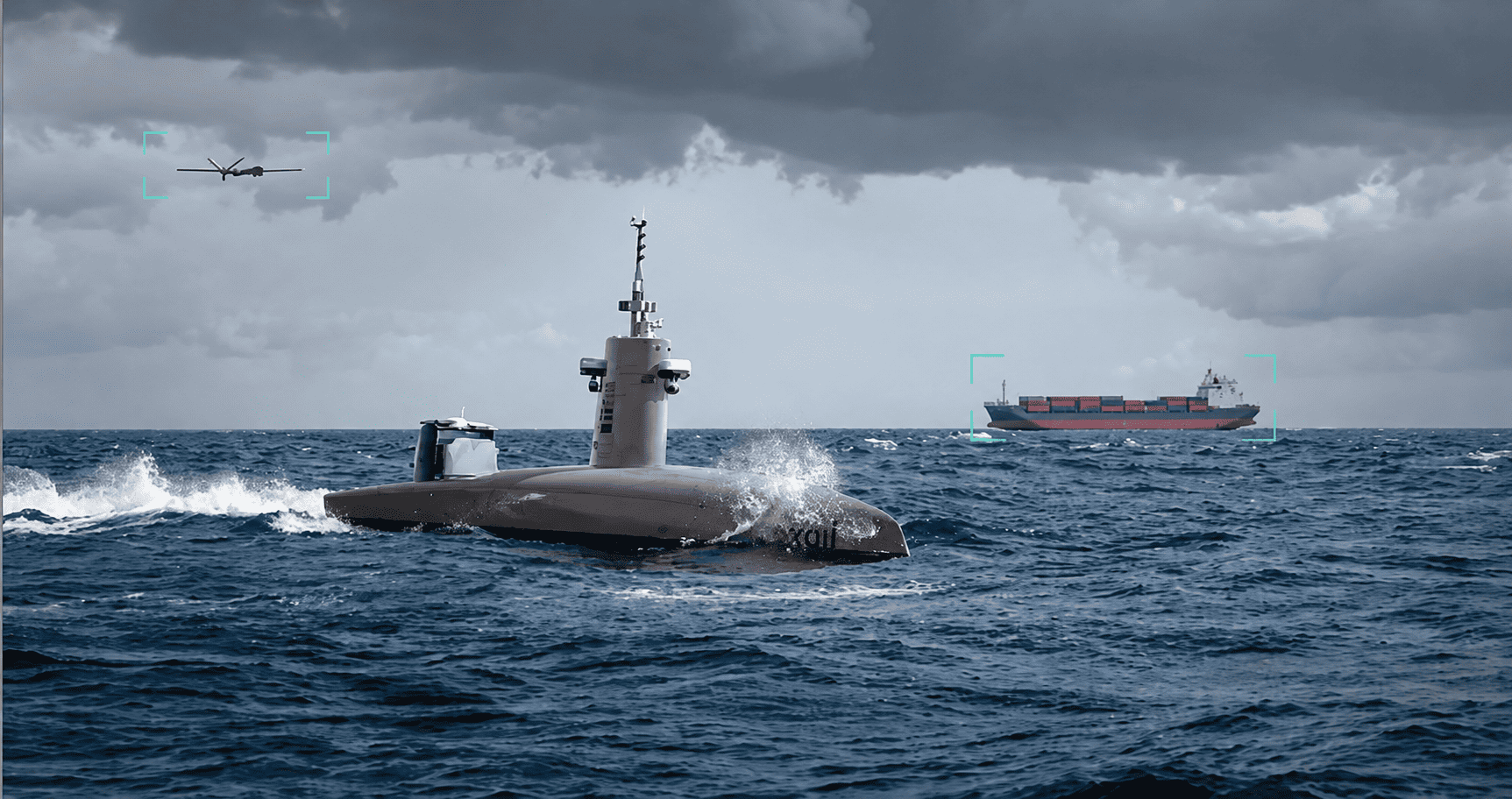
French navigation and maritime robotics company Exail unveiled Neptis on October 9, 2026, an integrated autonomous maritime surveillance system that networks a new family of Oryx uncrewed surface vessels (USVs), defense-grade sensor payloads and a mission command-and-control (C2) suite. The system targets intelligence, surveillance and reconnaissance (ISR), anti-submarine warfare (ASW), critical undersea infrastructure protection (CUIP) and counter-uncrewed aerial systems (C-UAS) missions.
The launch addresses a capacity problem facing European navies: too few crewed hulls for sea lanes, coastal approaches and seabed cable networks. NATO launched Baltic Sentry on January 14, 2025, pairing frigates and maritime patrol aircraft with naval drones after a string of damaged Baltic cables. Rather than sending a crewed ship wherever coverage is needed, Neptis distributes autonomous sensing nodes across an operating area and fuses their output. Sébastien Grall, Head of Maritime Autonomous Systems at Exail, framed the aim as expanding surveillance capacity “without proportionally increasing the number of personnel dedicated to these missions.”
Neptis Maritime Surveillance Architecture: Oryx H-8, H-9 and O-16
The Oryx series forms the mobile sensing layer. Exail says the family was built for naval concepts of operations but inherits the hull form, hydrodynamics and autonomy of its civil DriX line; the largest variant matches the published dimensions of the DriX O-16 demonstrated to French naval personnel in June 2024. Exail’s published specifications:
- Oryx H-8 (medium range): 7.71 meters, 1.6 tonnes, up to 10 days endurance, top speed under 14 knots, 1,000 nautical miles, towing capable.
- Oryx H-9 (long range): 9 meters, 2.1 tonnes, up to 20 days, under 13 knots, 2,000 nautical miles, towing plus sensor launch and recovery.
- Oryx O-16 (transoceanic): 15.75 meters, 10.5 tonnes, up to 30 days, under 16 knots, 3,500 nautical miles, dual hybrid propulsion, launch and recovery of towed vehicles, remotely operated vehicles, uncrewed aerial vehicles and autonomous underwater vehicles.
Endurance varies with speed, payload and towing load, a material caveat for ASW, where a towed acoustic array adds drag and power demand. Exail cites low visual, radar and acoustic signatures; the acoustic claim matters most, since a noisy hull masks the contacts its own passive sensors are hunting. The O-16’s ability to deploy underwater and aerial vehicles turns it from a sensor carrier into a mobile hub, extending coverage into the water column and low-altitude airspace.
The DriX lineage supplies sea time. Exail cites Sea State 7 survivability and participation in US Navy Task Force 59 and 4th Fleet activities, NATO’s Task Force X and REPMUS exercises, and French Navy operations.
How the Neptis C2 Suite Fuses Sensors Across Air, Sea and Seabed
Exail places its differentiation in the C2 layer. The modular software combines tactical track visualization, mission planning, contact classification, data fusion and AI-assisted decision support, and can connect to higher-level naval command systems. Operators supervise one or several Oryx hulls from shore or ship and retain authority over mission validation, retasking and operational decisions. Exail has not specified which classification functions are automated or which data standards govern interoperability.
Payloads are configured per mission. ISR packages combine radar, electro-optical/infrared (EO/IR) sensors, Automatic Identification System (AIS) receivers and electronic warfare (EW) sensors. ASW relies on acoustic payloads, including towed systems. CUIP pairs surface and underwater sensors to flag anomalous activity around infrastructure, while C-UAS and air threat early warning use radar and electro-optical sensors to detect and track low-flying threats. Exail has not named sensor suppliers for Neptis. Its Neptis material limits the C-UAS role to detection and tracking, although a January 7, 2026 contract from an undisclosed navy’s innovation office calls for an Exail long-range USV integrating third-party systems that can also neutralize aerial threats.
Resilience rests on high-grade inertial navigation for GNSS-degraded operations, onboard redundancy and configurable line-of-sight and beyond-line-of-sight radio and satellite links. Spreading sensors across several hulls means losing one platform degrades coverage rather than ending the mission. Navies can start with a single Oryx and one use case, then scale toward coordinated multi-platform operations.
Analysis: Neptis moves Exail from selling vehicles to selling a surveillance architecture, replicating its mine warfare model. Its Unmanned MCM Integrated System (UMIS) underpins the Belgian-Dutch replacement Mine Countermeasures (rMCM) program, a contract worth nearly EUR 2 billion awarded in May 2019 for 12 motherships and their drone toolboxes; the first toolbox was delivered in Zeebrugge in March 2026. Applying that integration logic to wide-area surveillance targets the gap between seabed protection and ASW that European navies now cover with scarce frigates and maritime patrol aircraft. The decisive test will be acoustic. Uncrewed hulls have proven persistent in ISR and hydrography, but sustained ASW depends on towed-array performance, self-noise and power budgets that Exail has not published. More than 90 USVs sold and 1.5 million nautical miles logged establish platform maturity, not a fielded ASW network.
Exail will present Neptis and the Oryx family at Euronaval in Paris in November 2026. No launch customer, pricing or delivery schedule has been announced. Existing buyers offer a potential path: an undisclosed European navy has ordered five Exail USVs for ISR, the largest order for the platform to date. Whether such customers migrate to the full Neptis architecture, and which partners supply its ASW sensors, are the next indicators to watch.