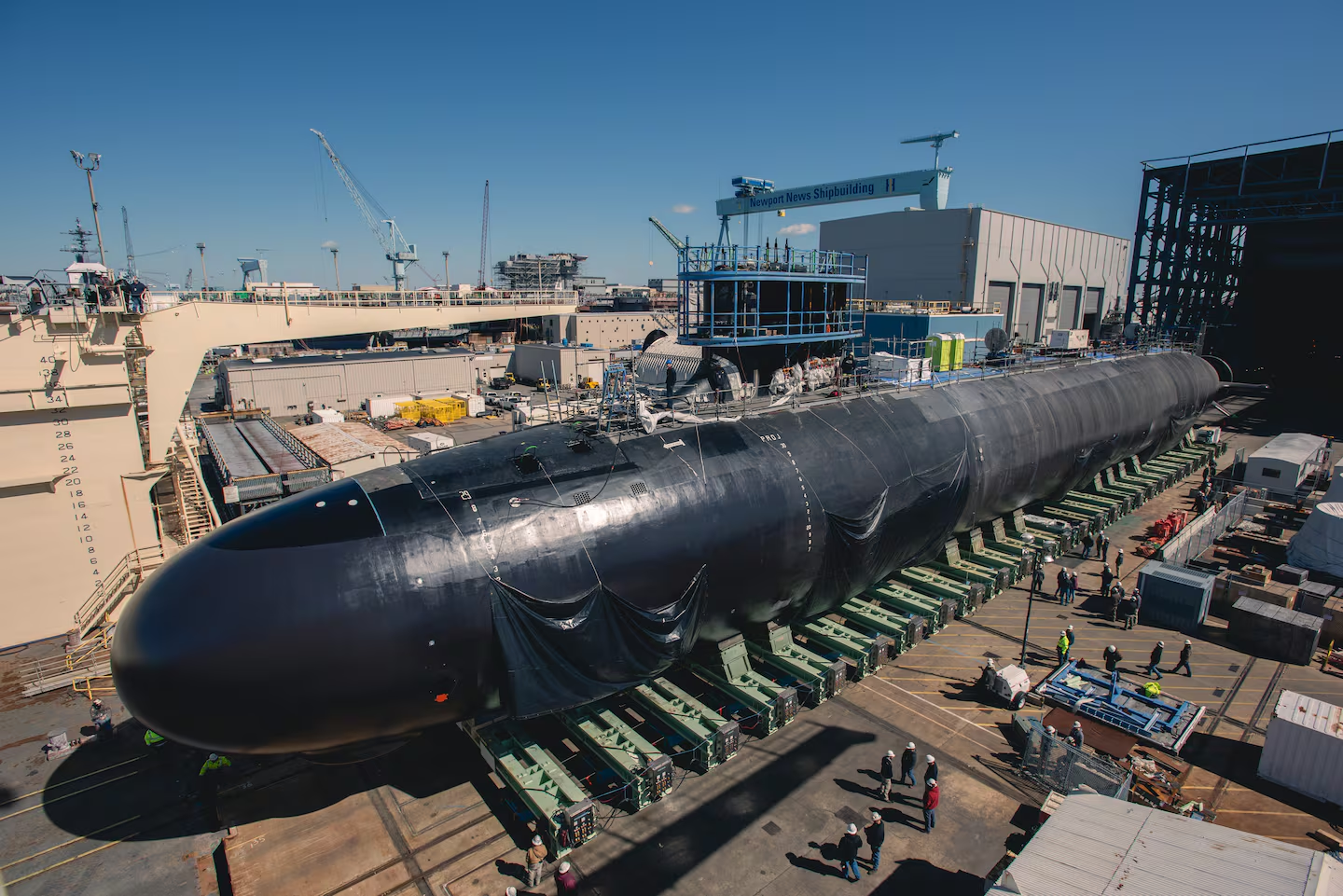
The US Navy on October 9, 2026, issued a Sources Sought Notice asking domestic shipyards to demonstrate whether they can serve as prime construction yards for SSN(X), the next generation attack submarine planned to succeed the Virginia class. Notice N00135-27-SSNX, published through Naval Sea Systems Command (NAVSEA) Team Submarine, closes at 5:00 p.m. Eastern Daylight Time on October 15, giving respondents seven calendar days to return a capability questionnaire.
The notice is market research under Federal Acquisition Regulation (FAR) Part 10, not a solicitation. The Navy says it intends to baseline current domestic industrial capabilities, identify future capital expenditure requirements, and shape acquisition strategy for the SSN(X) shipbuilding pipeline. The program remains years from steel: the fiscal 2025 budget deferred procurement of the first SSN(X) from FY2035 to FY2040, citing limits on the Navy’s total budget, and the May 2026 30-year shipbuilding plan places lead boat construction in the early 2040s.
What the Navy Requires From a Next Generation Attack Submarine Yard
The notice was issued jointly by the Director, Submarine Programs; the Director, Design and Construction; and the SSN(X) New Attack Submarine Program Office (PMS 351). A prime yard must execute complete hull fabrication, modular outfitting, precision systems integration, reactor compartment installation, and post-delivery testing. The Navy wants detail on operational capacity, drydock availability, specialized fabrication tooling, and the depth of each yard’s qualified shipbuilding design workforce.
Facility requirements are equally specific: certified graving docks or floating drydocks, heavy module fabrication shops, and gantry crane systems able to lift and translate major submarine modules. Respondents must also hold established quality management systems, mature nondestructive testing capability, and certified welding procedures for high-yield submarine-grade steels, advanced non-ferrous alloys, and specialized acoustic treatment installations.
Those criteria describe a nuclear-certified submarine builder, and the United States has two. General Dynamics Electric Boat operates in Groton, Connecticut, and Quonset Point, Rhode Island; Huntington Ingalls Industries’ Newport News Shipbuilding operates in Newport News, Virginia. Both build Virginia-class boats under a teaming arrangement led by Electric Boat, which is also prime contractor for the Columbia class. The notice’s reference to “prime construction yard(s)” leaves open whether the Navy will team the two yards again or award whole hulls to a single builder, a build-strategy question the Congressional Research Service has flagged as unresolved.
Responses must be unclassified and delivered through the DoD Secure Access File Exchange (DoD SAFE), and vendors must request a secure upload link before the notice closes. Incomplete questionnaires will not be reviewed, and no telephone inquiries will be accepted.
Seawolf Speed, Virginia Quieting, Columbia Availability: SSN(X) Design Goals
Navy officials have defined SSN(X) by borrowing from three classes: the speed and payload of the Seawolf (SSN-21) design, the acoustic quietness and sensors of the Virginia class, and the operational availability and service life of the Columbia class. The fiscal 2026 research and development justification calls for greater speed, increased horizontal payload capacity in the torpedo room, improved signatures, flexibility to adapt to future threats, and the ability to employ and coordinate a larger contingent of remote autonomous systems.
No official length, beam, displacement, tube count, or reactor plant has been released. For cost modeling, the Congressional Budget Office (CBO) assumed a submerged displacement of about 10,100 tons, roughly 11 percent above Seawolf’s 9,138 tons and well beyond the 7,800 tons of early Virginia boats. That growth explains the notice’s focus on drydocks and module-handling cranes. If the design converges on Seawolf-like proportions, publicly available specifications for that class indicate a 40-foot beam, against 34 feet for Virginia. Columbia’s 43-foot hull shows both yards can already handle larger diameters; the constraint is dock and crane time, not geometry.
Cost estimates diverge. In constant FY2024 dollars, the Navy puts average unit procurement cost at $7.1 billion and CBO at $8.7 billion; neither figure is a lead ship price, and no total program cost has been published. Funding has trended down: the FY2026 request sought $622.8 million, including $366.0 million for class development and $256.8 million for next-generation fast attack nuclear propulsion, while the FY2027 request for the class development line falls to $315.9 million.
Analysis: The notice reads less as a search for new builders than as an audit of how much capacity will remain once Columbia and Virginia take their share. The FY2027 to FY2031 plan commits $124.9 billion to submarine construction, funding one Columbia and two Virginias per year, a load the yards have not yet sustained; Virginia deliveries have run at roughly 1.1 to 1.2 boats annually since 2022. By asking yards to identify future capital expenditure requirements, the Navy signals that adding a third class likely demands new facility investment, not just schedule slack. The deeper exposure sits in engineering: the Navy’s FY2025 shipbuilding plan acknowledged that the gap between Columbia and SSN(X) design work strains the submarine design industrial base, and the request for design workforce data targets that risk directly.
Responses are due October 15, 2026, after which the Navy may follow up with vendors it judges capable. The next markers are the FY2028 budget request, which will show whether the class development line stabilizes, and the Navy’s choice of build strategy. Until requirements are frozen and a cost baseline is set, the FY2040 procurement date remains a planning figure.