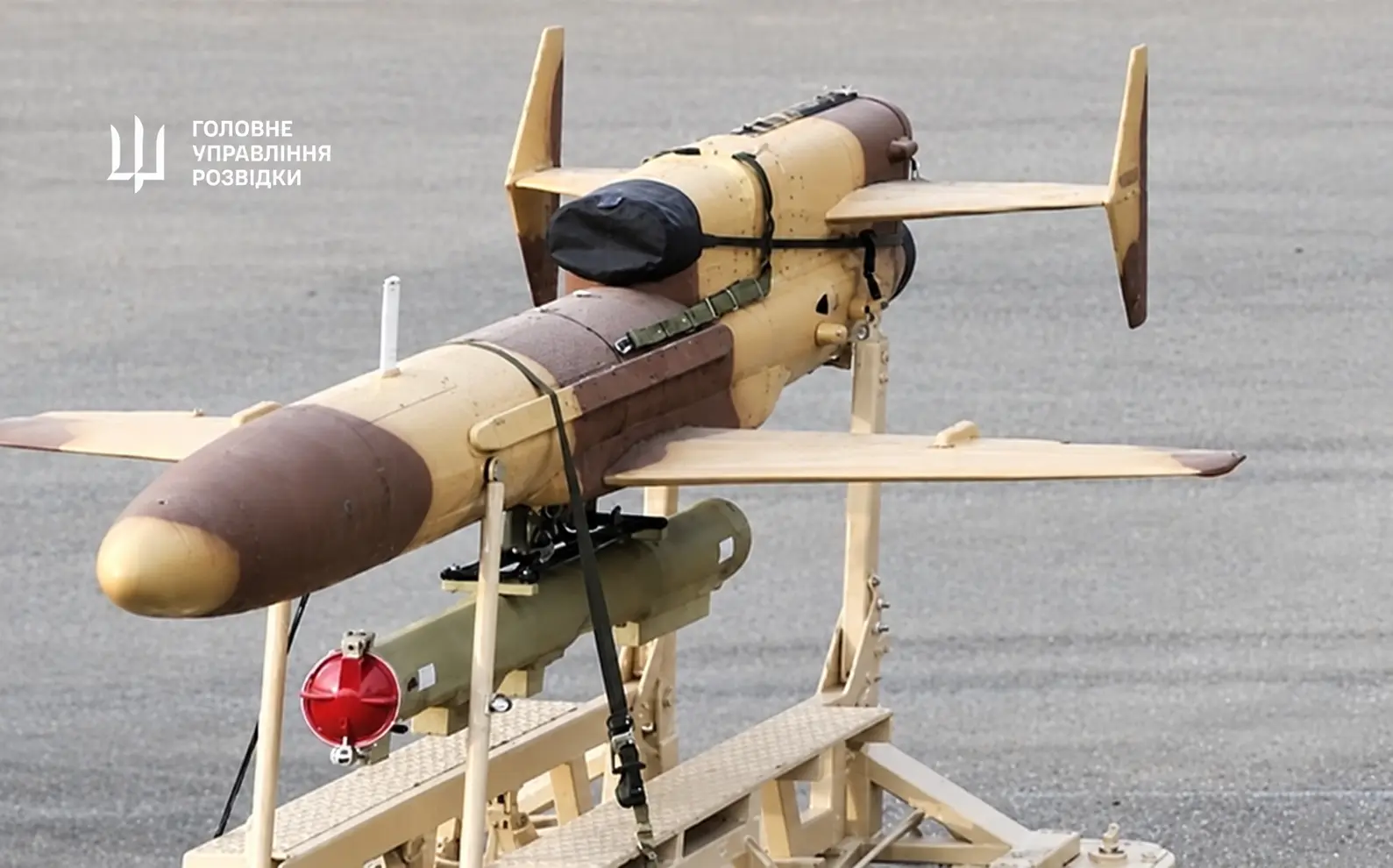
Russia has fitted upgraded Geran-4 and new Geran-5 K5 jet-powered attack drones with Susanin, an optical navigation system that fixes the aircraft’s position by matching camera imagery of the ground against preloaded reference photographs, Ukraine’s Main Directorate of Intelligence (HUR) disclosed on October 5, 2026. Serhii Beskrestnov, adviser to the Ukrainian president on defense technology, expects the method to spread across Russian strike drones and low-cost cruise missiles in 2027.
The upgrade targets the core of Ukraine’s defense against long-range drones. Since 2022, Ukrainian electronic warfare (EW) units have degraded Shahed-derived Gerans by jamming and spoofing Global Navigation Satellite System (GNSS) signals, pushing Russia toward multi-element Kometa antennas. Volume keeps climbing: Russia launched about 1,900 drones and 25 missiles at Ukraine in the week to October 4, according to President Volodymyr Zelensky, who expects Moscow to favor faster turbojet variants. A navigation channel that relies on no radio signal removes one of Kyiv’s cheapest counters.
How Susanin Gives Geran Drones Optical Navigation Without GNSS
Susanin applies the scene-matching principle. A downward-looking camera images the terrain, and an onboard processor compares those frames with reference imagery loaded before launch to compute a position fix and correct the programmed route. HUR describes it as an additional autonomous channel layered on the satellite and inertial navigation already carried by the Geran family. Beskrestnov said publicly available ground imagery, including Google’s, suffices for basic orientation, which lowers the mission-planning burden.
Because the system depends on neither satellite signals nor an operator link, radio-frequency jamming and spoofing cannot degrade it. Ukrainian analysts add that Susanin-equipped airframes no longer strictly need the mesh modems and airborne relays Russia has used to steer Gerans in flight, which could also reduce the emissions passive detection networks exploit. Russian war correspondent Andrey Filatov first publicized the Susanin name in September 2026 but disclosed no accuracy figures, components, or algorithms.
The concept is not new to Russian arsenals. Beskrestnov said comparable systems already fly on Molniya, V2U, and Lancet drones; HUR’s June 2025 teardown of the V2U found a Leetop A203 computer built around an Nvidia Jetson Orin module and a single GPS receiver. At the high end, the Kh-101 cruise missile variant designated Izdeliye 504AP used an optical system called Otblesk-U against Ukraine between 2022 and 2025, according to Ukrainian technical analysts, a role comparable to the Digital Scene Matching Area Correlator (DSMAC) on the US Tomahawk. What changes now is unit cost: a cruise-missile guidance concept is migrating onto mass-produced one-way attack drones.
Geran-4 vs Geran-5 K5: Specifications and the Limits of Jamming
The upgraded Geran-4, in Russian service since autumn 2026, pairs Susanin with a new MOKh module built around a PNI5GA magneto-inductive magnetometer from US manufacturer PNI Sensor. HUR says MOKh works with the SADRA inertial module to reduce gyroscope drift, so Susanin supplies intermittent fixes while a steadier inertial solution holds the track between them. The variant also carries a shaped-charge warhead designed to cut bridge structures and high-voltage pylons, and a Russian-made engine from the Alabuga plant in Tatarstan replaces the earlier Chinese turbojet. Ukrainian intelligence credits it with a 3.6-meter length, a 3.05-meter wingspan, a 450-kilogram maximum takeoff weight, a warhead of up to 50 kilograms, a 320 km/h cruise speed, and a range of about 770 kilometers.
The Geran-5, first used in January 2026, drops the Shahed delta for a conventional straight-wing airframe resembling Iran’s Karrar. HUR data gives it a length of 6 to 6.5 meters, a 5.5-meter wingspan, a weight of up to 850 kilograms, a 90-kilogram warhead, cruise speeds of 450 to 600 km/h on a Chinese Telefly turbojet, and a range of about 950 kilometers. The K5 modification adds a reworked fuselage alongside Susanin.
Faster airframes and jam-resistant navigation compound each other. Zelensky said on October 4 that Ukraine intercepts roughly 50 to 60 percent of jet-powered drones, with F-16s and 20mm ammunition performing best; Kyiv has installed more than 12 automated 12.7mm turrets around the capital and expects first combat results from domestic small interceptor missiles in the second half of October. Scene matching has known limits: publicly documented systems of this type lose accuracy at night without a thermal channel, under low cloud, and over snow or water. HUR has not disclosed whether Susanin uses infrared imaging.
Analysis: Susanin is less a breakthrough than a cost transfer. Russia is moving a guidance concept once reserved for Kh-101-class missiles onto jet drones built in volume at Alabuga, and pairing it with an anti-structure warhead whose effect depends on hitting a pylon or bridge span rather than an area. Every drone that leaks through becomes more lethal while the cheapest layer of Ukraine’s defense loses effect, shifting the burden onto guns, interceptors, and aviation. For NATO, the turbojet Geran-type drone that crashed in Moldova’s Orhei district on September 30, 2026, showed how readily these weapons reach neighboring territory; allied planning that counts on GNSS denial to divert them needs kinetic depth. The US-made magnetometer inside the Geran-4 also shows that export-control enforcement remains an open front.
Key unknowns remain Susanin’s accuracy, its night and winter performance, and the share of Geran output now carrying it. Further HUR teardowns of K5 wreckage should address the first; the winter strike campaign will test the rest. Kyiv’s first small interceptor missiles are due in combat before the end of October.