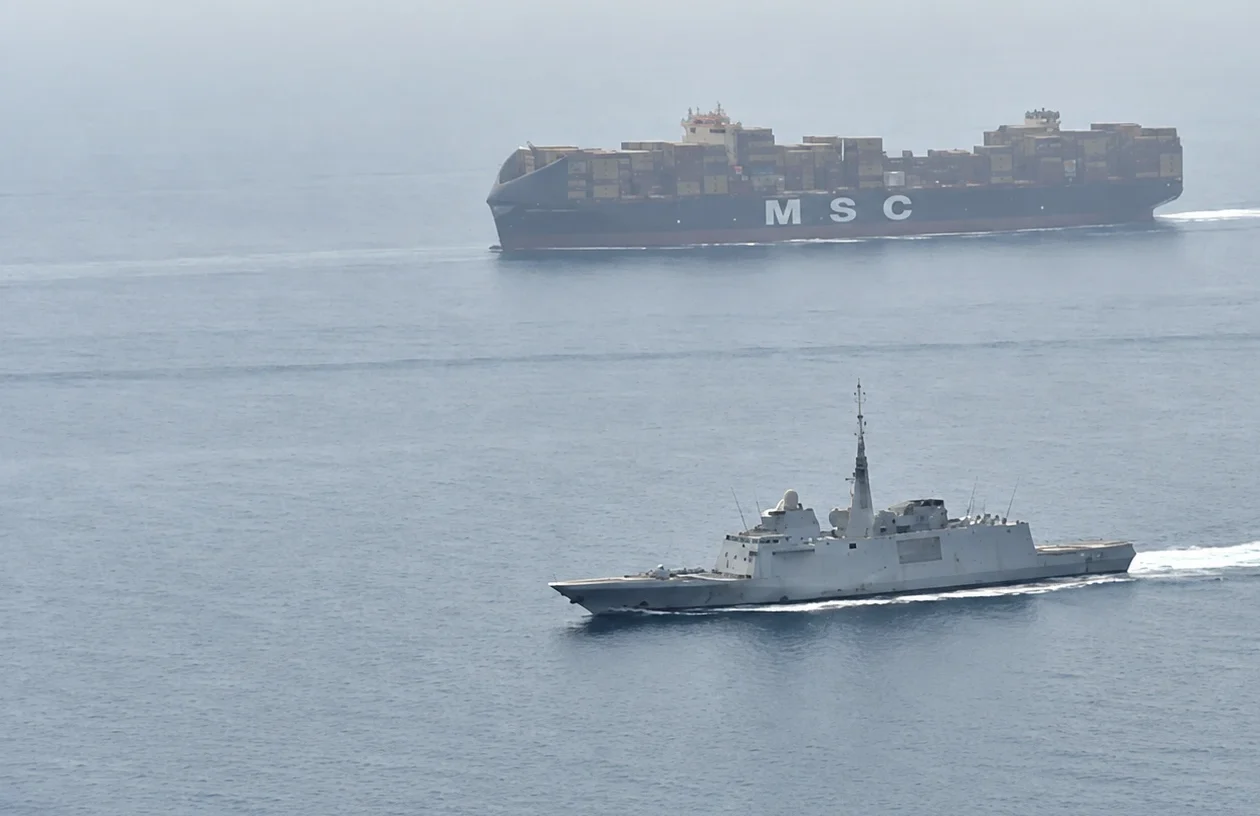
France’s multi-mission frigate FREMM Provence returned on October 2, 2026, from a deployment of nearly 11 months in the Indian Ocean, Red Sea and Gulf of Aden. The French Navy credits that endurance to its double-crew model, which rotates two complete ship’s companies on the same hull.
The deployment coincided with a sharp deterioration in regional maritime security. Iran’s closure of the Strait of Hormuz during its war with the United States and Israel pushed Saudi crude exports toward the Red Sea port of Yanbu, with flows through the Bab el-Mandeb up eightfold between March and mid-July 2026 year on year, according to tracker Kpler. In late July, Yemen’s Houthi movement declared a maritime embargo on Saudi shipping, just as Provence changed crews.
FREMM Provence Escort Operations Under EUNAVFOR Aspides
After a crew relief in Djibouti at the end of July 2026, Provence’s crew A spent two and a half months in the Arabian Sea, the Gulf of Oman and the Red Sea, under the operational control of the admiral commanding French forces in the United Arab Emirates and the Indian Ocean maritime zone (ALINDIEN COMFOR EAU).
Its principal tasking was the European Union naval operation EUNAVFOR Aspides. Provence conducted multiple escorts of merchant vessels through the Red Sea, the Bab el-Mandeb strait and the Gulf of Aden, in a posture the French Navy describes as exclusively defensive and aimed at upholding freedom of navigation. The ministry has not disclosed how many ships were escorted or whether Provence engaged any aerial or surface threats.
Aspides became operational on February 19, 2024, and is commanded from Larissa, Greece. On February 23, 2026, the Council of the European Union extended it to February 28, 2027, with nearly 15 million euros for common costs; its command reported more than 1,570 vessels supported in the first 23 months.
The threat hardened during crew A’s rotation. Houthi forces claimed missile attacks on Saudi-linked tankers in the southern and northern Red Sea through August, and a ballistic missile strike on a merchant vessel in the Bab el-Mandeb killed crew members, according to Yemen’s internationally recognized government. Provence also served as an autonomous sensor node for regional situational awareness in a zone where, in the Navy’s assessment, tensions remain acute.
Double Crew Model Extends Aquitaine-Class Frigate Time on Station
Provence is the second of eight Aquitaine-class FREMMs and belongs to the anti-submarine warfare configuration. Publicly available specifications indicate a 142-meter hull of about 6,000 tonnes, combined diesel-electric or gas turbine (CODLOG) propulsion, a top speed of 27 knots and a range of 6,000 nautical miles at 15 knots, with a core crew designed at 108 sailors, half that of the previous frigate generation.
Its Thales Herakles S-band multifunction radar provides air and surface search and guides 16 MBDA Aster 15 missiles in Sylver A43 cells, the ship’s main defense against drones and anti-ship missiles during escorts. A UMS 4110 CL hull sonar and a CAPTAS-4 variable depth sonar form the anti-submarine suite, while 16 MdCN naval cruise missiles in Sylver A70 cells, 8 Exocet MM40 Block 3 missiles, a 76 mm gun, MU90 torpedoes, the SETIS combat management system and a hangar for the NH90 Caiman Marine complete the fit.
Endurance on station depends on people more than machinery. The French Navy introduced dual crewing on Aquitaine in 2019 and now runs four of its eight FREMMs with two complete crews on four-month cycles. Handovers take about three days and can be conducted in Abu Dhabi or Djibouti, which is how Provence changed crews without returning to France. The service says the model raises sea days per hull from roughly 120 per year to between 170 and 180, underpinning the 80 percent first-rank availability rate cited in 2025 by Admiral Nicolas Vaujour, the French Navy’s chief of staff.
Allied Interoperability With HNLMS De Ruyter and HMS Dragon
The deployment also included interactions with HNLMS De Ruyter and HMS Dragon. De Ruyter, a Royal Netherlands Navy De Zeven Provinciën-class air defense and command frigate, sailed in April 2026 on a five-month Indo-Pacific deployment and supported Aspides during its Red Sea transit. Dragon, a Royal Navy Type 45 air defense destroyer, deployed to the Eastern Mediterranean in March 2026 and later operated in the Arabian Sea. Its Sea Viper system fires the same Aster missile family as Provence, a commonality that simplifies shared air defense procedures. The French Navy calls such partnership activity essential to interoperability with European partners in the region.
Provence also trained with the French Forces stationed in Djibouti (FFDJ). Its chain of command ran through the French Forces stationed in the UAE (FFEAU), a hub of nearly 900 personnel that conducts French operations across the Middle East and the Indian Ocean, provides rapid crisis response and protects French nationals.
Analysis: Dual crewing has turned France’s legally capped force of 15 first-rank combatants into a presence fleet larger than its hull count, which matters now that the Bab el-Mandeb and Hormuz are under pressure simultaneously. The binding constraint has shifted from crews to hulls and magazines. An anti-submarine FREMM carries 16 Aster 15 rounds that cannot be replenished at sea, a thin load against salvoes of ballistic missiles and drones, and each extended deployment consumes maintenance margin. With Aspides relying on a handful of national escorts at any one time, Europe’s Red Sea protection remains a rotation of individual ships rather than a layered air defense umbrella.
The Aspides mandate runs to February 28, 2027, with a further EU strategic review planned beforehand. The French Navy said in May that Auvergne would receive a second crew in 2026, bringing dual-crewed FREMMs to five. The ministry has not detailed how France will sustain its Aspides contribution after Provence’s return, and the shape of any multinational mission to secure Hormuz traffic once hostilities with Iran subside remains undefined.