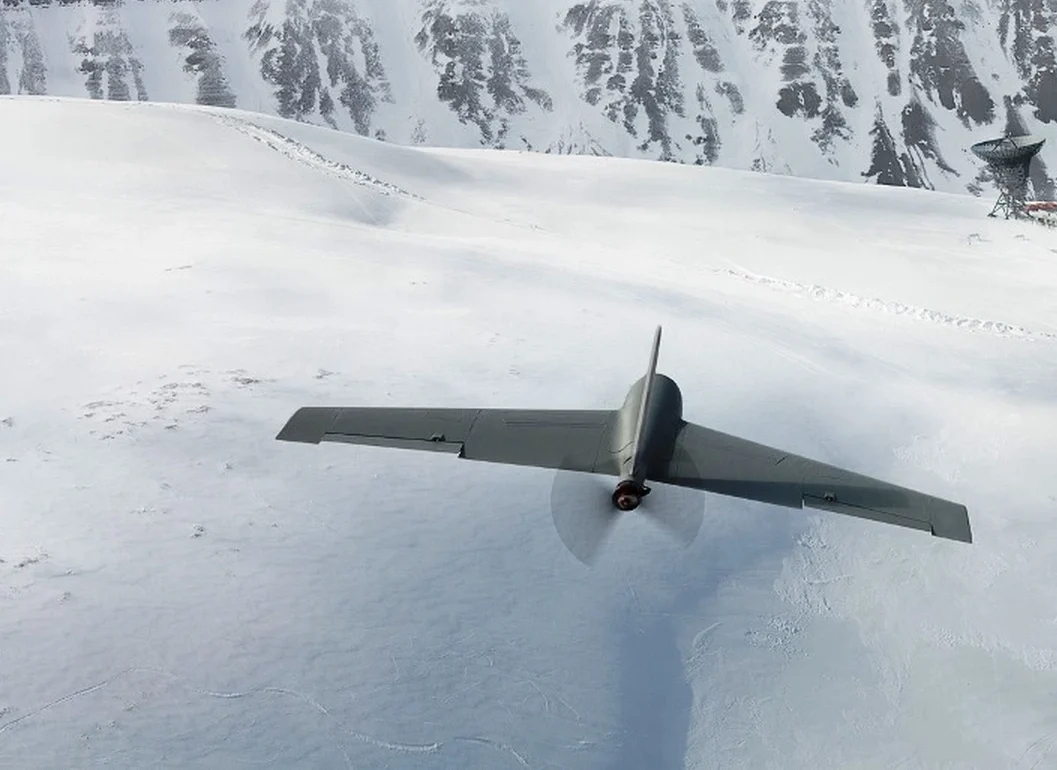
Heaviside Industries unveiled its TYR loitering munition on October 12, 2026, at the Association of the United States Army (AUSA) Annual Meeting and Exposition in Washington, DC, presenting a man-portable weapon that weighs just over 5 pounds and carries one of four interchangeable warheads supplied by Norway-based Nammo. The Los Angeles-based company says TYR has completed live-fire testing and is already under contract with unnamed Department of War customers.
TYR is the first precision munition from a startup founded in 2024 that emerged from stealth in May 2026 with a $28 million Series A round, followed three months later by a $60 million Series B announced alongside the Nammo partnership. It enters a crowded field. The Army bought AeroVironment’s Switchblade 600 under the Low Altitude Stalking and Strike Ordnance (LASSO) program and has since selected UVision’s HERO-90 for the same requirement, while the Pentagon’s July 2025 drone dominance memo reclassified small drones as consumables to speed bulk procurement. Company president Nils Haagenrud framed TYR as a way to “extend our robotic advantage” as peer adversaries field more autonomous systems.
TYR Loitering Munition Specifications and Four Nammo Warhead Options
Heaviside rates TYR at more than 60 minutes of flight time, a range exceeding 25 miles (40 km) and a top speed above 150 mph (240 km/h). The air vehicle weighs just over 5 pounds, about 2.5 kg, and the complete system approximately 15 pounds (6.8 kg). The company has not said whether that figure covers launcher, controller or batteries.
The warhead menu covers four effects: a shaped charge anti-tank warhead, an anti-structure munition, an explosively formed penetrator (EFP) and an anti-personnel fragmentation warhead. Heaviside claims the shaped charge variant can defeat main battle tanks but has not released penetration data, warhead mass or fuzing details. On an airframe this light, the warhead is necessarily small, so the anti-armor claim rests on top-attack geometry against thinner roof and engine-deck armor rather than raw explosive mass.
TYR is designed for contested and GPS-denied environments and, according to the company, keeps a low acoustic and visual signature. Heaviside lists three employment roles: ground and base defense, counter-unmanned aircraft systems (C-UAS) missions, and integration onto larger unmanned systems for multi-domain operations. It has not detailed how TYR would be cued against aerial targets. Propulsion, seeker, datalink, denied-environment navigation, autonomy level and launch method also remain undisclosed, and those parameters will decide how TYR performs against electronic warfare.
How TYR Compares With Switchblade 300 Block 20 and HERO-90
TYR’s closest US benchmark is AeroVironment’s Switchblade 300 Block 20. The manufacturer lists that munition at 3.7 pounds (1.7 kg) and the all-up round at 7.2 pounds (3.3 kg), with 30 km of range using an extended-range antenna, more than 20 minutes of endurance and a 100 mph (161 km/h) dash speed. The Block 20 now accepts fragmentation and EFP warheads.
Against those figures, TYR’s air vehicle is roughly 45% heavier but claims about three times the endurance, a third more range, a 50% speed advantage and two additional warhead types. Its 15-pound system weight is about double the Switchblade all-up round, though the figures may not be directly comparable.
At the heavier end, the HERO-90 selected for LASSO weighs about 18 kg (40 pounds), carries a 3 kg warhead and is reported to reach 45 km with roughly 40 minutes of endurance. TYR claims comparable reach at little more than a third of the system weight, yet its entire air vehicle weighs less than the HERO-90 warhead alone. That gap defines the trade: TYR buys range and endurance with a far smaller payload, placing it below the dedicated LASSO anti-armor class rather than in direct competition with it.
Analysis: TYR’s performance-to-weight figures are strong on paper, but every number comes from the manufacturer, and the variables that drive procurement remain undisclosed: unit cost, warhead mass, production rate and performance under jamming. Heaviside’s sharpest differentiator may be the warhead supply chain rather than the airframe. Sourcing qualified warheads from Nammo, an established NATO energetics supplier, addresses one of the hardest hurdles for venture-backed entrants, whose airframes often mature faster than their ability to qualify lethal payloads. With the Pentagon now treating small drones as consumables, price per round, not peak speed, is likely to determine whether TYR moves from initial contracts to brigade-scale buys.
Heaviside has not named its Department of War customers or disclosed contract values. The next indicators to watch are a published unit price, independent test data against armor and electronic warfare, and whether TYR enters a formal Army or US Special Operations Command (SOCOM) competition. The company is also developing MOTH, a land-based spectrum awareness system, and NYX for the maritime domain, with Series B funds earmarked for production capacity and existing customer commitments.