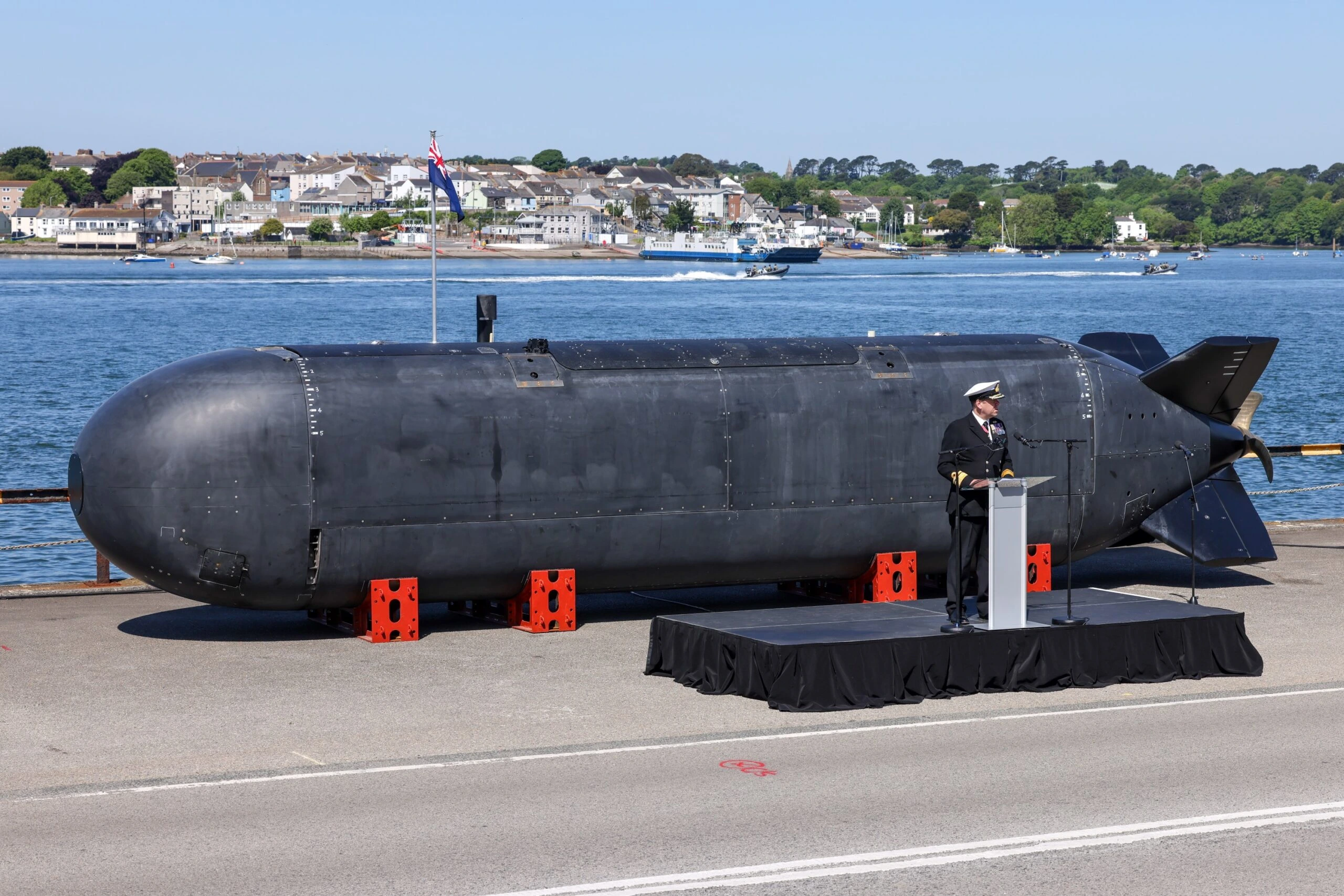
The Royal Navy has opened preliminary market engagement for the Type 93 Extra-Large Uncrewed Underwater Vehicle (XLUUV) and the AUKUS Signature Payload Programme, inviting companies to register interest in a Ministry of Defence (MoD) notice published on October 12, 2026. The service is initially considering platforms of approximately 2 meters in diameter and 12 meters in length, but has asked suppliers offering other dimensions to register as well.
The notice is the first formal industry step for a capability the Defence Investment Plan (DIP), published on June 30, 2026, assigned to Atlantic Bastion, the Royal Navy’s portfolio of programs to secure the North Atlantic against underwater threats in support of NATO. The MoD ties the effort directly to the 2025 Strategic Defence Review (SDR), the DIP and AUKUS Pillar II priorities, and to the service’s transition toward a Hybrid Navy that pairs crewed warships with autonomous systems. The Type 93 designation first surfaced in Project CABOT planning documents in February 2025.
Type 93 XLUUV Notice Targets Platforms, Payloads, and Autonomy
The Royal Navy says the exercise aims to improve its understanding of the market and wider ecosystem for XLUUV platforms, associated payloads and enabling functions. The registration list is deliberately broad: platform builders, payload providers, suppliers of autonomy, artificial intelligence (AI) and mission management software, systems integrators and through-life support providers. Small and medium-sized enterprises (SMEs) are flagged as particularly suitable.
Registered companies may be invited to collaborative workshops, one-to-one meetings, industry days and written requests for information (RFIs). Responses should arrive by 17:00 GMT on October 29, 2026, although registration stays open throughout the preliminary engagement program, which carries an engagement deadline of March 31, 2027. Submissions must be held at OFFICIAL classification, and participation confers no advantage or disadvantage in any future competition.
Commercial fields remain placeholders. The notice lists an estimated value of £0 and a contract window from April 1, 2027, to March 31, 2028, and states that the nominal £1 value and 12-month duration will be revised in future notices as figures mature. Its Common Procurement Vocabulary (CPV) codes cover uncrewed underwater vehicles, marine equipment, and repair and maintenance of warships, an early signal that sustainment will be scoped alongside the vehicle itself.
The 2-meter starting diameter sits just below the 84-inch (2.13-meter) threshold the US Navy uses to define the XLUUV class, according to the Congressional Research Service. Minister for Defence Readiness and Industry Luke Pollard told Parliament on July 15, 2026, that the number of Type 93 platforms and their construction schedules had not been determined, with detailed requirements to follow in the concept and assessment phases.
XV Excalibur Sets the Benchmark for AUKUS Pillar II Payloads
The starting envelope mirrors XV Excalibur, the 12-meter, 2-meter-diameter, 19-tonne demonstrator the Royal Navy already operates. Built by MSubs of Plymouth under Project CETUS, backed by a £15.4 million contract awarded in 2022, Excalibur was unveiled at His Majesty’s Naval Base (HMNB) Devonport in May 2025. During Exercise Talisman Sabre 2025, Royal Navy operators controlled it in UK waters from a remote operating center in Australia, more than 16,000 km away. It later trialed a quantum optical atomic clock for submerged timing and navigation and passed to Royal Navy ownership in December 2025.
On June 24, 2026, the Submarine Delivery Agency (SDA) directly awarded MSubs £6.68 million for trials and evaluation running to May 1, 2028. On September 13, 2026, Excalibur launched an inert, recoverable US Navy Mk 48 Mod 4 heavyweight exercise torpedo at the British Underwater Test and Evaluation Centre (BUTEC) near the Kyle of Lochalsh, the first heavyweight torpedo launch from an uncrewed underwater vessel by either the UK or the US. With no torpedo tubes, Excalibur carried the weapon externally beneath its hull. Follow-on work under Project CUTLASS shifts to Anduril’s Dive-XL to examine payload integration and command and control.
Allied programs bracket the Type 93 envelope. The US Navy’s Boeing Orca measures about 26 meters with its payload module, displaces roughly 85 tons and carries up to 8 tons in a 10-meter mission bay, according to publicly available specifications. Australia’s Anduril Ghost Shark, ordered under an AUD 1.7 billion (about $1.1 billion) contract in September 2025, is estimated at about 6 meters long.
Analysis: By benchmarking against Excalibur while leaving dimensions open, the Royal Navy is deferring the two choices that will define the Type 93: whether a 12-meter hull can carry meaningful AUKUS payloads internally, and whether Pillar II interchangeability favors a common allied vehicle over a sovereign British design. The Mk 48 firing validated the weapon interface but relied on external carriage, a configuration poorly suited to a vehicle intended for persistent, covert anti-submarine patrol. The notice’s emphasis on autonomy, AI and through-life support also suggests the service sees mission software and sustainment, rather than the hull, as the harder problem for Atlantic Bastion.
The next marker is the October 29 response target, followed by invitation-only workshops and RFIs through March 31, 2027. Ministers have said the Hybrid Navy will receive at least £1.5 billion over four years and that the first extra-large uncrewed underwater vessels carrying AUKUS-developed payloads should enter service by 2030. Fleet size, unit cost and acquisition route remain undisclosed and will not be clear until the MoD replaces the notice’s placeholder values.