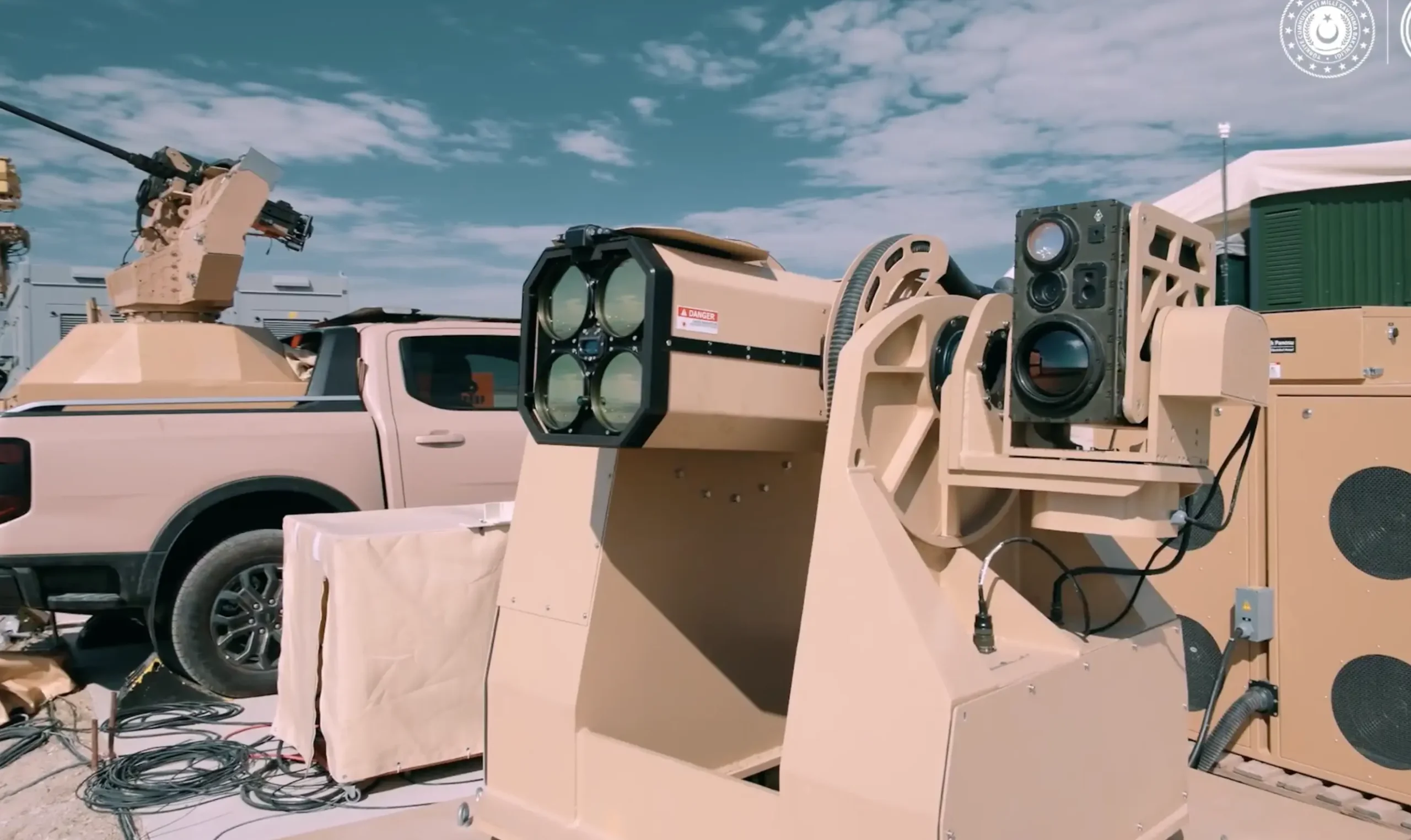
Türkiye’s state-owned Machinery and Chemical Industry Corporation (MKE) has destroyed a drone target at a distance of 760 meters with the 20-kilowatt fiber laser weapon developed for its TOLGA short-range air defense system, the company announced on October 13, 2026. The engagement took place during the Ateş Serbest-2026 live-fire event at the Polatlı training area west of Ankara and is the first public shoot-down of an aerial target by the new effector.
The test comes five months after MKE unveiled the laser at the SAHA 2026 exhibition in Istanbul in May, alongside an acoustic detection sensor and the ENFAL-17 missile, all proposed as new layers for TOLGA. TOLGA itself, launched at the IDEF exhibition, first fired its 12.7 mm and 20 mm turrets at the Karapınar range in Konya. Adding a directed energy layer responds to the same driver behind Türkiye’s Steel Dome program: the need to defeat large numbers of low-cost drones without expending missiles or gun ammunition at an unsustainable rate.
How the 20 kW TOLGA Laser Weapon Engages Drone Targets
Publicly released data indicate the MKE Laser Weapon System combines four 5 kW fiber laser modules for a total output of 20 kW. The turret measures 1,550 mm wide, 2,250 mm long and 1,850 mm high; MKE has not disclosed its mass. A separate electro-optical sensor unit mounted on the turret detects and tracks targets before the beam is fired, and the mount uses linear motors to deliver the angular speed and acceleration needed to hold the beam on a maneuvering target for the several seconds of dwell time a kill typically requires.
According to range data MKE released with the test footage, the weapon has three effect bands. It can dazzle a drone’s cameras and sensors at 2,500 to 4,500 meters, blind them completely at 1,500 to 2,500 meters, and physically destroy a target at 100 to 1,500 meters. The Polatlı kill at 760 meters therefore sits near the middle of the destruction envelope rather than at its edge.
Several parameters that determine operational value remain undisclosed: the beam combination method, beam quality, the mass and capacity of the power and cooling packs, the number of engagements available before recharge, and performance in rain, dust or haze. MKE has also not identified the drone type engaged or its size. These factors, more than peak output, will decide whether the laser can sustain engagements against a salvo rather than a single target.
At 20 kW, the weapon matches European naval laser demonstrators but sits well below the 100 kW class Israel is fielding against rockets and mortars, positioning it against small drones rather than rockets or cruise missiles.
Layering Lasers Into TOLGA and Türkiye’s Steel Dome Architecture
TOLGA is built as a modular, layered short-range air defense system. According to MKE, its mobile radar, electro-optical system and jammer provide surveillance and soft-kill effects out to 10,000 meters. Kinetic effectors include a 35 mm weapon system effective to 3,000 meters, a 20 mm system to 1,000 meters and 12.7 mm systems to 300 meters, all firing MKE-developed programmable ammunition that detonates near the target and disperses fragments.
The laser’s 1,500-meter destruction range slots between the 35 mm and 20 mm guns, while its dazzling band extends beyond the 35 mm envelope. In practice, the laser can engage cheap quadcopters and loitering munitions at negligible marginal cost, preserving cannon rounds and missiles for faster or harder targets. MKE says the weapon is also intended to counter close-range land and sea threats.
MKE joins two other Turkish directed energy efforts: ASELSAN’s GÖKBERK, displayed on BMC’s AMAZON armored vehicle, and Roketsan’s ALKA. All three feed into Steel Dome, the layered network combining lasers, guns, jammers and missiles to protect troops, bases and cities from drone and missile attack.
Analysis: The Polatlı shot shows MKE, historically a gun and ammunition producer, moving into directed energy and offering a single-vendor package from sensor to effector. For a NATO member exposed to drone threats on its southern borders and in the Black Sea region, an organic laser layer improves the cost-exchange ratio against mass drone attacks. The test, however, demonstrates a single engagement under controlled conditions. Türkiye now has three parallel domestic laser lines, which builds industrial depth but raises the question of whether procurement authorities will consolidate funding or sustain competing programs.
The next indicators to watch are a qualification program or order from the Turkish Armed Forces, disclosure of the platform and power configuration intended for fielding, and any export offer bundled with TOLGA, which MKE already markets to foreign customers. Data on engagement rate, weather performance and power pack size will determine how far the laser can carry the counter-drone mission inside Steel Dome.