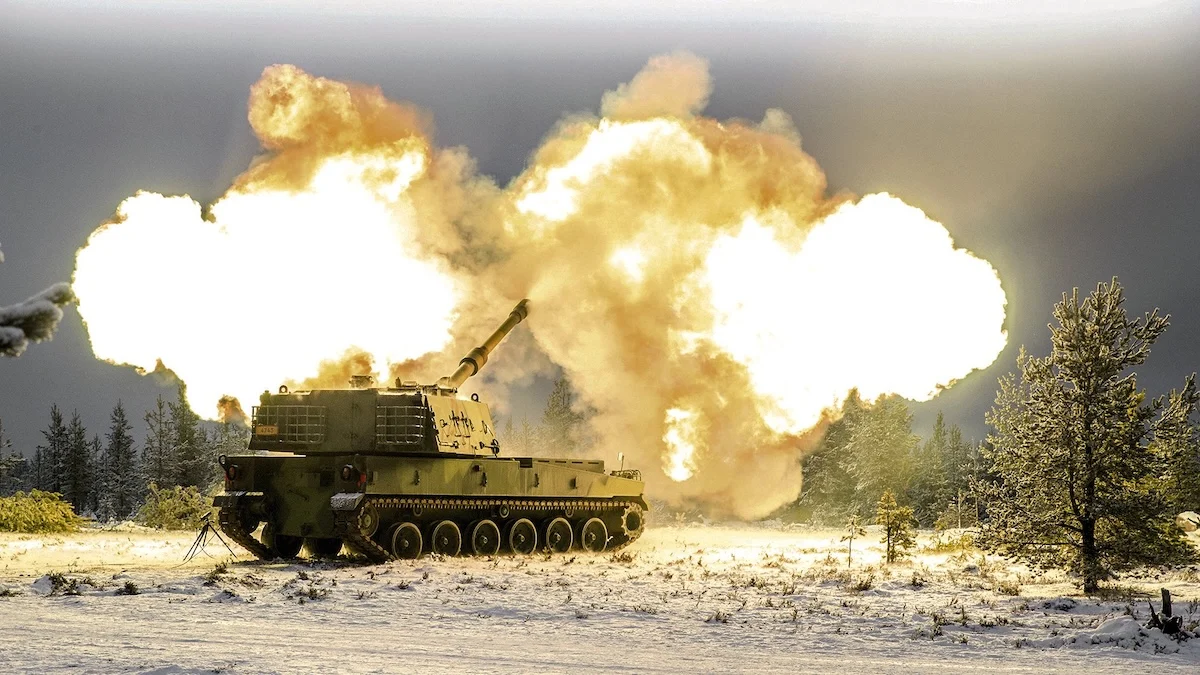
The European Commission has awarded €30 million to Finnish explosives manufacturer Forcit for the TNT production facility it is building in Noormarkku, outside Pori on Finland’s west coast, the company announced on October 14, 2026. The grant, drawn from the European Defence Industry Programme (EDIP), supports a plant that Forcit says will double European TNT production capacity for military use once operations begin in 2028, and that will be the first TNT production plant in Northern Europe.
TNT, or trinitrotoluene, is a core high explosive for artillery and mortar ammunition, and its supply has become a choke point. Forcit CEO Joakim Westerlund described TNT availability as “one of the most significant bottlenecks in European ammunition production.” Industrial TNT output inside the European Union effectively rests on a single site: Nitro-Chem in Bydgoszcz, Poland, part of state-owned Polska Grupa Zbrojeniowa (PGZ), which produces roughly 10,000 tonnes a year. A large share of that output is committed abroad, including an 18,000-tonne contract worth about $310 million for delivery to a US intermediary between 2027 and 2029.
How EDIP, Tesi and Washington Finance European TNT Production in Pori
The Pori project, designated THUNDER FORCIT, received €30 million under EDIP’s Industrial Reinforcement Actions, the joint-largest award of the round. The Commission selected eight projects worth €168.2 million in total, which it expects to mobilize €1.26 billion in industrial investment across 17 sites in 14 member states and Norway. The same round funded military-grade nitrocellulose at MSM Walsrode in Germany (€29.3 million).
EDIP money covers a small slice of the bill. Forcit announced on January 31, 2025, that it planned to invest more than €200 million in the plant, which puts the EU grant at no more than 15 percent of total cost. The Finnish Ministry of Defence initiated the project in 2024 and anchored it with demand: on August 22, 2025, Defence Minister Antti Häkkänen authorized the Finnish Defence Forces to sign a €189 million procurement contract, excluding VAT, with Forcit Pori Oy for TNT deliveries from 2028 to 2037. Under that agreement, Forcit reserves 3,000 tonnes of annual output for the Defence Forces, which commit to ordering at least 1,500 tonnes per year.
State-owned investment company Tesi has taken a stake in the project company, in which Forcit remains majority owner. The United States committed $20 million in financial support, according to the Finnish Ministry of Defence, which framed the plant’s output as serving Finland, NATO and long-term assistance to Ukraine. Construction started in summer 2026 after the City of Pori issued first-phase building permits, and Forcit laid the foundation stone on September 15, 2026.
Doubling Military-Grade TNT Capacity Against Nitro-Chem’s 10,000-Tonne Baseline
Forcit has not disclosed the plant’s nameplate capacity in tonnes. Measured against Nitro-Chem’s roughly 10,000 tonnes a year, the doubling claim implies output of a similar order, and the 3,000-tonne Finnish reservation indicates a plant sized well beyond national requirements. Forcit says it has already signed binding supply agreements with leading European defence companies, without naming them.
Manufacturing TNT is chemically simple and industrially demanding. Toluene is nitrated in stages with mixed nitric and sulfuric acids, then purified, a process that consumes large acid volumes, generates hazardous effluent and requires wide safety buffers; Forcit has cited a safety distance of about one kilometer at Noormarkku. Forcit is sourcing technology, engineering and chemicals from Nordic and Central European suppliers.
The operational payoff is measured in shells. Manufacturer data list the 155mm M107 high-explosive projectile with a fill of about 6.6 kilograms of Composition B, the RDX and TNT melt-cast mix common in NATO artillery. By weight, 10,000 tonnes of TNT equals roughly 1.5 million fills of that size. The real figure depends on the fill mix, since Composition B uses less TNT per shell and the same pool also supplies mortar bombs, demolition charges and aluminized fills such as tritonal for aircraft bombs.
The baseline is also moving. Nitro-Chem signed a contract with engineering firm PROZAP on March 16, 2026, to design a second TNT line, part of a Polska Grupa Zbrojeniowa plan to double output to as much as 20,000 tonnes a year over several years, with no public completion date. If Nitro-Chem doubles as planned and Pori matches today’s Polish output, EU capacity would roughly triple from current levels.
Analysis: The €30 million is marginal against a project already financed by Finnish offtake, a state investor and US money; its weight is political. Brussels is now paying to remove a single point of failure in Europe’s ammunition chain, where one Polish site has fed both European and American shell programs. A second producer on NATO’s northern flank adds geographic redundancy against sabotage, industrial accidents or attack, and gives European prime contractors a supplier not already committed to US orders. TNT alone does not produce rounds, however. The parallel EDIP bet on nitrocellulose at Walsrode reflects that energetics capacity must rise in step with propellant, shell bodies, fuzes and filling lines, or the bottleneck simply migrates downstream.
Forcit targets first production in 2028, matching the start of Finnish Defence Forces deliveries, which leaves Europe reliant on current capacity for at least two more years. Permitting remains a variable: local associations and residents have appealed the plant’s siting and exception permits to the administrative court, and the site’s safety distances must still be set in a permit from Finland’s Safety and Chemicals Agency (Tukes). Key unknowns include the plant’s exact annual tonnage, the identity of its European customers, the share earmarked for Ukraine, and whether Nitro-Chem’s second line comes online first.