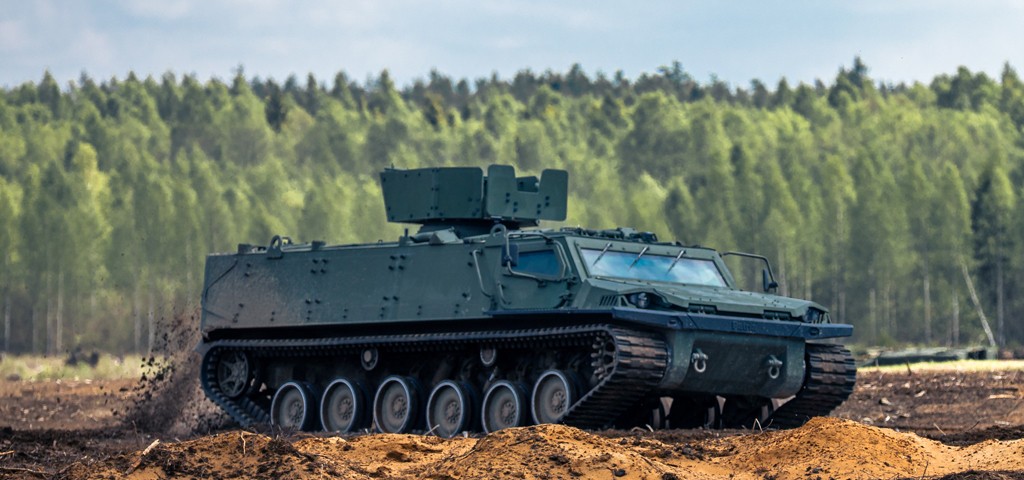
Finland and Sweden have placed the first orders for Patria’s TRACKX tracked armored personnel carrier (APC), Patria announced on September 30, 2026, moving the European Defence Fund-backed vehicle from development into procurement. Finland is acquiring vehicles with support arrangements and has signed a Letter of Intent with Patria covering potential future serial deliveries. Sweden is buying vehicles for testing and evaluation. Deliveries start in 2027.
On June 15, 2026, the Finnish Defence Forces (FDF) and the Swedish Defence Materiel Administration (FMV) signed the Implementation Arrangement for Common Arctic Mobility (IA CAM) at Eurosatory in Paris, and on July 7, Finland, Norway and Latvia signed a Statement of Intent on the vehicle at the NATO Summit in Ankara. The driver is terrain: the bogs, forests and deep snow of the High North, where wheeled vehicles lose mobility and aging M113 and MT-LB fleets need replacing.
Patria TRACKX Pre-Series Orders and the 2027 Delivery Timeline
Neither government has disclosed the number of vehicles or the contract values. FMV stated in June that the Swedish trial program covers five vehicles, to be evaluated by the Swedish Armed Forces; the September 30 announcement did not confirm a final Swedish quantity or specify the size of the Finnish order. Maj. Gen. Tero Ylitalo, Chief of the FDF Logistics Command, represented Finland at the signing, while Hans Fridén, head of FMV’s Vehicles Department, represented Sweden.
Once vehicles arrive, each country will run national field trials to assess suitability for operational use, with part of the test campaign expected to be conducted jointly. The Finnish Letter of Intent is the more consequential element: it gives Patria a defined path from pre-series to serial production if trials succeed, something the Swedish evaluation buy does not yet provide.
“The transition from development to procurements is an important milestone for Patria TRACKX,” said Jussi Järvinen, Executive Vice President of Patria’s Protected Mobility business area. He added that Patria is expanding production capacity to begin deliveries to other customer nations in 2027 as well. The Finnish Ministry of Defence has placed the start of serial production in the 2027 to 2028 window.
Ground Pressure, Hydropneumatics and Protection: Inside the TRACKX Design
TRACKX is a two-track, amphibious light APC in the 13 to 18-tonne class. The baseline version carries a driver, a commander and up to 10 dismounts in blast-attenuating seats. Manufacturer data gives an empty weight of 12 tonnes, a 3.5-tonne payload and a maximum combat weight of 15.5 tonnes. The hull is slightly over 7 meters long, under 3 meters wide and 2 meters high to the roof plate, with 55 cm of ground clearance.
Rubber tracks 56 cm wide hold maximum ground pressure to 32 kPa at combat weight, low for an armored vehicle of this mass. Each road wheel runs on independent, adjustable hydropneumatic suspension, using Swedish firm Kaller’s Hydrop H3 gas-hydraulic units, a layout that eliminates torsion bars and allows a nearly flat hull floor. A 269 kW (about 360 hp) engine delivers a road speed of 80 km/h and a range of 500 km. The vehicle swims at 4 km/h, climbs a 60 percent gradient, crosses a 2-meter gap and is rated for temperatures from minus 46 to plus 44 degrees Celsius.
Patria argues that two tracks can match the soft-ground performance of the articulated four-track carriers long used by Nordic armies while freeing a roomier, higher-visibility crew compartment. Protection is the trade-off: baseline ballistic and mine protection is rated at STANAG 4569 Level 1, sufficient against rifle-caliber small-arms fire and small antipersonnel blasts. The APC mounts a 12.7 mm machine gun, and Patria displayed a TRACKX fitted with its NEMO 120 mm turreted mortar at Eurosatory 2026, signaling potential fire-support variants.
From FAMOUS to a CAVS-Style Multinational Tracked Vehicle Program
TRACKX was developed under the Future Highly Mobile Augmented Armoured Systems (FAMOUS) program, co-funded by the European Defence Fund, and was unveiled at DSEI in London in September 2025 after trials on snow, mud, forest tracks and road networks. The procurement architecture now forming around it mirrors the Common Armoured Vehicle System (CAVS) program, under which Finland, Sweden, Latvia and other partners buy the Patria 6×6 through common requirements, coordinated purchasing and shared life-cycle support.
The IA CAM, signed by Lt. Gen. Jari Mikkonen, FDF Deputy Chief of Staff for Armaments and Logistics, and Brig. Gen. Jonas Lotsne, director of FMV’s Land Systems Department, allows the two countries to share data during the pre-series phase while preserving separate national decisions. FMV has said the goal is an identical configuration in both armies, with synergies in spare parts, training and test data. The Ankara Statement of Intent, signed for Finland by Defense Minister Antti Häkkänen, extends the framework to Norway and Latvia for information sharing, possible joint procurement and joint development. Helsinki says it is preparing a Finnish-led multinational program modeled on CAVS and has linked the effort to the EU’s Eastern Flank Watch initiative.
Analysis: The initial buys are evaluation-scale, but they mark a reinvestment in the light tracked class that most European armies let atrophy after the Cold War. Finland and Sweden already field wheeled Patria 6×6 carriers and heavy CV90 infantry fighting vehicles; TRACKX targets the gap between them, terrain too soft for wheels where a 30-tonne-plus IFV is excessive. If Finland, Sweden, Norway and Latvia converge on a single configuration, NATO’s northern and eastern flank gains a common over-terrain mobility layer with pooled logistics. The open question is survivability: Level 1 protection is thin against the drone and artillery threat observed in Ukraine, and protection growth will define how close to the front TRACKX can operate.
The next milestones are the 2027 deliveries and the start of national and joint field trials. Beyond that, three decisions will shape the program: whether Finland converts its Letter of Intent into a serial contract, whether Norway and Latvia move from intent to orders, and which mission variants beyond the APC the partner nations choose to fund.