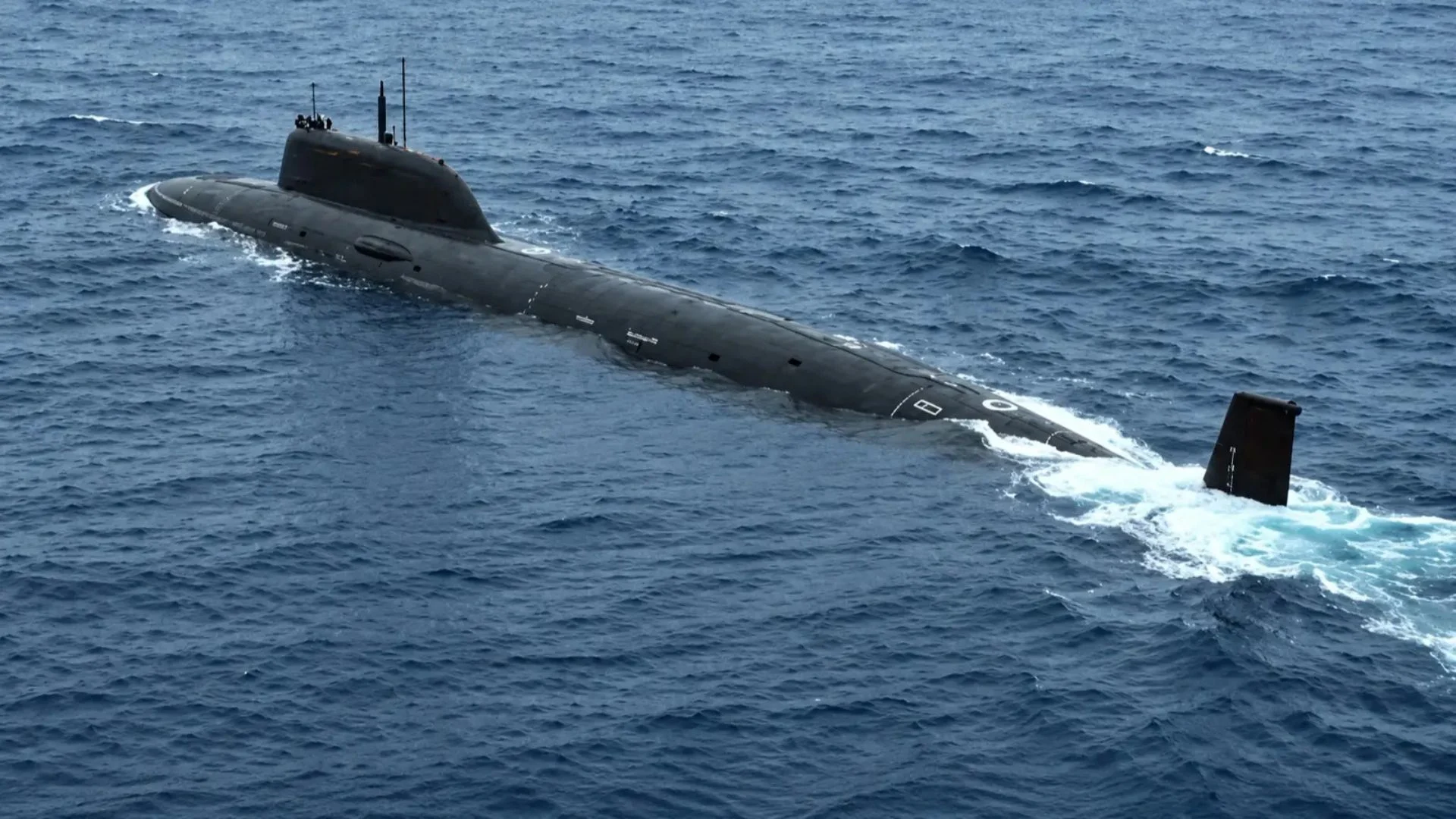
The Russian Pacific Fleet’s Project 885M Yasen-M nuclear-powered submarine Novosibirsk fired an Oniks supersonic anti-ship missile and a Kalibr cruise missile while submerged in the Pacific Ocean during scheduled exercises off Kamchatka, the Russian Defense Ministry reported on October 15, 2026. According to the ministry, the Oniks struck a maritime target simulating an enemy surface ship at a range of more than 170 kilometers, while the Kalibr hit its designated target at the Kura test range on the Kamchatka Peninsula after a flight of more than 1,200 kilometers.
The launches extend a pattern of long-range Yasen-M firings into the Kura range, after sister submarine Krasnoyarsk hit the same range with a Kalibr from more than 1,100 kilometers in April 2025. Novosibirsk, which the ministry describes as the first serial-production Project 885M boat, was laid down on July 26, 2013, launched on December 25, 2019, and commissioned on December 21, 2021, alongside the Project 955A Borei-A ballistic missile submarine Knyaz Oleg. Both boats reached Kamchatka from the Northern Fleet in late September 2022.
Inside the Novosibirsk Submarine’s Oniks and Kalibr Strike Package
Publicly available specifications indicate the Yasen-M measures 130 meters long and 13 meters in beam, displacing about 8,600 tons surfaced and 13,800 tons submerged, with a crew of 64. Open sources credit the design with a fourth-generation KTP-6 reactor, a working depth of 520 meters, 100 days of endurance, and a submerged speed reported at about 31 knots. Novosibirsk was built to an upgraded standard with a new electronic component base and Russian-made materials. Strike capacity sits in eight SM-346 vertical launch modules, each accepting four Oniks or five Kalibr missiles, for a theoretical maximum of 32 or 40 weapons.
The Oniks, designated 3M55 and known to NATO as the SS-N-26 Strobile, is a ramjet-powered anti-ship missile cruising at roughly Mach 2 to Mach 2.6 before a sea-skimming terminal run, with a 200 to 300 kilogram warhead depending on variant. Published ranges run from 120 kilometers on an all-low trajectory to 300 kilometers on a high-low profile, with up to 600 kilometers claimed for the domestic version. The 170-kilometer engagement sits at the shorter end of that envelope; the ministry did not specify the flight profile.
The Kalibr strike beyond 1,200 kilometers is consistent with the 3M14K land-attack variant, NATO designation SS-N-30A, a subsonic missile flying at about Mach 0.8 with a warhead of roughly 450 kilograms and an estimated range of 1,500 to 2,500 kilometers. The 3M54K anti-ship variant, estimated at up to about 660 kilometers, falls well short of that distance. The ministry did not name the variant. Firing both from a submerged hull illustrates the Yasen-M’s design logic: anti-surface warfare and land attack from one multipurpose platform that also hunts submarines.
Pacific Fleet Yasen-M Force Prepares for Zircon-Armed Perm
Novosibirsk and Krasnoyarsk are the Pacific Fleet’s two Yasen-M submarines, while Kazan and Arkhangelsk serve with the Northern Fleet alongside the Project 885 lead boat Severodvinsk. The next Pacific addition is Perm, launched at the Sevmash shipyard in Severodvinsk in March 2025. In late July 2026, Russian Navy Commander-in-Chief Admiral Alexander Moiseyev told President Vladimir Putin that Perm would be commissioned before year’s end as the first nuclear-powered submarine designed to carry the Zircon hypersonic missile. Russian officials claim speeds of up to Mach 9 for Zircon; range figures cited by officials and open sources vary, and none have been independently verified.
Novosibirsk is based at Vilyuchinsk on Kamchatka, the Pacific Fleet’s submarine base that also hosts its Project 955 and 955A ballistic missile submarines. The Kura range serves as the established impact area for Russian strategic missile tests, including Bulava launches from Borei-class submarines, and has become the recurring target area for the Pacific Fleet’s long-range Kalibr firings.
Production continues behind Perm. Sevmash launched Ulyanovsk on July 28, 2026, and laid down Murmansk, the ninth boat of the project, on June 17, 2026, while Voronezh and Vladivostok remain under construction. The class is intended to replace Project 971 Akula and Project 949A Oscar II submarines; the Pacific Fleet Oscar II boat Omsk received Oniks and Kalibr launch complexes during a 2015-2019 modernization. With Perm, the Pacific Fleet would field three Yasen-M boats able to load subsonic Kalibr, supersonic Oniks, and hypersonic Zircon into the same launch modules.
What the Novosibirsk Submarine Strikes Mean for North Pacific ASW
Analysis: The announced ranges sit well inside published envelopes, and Krasnoyarsk flew a comparable Kalibr profile 18 months ago. The more telling signal is repetition: the Pacific Fleet is exercising its Yasen-M boats in combined anti-surface and land-attack fires from submerged positions on a recurring basis, building crew proficiency before Perm arrives. Once Zircon enters the Pacific magazine, a single submarine could pair subsonic Kalibr with supersonic Oniks and hypersonic Zircon in one engagement, compressing defenders’ reaction time. For US and Japanese planners, that raises the demand on North Pacific anti-submarine warfare, from P-8A Poseidon patrols to attack submarine tasking. Depending on launch position, the Kalibr’s estimated land-attack envelope from the northwest Pacific covers US and allied facilities in Japan and the Aleutian Islands.
The next milestone is Perm’s commissioning and transfer to Kamchatka, followed by any first Zircon live fire from a Pacific-based Yasen-M. Key unknowns remain: the ministry released no data on the launch date, firing position, missile variants, or whether Novosibirsk used its vertical launch modules or torpedo tubes.