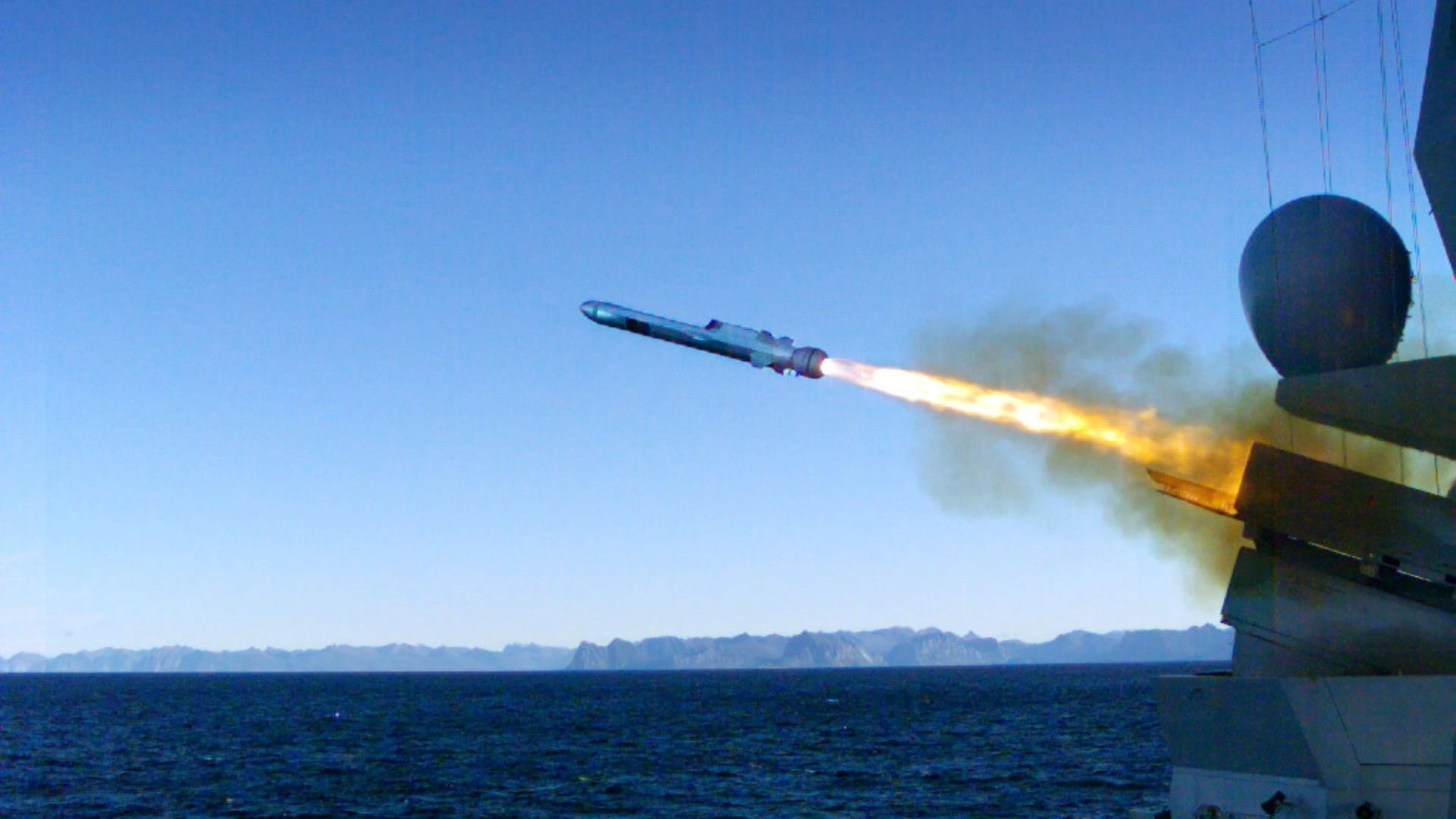
Kongsberg Defence & Aerospace has signed a contract worth about NOK 400 million, roughly $42 million, to deliver an undisclosed number of additional Naval Strike Missiles (NSM) to Denmark, the Norwegian company announced on October 19, 2026. The purchase is a government-to-government sale between the Norwegian Defence Materiel Agency (FMA) and the Danish Ministry of Defence Acquisition and Logistics Organisation (DALO), and Kongsberg says it will strengthen Denmark’s coastal defense.
The order follows two earlier NSM contracts. On March 6, 2025, Denmark committed NOK 2.1 billion, about $193 million at the time, to arm the Royal Danish Navy’s three Iver Huitfeldt-class frigates with NSM, replacing RGM-84 Harpoon missiles donated to Ukraine from spring 2022. On December 17, 2025, it signed for the NSM Coastal Defence System (NSM CDS) in a deal worth more than €100 million, restoring a land-based anti-ship capability Denmark had abandoned in 2003. That purchase made Denmark the fifth NATO operator of the coastal system, after Poland, the United States, Romania and Latvia.
Naval Strike Missile Order Follows Denmark’s 2025 Coastal Battery Buy
Kongsberg did not disclose the missile count, the delivery schedule, or which Danish launch platform the new rounds will equip. Steen Balslev, head of DALO’s maritime division, said the purchase builds on the existing agreement with Norway and Kongsberg and strengthens the navy’s missile capability; DALO added that the missiles can engage both ships and targets on land. The December 2025 battery contract likewise withheld the number of batteries and missiles. Danish procurement officials said at the time that first deliveries were expected during 2026; whether any battery has yet been handed over to the Royal Danish Navy, which is responsible for coastal defense, has not been publicly confirmed.
At NOK 400 million, the new contract is less than one-fifth of the 2025 frigate deal, which also covered shipboard equipment, training and logistics support. That points to a magazine top-up rather than a new capability. Kongsberg publishes no per-missile price, so the value cannot be converted into a reliable round count.
Both the frigate contract and the new order run through the FMA, with Denmark financing and Kongsberg delivering. Danish officials justified that route in 2025 on acquisition price, delivery time and allied interoperability. The coastal battery program was earmarked for funding from Denmark’s DKK 50 billion Acceleration Fund, set up in 2025.
Range, Seeker, and Warhead: How NSM Compares With the Harpoon
Kongsberg classifies the NSM as a fifth-generation anti-ship and land-attack missile. Publicly available specifications indicate a launch weight of 407 kg and a length of 3.96 m including the solid rocket booster, which pushes the missile clear of its canister before a turbojet sustainer takes over for high-subsonic cruise. Kongsberg’s current literature lists a range beyond 300 km; the figure long cited for the missile is more than 185 km, or 100 nautical miles, with actual reach depending on flight profile.
Midcourse navigation blends inertial, GPS and terrain-reference inputs, letting the missile route over and around landmasses before descending to sea-skimming altitude. Terminal homing relies on a passive imaging infrared seeker and an onboard target database for autonomous recognition by ship class, so the missile emits no radar energy for an adversary to detect. Open-source data credits the NSM with a titanium-cased blast-fragmentation warhead of roughly 120 kg, while Kongsberg cites a thrust-to-weight ratio above one, a low radar cross-section and high-g end-game maneuvers as its penetration features.
Those characteristics map onto the limitations of the missile NSM replaces. Open-source figures credit the Harpoon with a range of about 124 km and an active radar seeker that announces the weapon during its terminal run. Harpoon carries a heavier warhead, in the 220 kg class; NSM trades explosive mass for precision against a selected aimpoint. In the Danish straits, where warships transit alongside heavy commercial traffic, a seeker that can tell a hostile corvette from a bulk carrier is an operational requirement.
Korsør Basing Puts the Danish Straits Within NSM Range
Danish defense authorities announced in February 2026 that the first coastal missile batteries will be based at the naval station in Korsør, on the western coast of Zealand facing the Great Belt. All three Danish straits, the Great Belt, the Little Belt and the Øresund, lie within about 120 km of the garrison, inside the missile’s conservative published range, as do the Fehmarn Belt and Kiel Bay.
Because the launchers are truck-mounted, Korsør functions as a home base rather than a fixed firing position. Batteries can disperse along Denmark’s long coastline, complicating an adversary’s targeting while keeping the main sea lanes covered. Kongsberg built the system’s fire distribution center to accept third-party radars and external sensors, allowing the batteries to draw targeting data from Denmark’s wider joint fires network.
The Danish defense ministry has framed control of Danish waters, the access routes to the Baltic Sea, as a core task of the armed forces. Those routes form the principal maritime link between the Baltic and the North Sea, and Russia’s Baltic Fleet must transit them to reach the Atlantic. Fielding the same missile at sea and ashore gives the Royal Danish Navy a single munition, training pipeline and logistics chain for both layers of its anti-surface defense.
Analysis: The order matters chiefly as a signal of stockpile planning. Denmark is deepening the magazine behind its new launchers, a lesson sharpened after it donated Harpoon missiles to Ukraine in 2022 and contracted a replacement only in 2025. Standardizing on NSM also anchors Denmark in a regional user base that includes Norway, Germany, Poland, Latvia, the Netherlands, Belgium and the United Kingdom, easing allied resupply in a contested Baltic. For Kongsberg, small repeat buys compete for production capacity with larger commitments, including launchers for the US Marine Corps’ Navy/Marine Expeditionary Ship Interdiction System (NMESIS).
Key unknowns remain the size of the new lot, its delivery timeline, and whether the first NSM CDS battery has reached Korsør. Frigate deliveries under the 2025 contract are scheduled to run through 2030, and the Royal Danish Navy has not confirmed whether NSM will extend to other vessels as Harpoon leaves service. The FMA channel gives Copenhagen a ready mechanism for further incremental orders as it sizes coastal stocks against wartime expenditure rates.