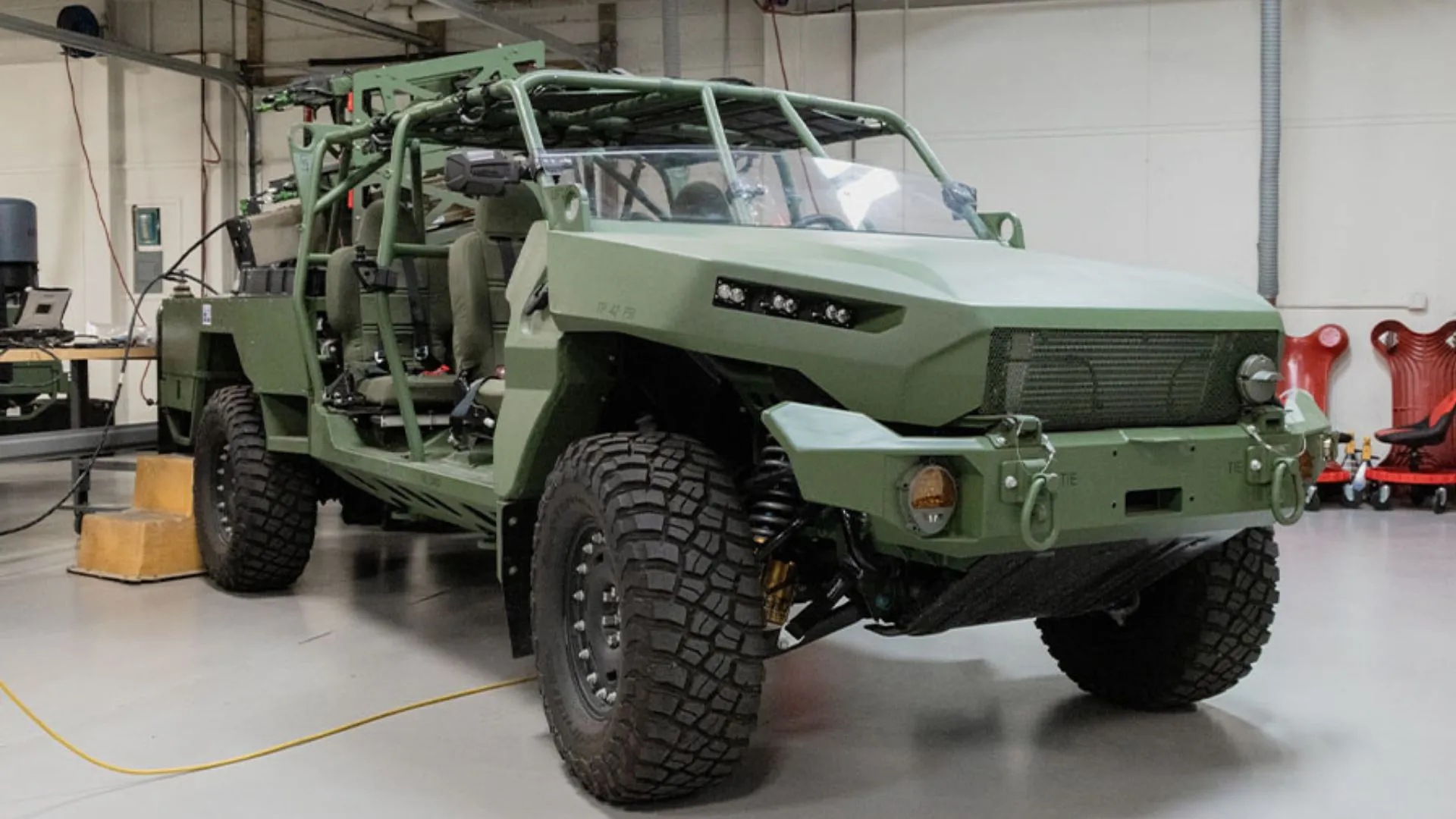
US Army infantry soldiers fired the Spike Non-Line-of-Sight (NLOS) missile from the utility variant of the Infantry Squad Vehicle (ISV-U) during a three-day live-fire demonstration at Dugway Proving Ground, Utah, Lockheed Martin announced on October 20, 2026. The series logged 17 precision engagements against simulated operational targets and marked the first Spike NLOS launch from the ISV-U, advancing the Army’s Mobile-Long Range Precision Strike Missile (M-LRPSM) directed requirement.
The Army wants M-LRPSM to give light and mobile formations an organic way to defeat armored vehicles, troops, field fortifications and urban structures at ranges of at least 25 kilometers, per the service’s requirement. The Army selected Spike NLOS for Phase 1 in August 2025; one week after award, Lockheed Martin fired three ground-launched rounds at Dugway, hitting one unobstructed and two obstructed targets. In October 2025, the Army advanced the system to Phase 2 under a $30 million contract covering hardware for safety confirmation testing and integration on the ISV-U.
How Spike NLOS Performed in 17 Engagements From the ISV-U
Army infantry soldiers, not contractor crews, fired the majority of the 17 shots, all launched from the ISV-U at varied combat ranges, per Lockheed Martin. The company has not disclosed engagement distances, warhead types, hit count, test dates or launcher capacity. Those gaps matter: the release establishes safe mobile employment by soldiers, not demonstrated performance against the 25-kilometer threshold.
Publicly available specifications indicate the all-up round weighs up to 165 pounds, roughly 75 kilograms, and engages targets between 1 and 32 kilometers in its baseline ground-launched configuration. Guidance pairs an electro-optical/imaging infrared seeker with a wireless datalink that streams real-time video to the operator, who keeps man-in-the-loop control throughout flight and can retarget or abort. The missile supports lock-on-before-launch and lock-on-after-launch profiles and carries one of three warheads: fragmentation against unarmored targets, high-explosive anti-tank (HEAT) for armor, or penetrating blast-fragmentation (PBF) for bunkers and structures. Rafael Advanced Defense Systems, which designed the missile, markets a newer generation with a claimed range of up to 50 kilometers when launched from a helicopter, while ground launch remains at 32 kilometers; which configuration underpins the M-LRPSM prototype has not been disclosed.
That datalink is what makes the weapon relevant to infantry: a small crew can engage a target masked by terrain, confirm identification through seeker video and observe impact, tasks that otherwise require a separate drone or forward observer.
The carrier is the GM Defense ISV-U, a five-seat derivative of the M1301 Infantry Squad Vehicle built on Chevrolet Colorado ZR2 architecture, with a 2.8-liter Duramax turbodiesel and a rear cargo bed adaptable to logistics, fires and other mission payloads. The vehicle is light and unarmored, trading protection for the speed and deployability the Army wants in its Mobile Brigade Combat Teams (MBCTs).
M-LRPSM Path to Phase 3 Production for Mobile Brigade Combat Teams
Lockheed Martin said further validation testing will run over the next year before Phase 3, when initial operational production begins and the Army receives final system prototypes. Neither the company nor the Army has published a Phase 3 contract value or award date.
Soldiers from the Army’s Transforming in Contact (TiC) units, the formations converting Infantry Brigade Combat Teams into MBCTs, were among the first to handle the missile and will remain involved through soldier touchpoints during validation. According to Lockheed Martin, the troops completed system training and conducted live fire within the same week. That feedback feeds directly into the final M-LRPSM requirement, which remains open.
“This demonstration represents a critical milestone for Spike NLOS, showing that our infantry partners can confidently employ a long-range precision missile,” said Casey Walsh, program director at Lockheed Martin Multi-Domain Missile Systems.
The vehicle side is scaling in parallel. GM Defense planned to begin ISV-U deliveries as early as May 2026, with more than 1,200 slated for this year, and announced in October 2026 that the Army had expanded its planned ISV buy from 649 to nearly 12,000 vehicles. A missile kit validated on that chassis gains access to a large and growing fleet.
Lockheed Martin teams with Rafael to offer the missile to US customers. Spike NLOS already serves as the Army’s interim Long Range Precision Munition on the AH-64E Apache, a role it was selected for in 2020. A common all-up round across ground and aviation launchers would simplify munitions logistics for divisions fielding both.
Analysis: The Dugway series validates the least visible and most consequential part of M-LRPSM: whether infantry soldiers can operate a 32-kilometer, man-in-the-loop missile from an unarmored light truck after a week of training. If that holds through validation, an MBCT gains an organic beyond-line-of-sight strike option that does not depend on aviation or a higher-echelon fires request. The open question is survivability. Man-in-the-loop guidance ties the crew to a radio-frequency datalink for the full time of flight, an exposure the drone- and electronic warfare-heavy fight in Ukraine has made central to Army planning. The final requirement will need to address emission control and shoot-and-scoot procedures as much as range.
Next milestones include completion of validation testing over the next 12 months, the final M-LRPSM requirement and a Phase 3 decision that would start initial operational production. The Army has not publicly confirmed a final M-LRPSM selection. Key unknowns remain the engagement ranges and hit rate achieved at Dugway, the ISV-U launcher’s capacity, Phase 3 funding and whether other light vehicles will carry the round.