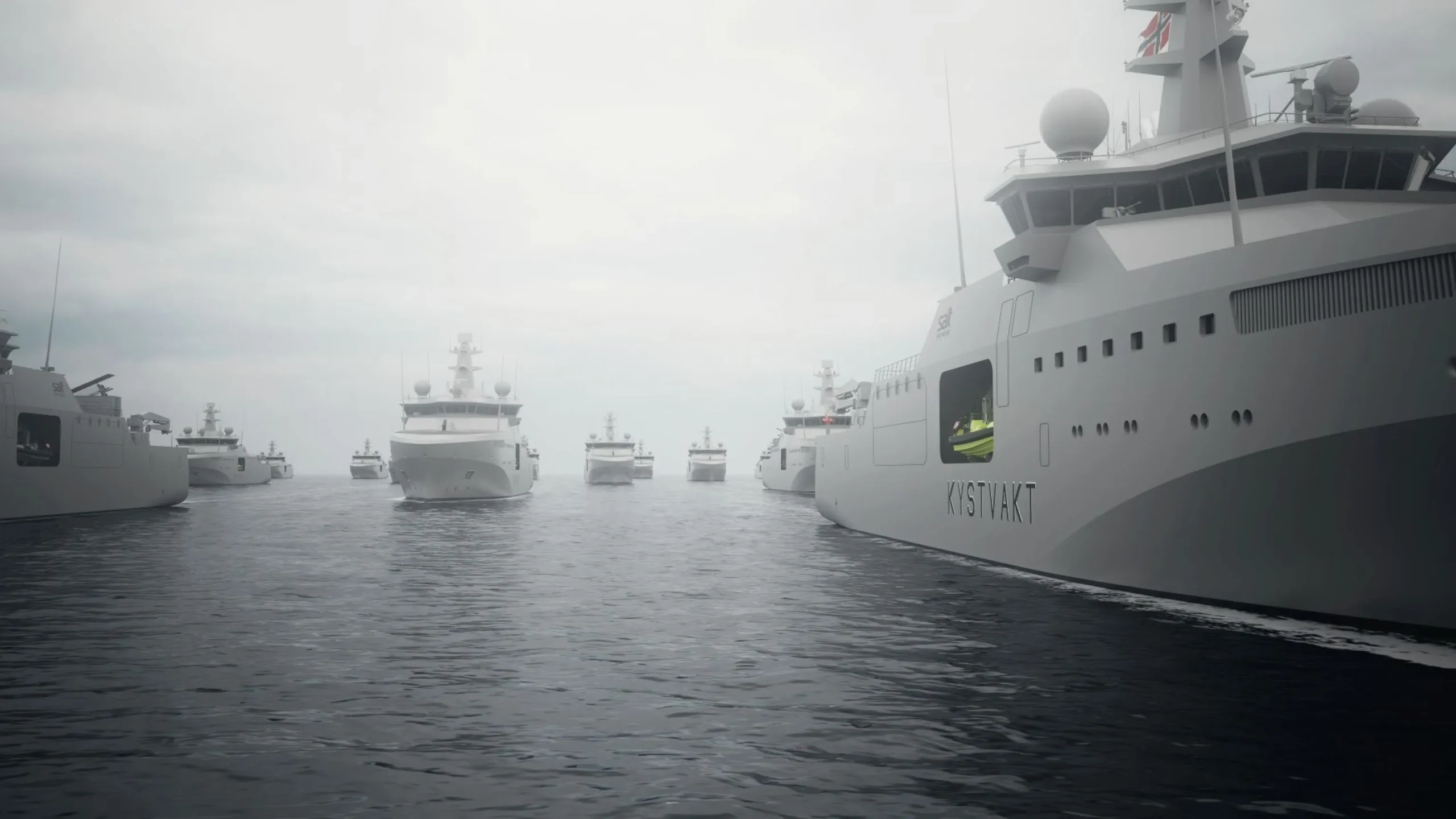
The Norwegian Defence Materiel Agency (Forsvarsmateriell, FMA) on October 20, 2026, set out how it intends to buy up to 20 ocean-going standardized vessels for Norway, the United Kingdom and Lithuania. In a market signaling notice for program P1118, the agency said it will split the shipbuilding competition into two parallel contracts and, as a main principle, will not award both to the same bidder.
P1118 is a pillar of Norway’s long-term defense plan and the 2024 Fleet Plan, which call for up to 28 standardized vessels in a large ocean-going variant and a smaller coastal variant to replace seven existing vessel classes across the Royal Norwegian Navy and the Norwegian Coast Guard. FMA awarded the concept design to a consortium of Salt Ship Design and Kongsberg Defence & Aerospace (KDA) on March 30, 2026. Citing uneven maturity between the two concepts, the agency will now procure the ocean-going variant first. State Secretary Marte Gerhardsen of the Ministry of Defence said the target remains a construction contract for the large vessels in 2027 and a first delivery in 2030.
Two Contracts, One Rule: How the Standardized Vessels Competition Works
The market signaling distributes the ocean-going buy as follows:
- Norway: up to six vessels for the Coast Guard and up to four for the Navy
- United Kingdom: up to six vessels
- Lithuania: up to four vessels
British and Lithuanian hulls will be based on the navy variant. FMA will announce the competition as a single procurement but run it as two parallel tracks: one contract for up to 14 navy-variant vessels and one for up to six Coast Guard vessels. Shipyards may prequalify for either or both, but the agency’s stated main principle is that a single bidder should not win both contracts.
FMA Director Gro Jære described P1118 as one of the largest and most important maritime acquisitions the agency will run in the coming years. She said dividing the work aims to broaden industry participation, reduce program risk and secure delivery capacity, while cooperation with London and Vilnius opens opportunities for Norwegian maritime industry. Gerhardsen framed the program as an export project for Norwegian yards, with the large vessels prioritized to meet British and Lithuanian requirements.
The notice is indicative and subject to change. FMA will communicate updates through the pre-qualification questionnaire (PQQ) and the later invitation to tender (ITT).
Salt and Kongsberg Reference Design Sets the Ocean-Going Baseline
Bidders will compete on a common technical basis. Under the March 30 contract, Salt and KDA are developing a requirements specification and reference design due by the end of 2026, which FMA intends to make available to all bidders. The agency has asked for vessels built as far as possible to civilian standards with commercially available technology, using modular mission systems and able to operate alongside uncrewed systems.
The Norwegian government has defined the navy variant’s mission set as maritime surveillance, minelaying, mine clearance, protection of other vessels and a limited anti-submarine warfare capability. The Coast Guard variant will be tailored to that service’s tasks and able to take on some navy mission modules when required. Earlier design competition documents reportedly set a maximum speed of 18 to 20 knots for both variants. FMA has not published length, displacement, armament, sensor fit or propulsion architecture for the ocean-going hull, and the concept illustrations released so far do not represent a final design.
The coastal variant, which accounts for the remaining 18 of Norway’s 28 planned hulls, has been deferred while FMA matures its concept. Gerhardsen said the ministry will take the time needed to develop the smaller vessels further.
Analysis: The allocation turns P1118 from a domestic fleet renewal into an allied production line. Ten of the 14 navy-variant hulls would go to the United Kingdom and Lithuania, making foreign demand the main driver of the larger contract. The Norwegian government has tied British deliveries to the strategic agreement linked to its frigate procurement, under which Oslo selected the UK’s Type 26 design for at least five new frigates, while Lithuania signed a memorandum of understanding on July 8, 2026, covering four vessels and targeting at least 30 percent of its project value in Lithuanian industry. The rule against a single winner signals that FMA treats a second military-capable yard as a supply-security asset, even at some cost in economies of scale.
The PQQ comes next, though FMA has not given a date; earlier planning placed the shipbuilding competition between fall 2026 and spring 2027. Key unknowns remain the program budget, the specific British requirement the six hulls will fill, how Lithuania’s industrial share will fit inside a Norwegian-run contract, and whether the October 2025 decision to hold a national construction competition still governs the allied hulls. The coastal variant’s procurement timeline is also open.