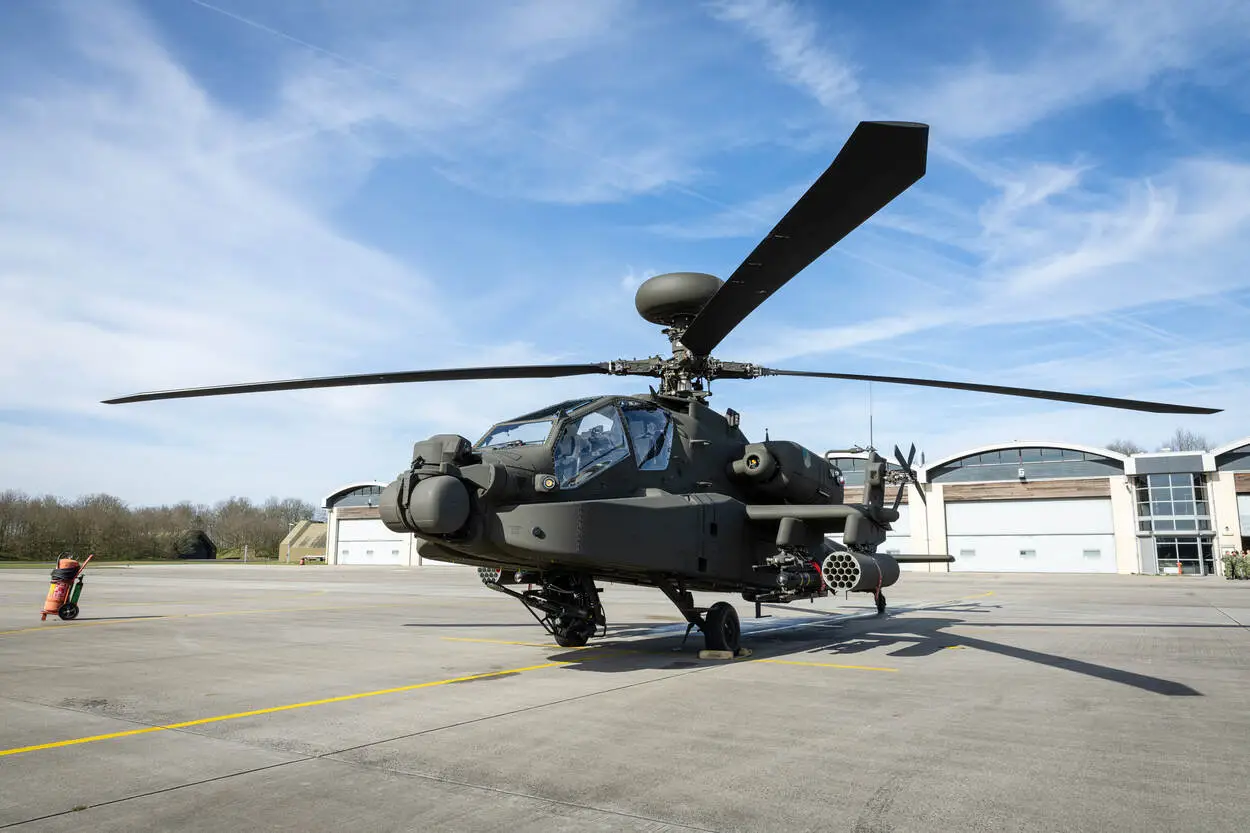
The U.S. State Department on October 19, 2026, approved a possible Foreign Military Sale to the Netherlands of 16 OT-228/U Common Infrared Countermeasure (CIRCM) systems and 38 AN/APR-39E(V)2 radar warning receivers (RWR), with an estimated total value of $294 million. Northrop Grumman, through its Rolling Meadows, Illinois, site, is the principal contractor under Transmittal 26-120, which now enters congressional review.
The approval opens a U.S. government channel for two pillars of the Dutch Improvement of Helicopter Self-Protection Systems project, announced to parliament on May 21, 2024, by then-State Secretary for Defence Christophe van der Maat. The project covers the NH90, AH-64 Apache, and CH-47 Chinook fleets and responds to increasingly capable infrared- and radar-guided air defenses, a threat sharpened by helicopter losses to short-range air defenses in Ukraine. The 2025 Defence Projects Overview places it in the €250 million to €1 billion budget band and lists a directed infrared countermeasure (DIRCM) and an improved digital RWR for the Apache among its deliverables.
Netherlands CIRCM Request Extends a Two-Track Helicopter Survivability Plan
The notification does not assign the equipment to specific aircraft. Dutch planning documents, however, tie a U.S.-sourced laser jammer to the Apache, and The Hague said in 2024 it was examining a U.S. government purchase for that requirement. The Royal Netherlands Air Force is taking delivery of 28 AH-64E Version 6 Apache Guardians remanufactured from its AH-64D fleet, based at Gilze-Rijen and Fort Cavazos, Texas. It received the penultimate pair in October 2026, and the final aircraft are due in 2027.
The Chinook fleet is moving along a separate contractual path. A report delivered to Congress on October 1, 2025, added 10 OT-228/U CIRCM systems to the Netherlands’ CH-47F case first notified in 2015, for $85 million in new items, lifting that case’s estimated value to $1.56 billion. The same case previously carried eight AN/ALQ-212 Advanced Threat Infrared Countermeasures (ATIRCM) systems, the heavier predecessor CIRCM replaces in U.S. Army service, alongside AN/AAR-57 Common Missile Warning System (CMWS) sensors and earlier APR-39 receivers.
Taken together, the two notifications cover 26 CIRCM systems against a combined 48 Apaches and Chinooks, while the 38 receivers exceed the Apache fleet alone. Those figures are consistent with spares, training sets, or a pooled partial-fit approach, but no allocation has been published. The release also contains an inconsistency: its opening sentence describes the purchase as “Counter-Unmanned Aerial Systems Platforms,” yet every itemized article is aircraft survivability equipment.
OT-228/U CIRCM Laser Architecture and Near-Spherical Missile Coverage
CIRCM is the U.S. Army program of record for directed infrared countermeasures on rotary-wing, tiltrotor, and small fixed-wing aircraft. Each OT-228/U system comprises two pointer/trackers, two lasers, and one system processor unit. The jammer takes an angular bearing hand-off from the missile warning system, either CMWS or the Limited Interim Missile Warning System (LIMWS), slews a pointer/tracker onto the inbound missile, and degrades its seeker with modulated laser energy until the round misses. Paired turrets provide near-spherical coverage of the host airframe.
The laser source is a solid-state quantum cascade laser from Leonardo DRS, which reported delivering its 1,000th Solaris unit for the program in January 2024. Semiconductor lasers of this type are smaller and more reliable than the optical parametric oscillators used in earlier jammers. Weight drove the requirement: the Pentagon capped the two-turret B-kit at 85 pounds, and Northrop Grumman now puts the system at about 50 pounds. ATIRCM’s mass confined it to a limited set of airframes; CIRCM fits an attack helicopter flying a full weapons load, and its laser offers effectively unlimited engagements where flare magazines run dry.
Program maturity lowers the risk. CIRCM entered full-rate production on April 13, 2021, and in September 2026 the Army awarded Northrop Grumman a $4.84 billion production contract running to September 30, 2035, which also supports foreign buyers. More than 750 shipsets have been delivered, logging over 75,000 operational flight hours on AH-64, CH-47, and UH-60 helicopters. Germany has ordered 47 systems for its CH-47F Block II fleet and the United Kingdom 17 for its new H-47 Chinooks.
AN/APR-39E(V)2 Adds Digital Radar Warning and Millimeter-Wave Detection
The AN/APR-39E(V)2, developed as the Army’s Modernized Radar Warning Receiver, is the fully digital successor to the partially digital AN/APR-39D(V)2 and the legacy AN/APR-39C(V)1, the latter already supplied to Dutch Chinooks. The Army placed it in initial production under a five-year contract in March 2024.
Built on Northrop Grumman’s ultra-wideband architecture and digital millimeter-wave antennas shared with other electronic warfare programs, the receiver provides 360-degree coverage and automatically identifies emitter type, bearing, and lethality. Clutter reduction and threat geolocation support both evasion and targeting. Millimeter-wave coverage matters because modern fire-control radars, including the Apache’s own AN/APG-78 Longbow, operate in that band, which legacy analog receivers were not built to cover.
The system also serves as the electronic warfare management system, fusing radar warning, missile warning, and countermeasure cues into a single cockpit picture with digital voice alerts. That suite-controller role explains why the two items are bought together.
Analysis: The sale moves Dutch rotary-wing survivability onto the same hardware baseline the U.S. Army fields on its AH-64Es and CH-47Fs, rather than a European or Israeli alternative. For a force that trains its Apache crews in Texas and deploys inside NATO formations, that commonality brings shared training, a sustainment chain anchored to a funded U.S. production line, and upgrades driven by the largest CIRCM operator. The cost is dependence on U.S. release decisions for software and mission data. The Hague is dividing the problem by threat: U.S. equipment for overland Apache and Chinook missions facing infrared-guided man-portable air defense systems (MANPADS), and a separately sourced modular system for the NH90 in its radar-dominated littoral environment.
Under the Arms Export Control Act, Congress has 15 days to review sales to NATO members. The next steps are a Letter of Offer and Acceptance, any offset negotiations with Northrop Grumman, and integration and certification on Dutch airframes. Delivery schedules, the platform split, and whether the State Department amends the counter-UAS wording remain unannounced, as does the scope of Dutch industrial participation.