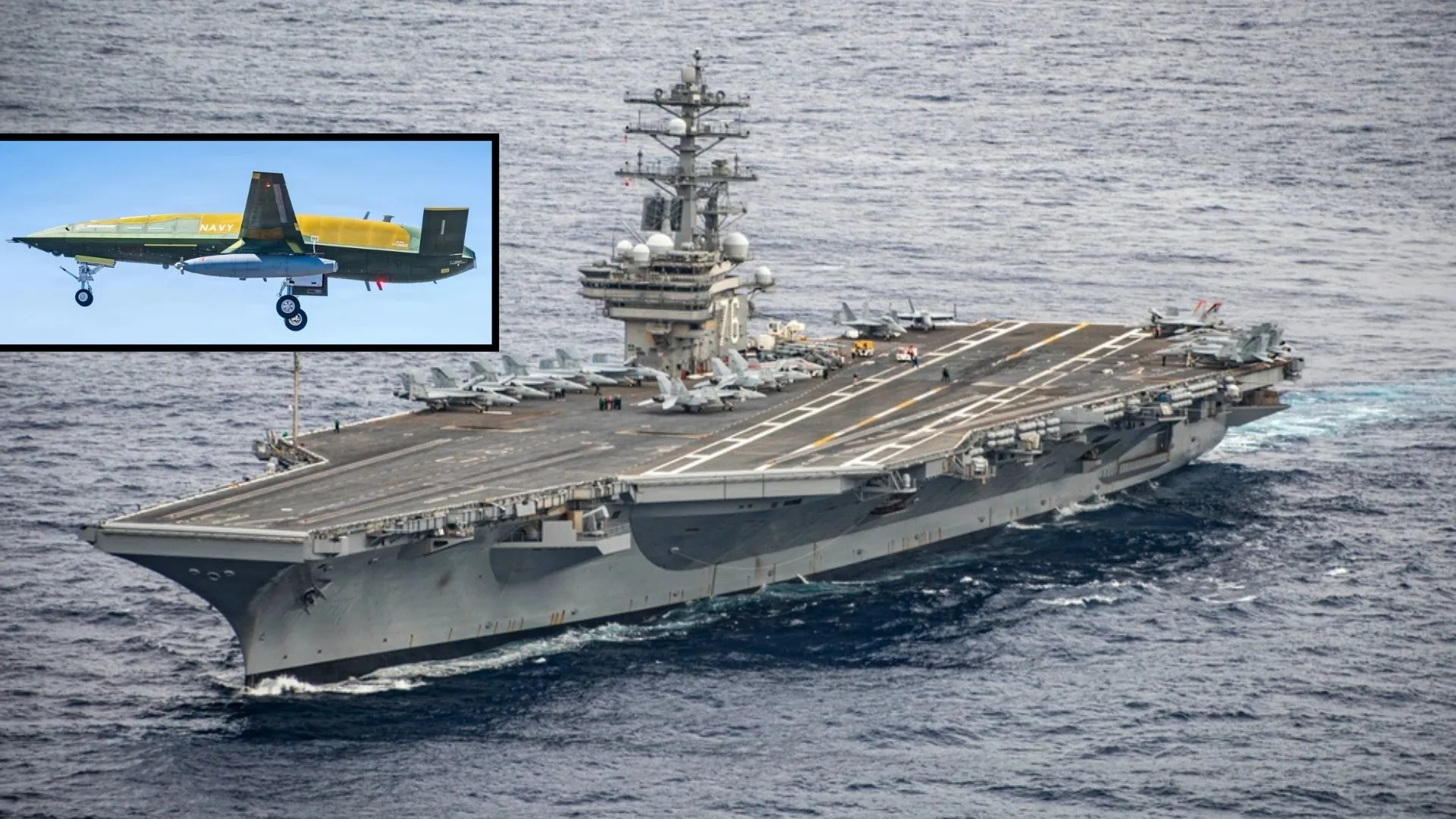
The U.S. Navy has, for the first time, commanded an MQ-25A Stingray unmanned aerial refueler from an aircraft carrier underway, linking the Nimitz-class carrier USS Ronald Reagan (CVN 76) in the Pacific Ocean with a test aircraft at Boeing’s facility in Mascoutah, Illinois, more than 2,100 miles away. The Navy’s Portfolio Acquisition Executive Aviation at Patuxent River, Maryland, announced the event on October 19, 2026.
During a Preliminary Sea Trial, the carrier’s Unmanned Air Warfare Center (UAWC) used its MD-5C Ground Control Station (GCS) to establish a beyond-line-of-sight (BLOS) connection with the aircraft over a Proliferated Low Earth Orbit (pLEO) satellite network. The Navy did not disclose the test date, the pLEO provider, or whether the aircraft was airborne.
The first Engineering Development Model (EDM) MQ-25A flew on April 25, 2026, after slipping from a 2025 target, and the program reached Milestone C in May 2026, clearing it for low-rate initial production (LRIP). Initial operational capability (IOC) has slipped repeatedly and is now projected for February 2029, according to Navy budget documents. Fielding requires both the Boeing-built air vehicle and the Unmanned Carrier Aviation Mission Control System (UMCS) that commands it from the ship.
How USS Ronald Reagan’s MD-5C Station Controls the MQ-25A Stingray
The MD-5C GCS is the shipboard element of UMCS. According to the Navy, it integrates the service’s Command, Control, Communications, Computers and Intelligence (C4I) network with Lockheed Martin’s MDCX hardware and software and other government-produced equipment. From the UAWC, Air Vehicle Pilots (AVPs) control the MQ-25A. The Navy intends the same station to control its future unmanned carrier aircraft.
The pLEO link is the operationally relevant element. Low Earth orbit constellations offer lower latency and higher throughput than legacy geostationary satellite communications, both critical when controlling an aircraft beyond the carrier’s radio horizon. On the evidence released, the test validated the BLOS command path; it did not demonstrate an aerial refueling mission or shipboard launch and recovery.
“We have redefined naval power projection,” said Capt. Daniel Fucito, program manager of the Unmanned Carrier Aviation Program Office (PMA-268). “This first-ever underway connection between a carrier-based UAWC and an MQ-25A aircraft proves that the Carrier Air Wing of tomorrow is a reality today.”
The event was one of a series of build-up exercises to validate procedures, networks and interfaces. PMA-268’s UMCS team had already run pier-side and at-sea tests with the MQ-25 Integrated Test Team, which includes the Navy, Boeing and Lockheed Martin. Reagan’s UAWC follows two earlier installations: a test center aboard USS George H.W. Bush (CVN 77) in August 2024, and USS Theodore Roosevelt (CVN 71), which became the first fully operational, deployable MQ-25-capable carrier in March 2026, according to Pentagon acquisition reporting.
Organic Tanking for the Carrier Air Wing: Payload and Program Status
According to the Congressional Research Service (CRS), the MQ-25A is powered by a Rolls-Royce AE 3007N turbofan and is required to deliver at least 14,000 pounds of fuel at 500 nautical miles from the carrier. The T1 demonstrator refueled an F/A-18 Super Hornet, an E-2D Advanced Hawkeye and an F-35C Lightning II in 2021. The Navy also plans to use the aircraft for intelligence, surveillance and reconnaissance (ISR).
The operational rationale is sortie economy. F/A-18E/F Super Hornets configured as buddy tankers currently fly recovery and mission tanking, consuming airframe hours that would otherwise go to strike. The Navy states the Stingray will provide organic refueling that frees more F/A-18E/F aircraft for strike missions and extends the air wing’s reach. “The MQ-25A Stingray’s carrier-based refueling capabilities enable F/A-18 Super Hornets to fly farther and longer,” said Acting Secretary of the Navy Hung Cao.
The Navy plans to acquire 76 MQ-25s. Its fiscal 2027 budget request seeks $1.75 billion for three LRIP aircraft, long-lead materials for a five-aircraft Lot 3, and UMCS control stations, networks and ship installations.
Analysis: The milestone is architectural more than aeronautical. By routing Stingray command and control through a pLEO constellation and the fleet C4I network, the Navy is building unmanned carrier aviation around a networked control layer designed to scale beyond a single aircraft. That design also concentrates risk. A tanker sustaining a strike package at range would depend on space-based links that the People’s Liberation Army is investing to jam, spoof or deny. The release provides no data on link latency, redundancy or performance under electronic attack, the parameters that will determine whether shipboard control holds in a Western Pacific fight.
The harder tests remain. The EDM aircraft has yet to demonstrate launch and recovery aboard a carrier, and the Navy has not published a date for that event. Testing is set to move to Naval Air Station Patuxent River, Maryland, for carrier qualifications, ahead of IOC in February 2029.