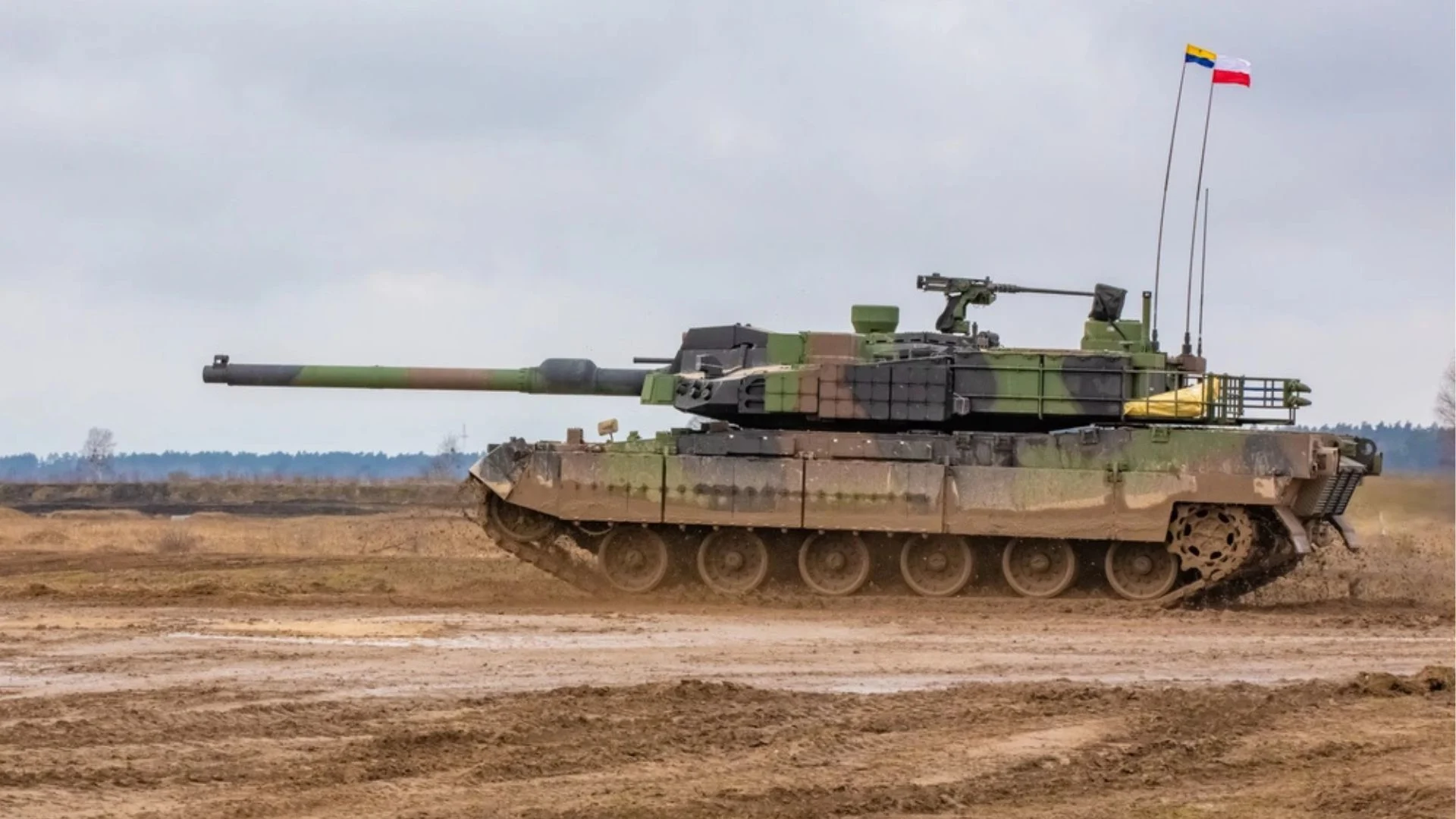
Norway’s Kongsberg Gruppen has signed a contract valued at about NOK 700 million, roughly $75 million, with South Korea’s Hyundai Rotem to supply Protector RS4 remote weapon stations (RWS) for the K2 vehicle family ordered by the Polish Armed Forces, the company announced on October 22, 2026. The stations will equip three K2 variants: the main battle tank (MBT), the armored recovery vehicle (ARV) and the combat engineering vehicle (CEV). First deliveries for vehicle integration begin in spring 2027.
The order flows from Poland’s second executive contract for the K2 Black Panther, a $6.5 billion agreement signed with Hyundai Rotem in Gliwice on August 1, 2025. It covers 180 tanks, 116 in the K2GF configuration for delivery in 2026 and 2027 and 64 in the Polish-specific K2PL standard for 2028 through 2030, plus 81 K2-based support vehicles: 31 ARVs, 25 CEVs and 25 armored vehicle-launched bridges, due between 2029 and 2031. Both executive contracts fall under the July 2022 framework agreement for up to 1,000 K2-family tanks.
How the Protector RS4 Fits the K2PL Counter-Drone Architecture
Kongsberg did not specify which tank configuration will receive the stations, but Polish reporting ties the MBT systems to the K2PL. The distinction matters. The K2GF tanks fielded so far, primarily with the 16th Mechanized Division, carry a K6 12.7 mm heavy machine gun but no remote weapon station, which Hyundai Rotem lists among the additions for the K2PL, making the RS4 one of the clearest physical differences between the two standards.
Hyundai Rotem has described the K2PL’s counter-unmanned aircraft system (C-UAS) protection as a two-layer design. A soft-kill jammer disrupts drone control links and GPS signals, while a 12.7 mm machine gun on the remote weapon station provides the hard-kill layer. Rafael and Hyundai Rotem agreed at MSPO 2025 to integrate Rafael’s Trophy hard-kill active protection system on the K2PL, and Hyundai Rotem cites reinforced armor for the new standard. In that stack, the RS4 is the final kinetic layer against first-person-view (FPV) drones and loitering munitions that survive jamming, and it lets the three-person crew engage infantry and light vehicles without anyone exposed above the hatch line. Combat in Ukraine has shown how effectively top-attack drones exploit thin roof armor and crew members working outside the turret.
Extending the RS4 to the ARV and CEV applies the same logic to vehicles that operate in the contact zone yet spend long periods static. Recovery crews hooking up immobilized tanks and engineers clearing obstacles present predictable targets for drone operators. The K2 recovery variant is being developed with German firm FFG, which supplies the specialist recovery equipment. The 25 bridge layers do not appear in the Kongsberg contract, and their secondary armament has not been disclosed.
RS4 Sensors, Stabilization and Commonality With Polish Abrams Tanks
The RS4 is the core product of Kongsberg’s Protector family, which the company says has passed 25,000 systems delivered to more than 31 nations. Kongsberg product data lists a weight from 195 kg without weapon and ammunition and from 295 kg with an M2 and 400 rounds of 12.7 mm ammunition, with a height of 830 mm, a width of 890 mm, a length of 962 mm and 360-degree traverse at up to 90 degrees per second.
The station uses a fully stabilized 2+2-axis detached line-of-sight architecture: the sensor head tracks the target independently of the weapon and its ballistic solution, preserving accuracy when firing on the move. The modular sensor package combines a day camera, a thermal imager and a laser rangefinder. Integrated weapons include 12.7 mm machine guns such as the Browning M2 and the Polish-made WKM-B, along with 40 mm grenade launchers, coaxial weapon kits and anti-tank guided missiles. Kongsberg’s Collaborative Fire Control software enables two-way slew-to-cue with adjacent sensors and weapons. Neither company has disclosed the number of stations, the selected machine gun or any C-UAS software fit for the Polish vehicles. The contract also includes an Integrated Product Support (IPS) package covering initial spares and training.
The design also underpins the US Army’s Common Remotely Operated Weapon Station (CROWS): Kongsberg delivered the RS4 to the CROWS II program and also builds a CROWS Low-Profile (CROWS-LP) configuration. Poland’s M1A2 SEPv3 tanks carry the M153A1E1 CROWS-LP. Poland’s two newest tank fleets will therefore field weapon stations from the same product family, although CROWS is procured through US Foreign Military Sales (FMS) while the RS4 order runs through a commercial subcontract.
Analysis: Small against the $6.5 billion K2 program, the contract clarifies two trends. First, a stabilized remote weapon station is becoming baseline equipment on a main battle tank, because it provides a kinetic answer to small drones that jamming fails to stop. Second, it shows where Polonization stops. Hyundai Rotem will assemble 61 K2PLs at Bumar-Łabędy and develop the support variants with Polish and German partners, yet the weapon station comes from Norway although Polish firms such as ZMT build RWS designs. Warsaw is trading domestic workshare on this subsystem for a mature, NATO-wide sustainment base and family commonality with its Abrams fleet.
Hyundai Rotem is building the first three K2PL tanks in South Korea before production moves to Bumar-Łabędy in Gliwice. Unknowns include the unit count, the weapon fit and whether an upgrade of Poland’s 296 K2GF tanks toward the PL standard, which Hyundai Rotem has described as possible, will generate follow-on RS4 orders. Seoul’s own K2 upgrade, approved on August 11, 2026 at about $2.4 billion for 2028 through 2046, also calls for a remote weapon station; no supplier has been named.