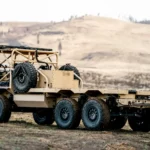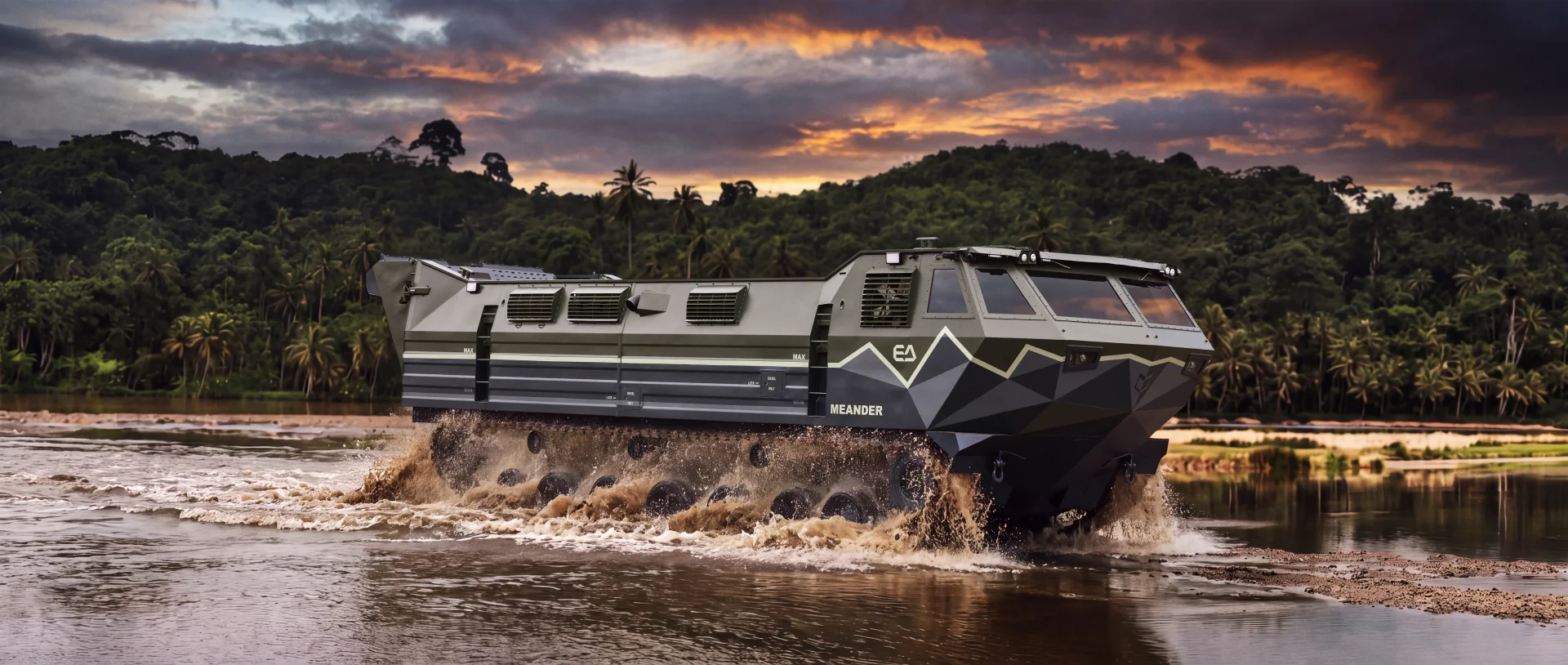
Czech defense group CSG unveiled the Meander tracked amphibious vehicle on October 21, 2026, at the Future Forces Forum exhibition in Prague, showing the first prototype in its basic transport configuration. Developed by CSG subsidiary Excalibur Army and New Space Technologies (NST), a member of the Krill Business Partners (KBP) group, the 33-tonne vehicle carries a 13-tonne payload across rivers, swamps and wetlands without bridging support.
Excalibur Army and NST formalized their cooperation through a memorandum signed at Eurosatory 2026 in Paris in June, and the prototype appeared roughly four months later. Meander derives from KALAN, an amphibious tracked vehicle NST developed with the Fire Rescue Service of the Czech Republic, which Czech firefighters are currently trialing. Excalibur Army defines the military, operational and user requirements, while NST leads technical design and production development.
Meander Amphibious Vehicle Specifications: Payload, Propulsion, and Crew
According to CSG, Meander is more than 11 meters long and has a gross weight of up to 33 tonnes, of which 13 tonnes is payload. A 12-cylinder air-cooled Tatra engine rated at 440 kW, roughly 590 hp, gives a power-to-weight ratio of about 13.3 kW per tonne at full load. CSG quotes a top road speed of 48 km/h and around 12 km/h afloat. The vehicle runs on tracks ashore and uses propellers in the water.
The flat cargo deck takes up to 70 standing troops, 12 stretchers, a medium-sized military truck or a standard 20-foot container. An electrically operated rear ramp, itself rated at 13 tonnes, handles roll-on loading. Container compatibility lets logistics units move supplies or mission modules across a water obstacle without transloading at the bank.
The crew comprises a driver and an operator, with an optional third member. The driver uses a wheel and pedals on land and water through electronic steer-by-wire, an unusual layout for a tracked vehicle that should ease training. A touchscreen displays vehicle data, and a camera system provides all-round visibility.
NST says Meander uses a different waterborne propulsion system from KALAN. Manufacturer data for the KALAN prototype listed a 10.2-meter hull, the same 440 kW Tatra V12 and a 60 km/h road speed. CSG has not disclosed protection levels, range, water endurance, current or sea-state limits, or unit cost.
Why Soviet-Era PTS Fleets Leave an Opening for Meander
Excalibur Army CEO Adam Liška framed the vehicle around a specific need: moving “troops, materiel or smaller vehicles across watercourses or marshy terrain without having to build pontoon or engineer bridges.” He added that in this segment, “equipment that is decades old is still in service.”
That describes the Soviet PTS family, fielded from 1965 and still in service across former Warsaw Pact armies. The Czech Army operates the type as the PTS-10. Poland fields around 282 PTS-M vehicles and has outlined a replacement under its Jodła-GTI tracked engineer transporter program, with a stated requirement for 212 vehicles. Publicly available specifications indicate the PTS-M reaches 42 km/h on roads and about 10.6 km/h afloat, carrying roughly 70 troops or 10 tonnes of cargo. On paper, Meander improves on each figure and adds container handling.
Liška said the design also allows specialized versions and variants carrying weapon systems, though CSG has not named the weapons or roles involved. NST executive director Václav Zajíc said the vehicle has “virtually no competition in its category,” a manufacturer claim buyers will test against their own requirements.
Analysis: Meander targets a capability many eastern flank armies have left largely unrecapitalized since the Cold War. Wet-gap crossing has returned to the center of land warfare planning since Russia’s full-scale invasion of Ukraine, where river lines shaped operations. A self-propelled amphibian that shuttles a truck or container without assembly time fills the gap between assault boats and pontoon bridges, and doubles as a flood-response asset in peacetime. Protection is the open question. If the transport variant is unarmored, which CSG has not clarified, a slow 33-tonne vehicle at a drone-watched crossing becomes a priority target, confining it to rear-area logistics unless protected variants follow.
Neither company has announced a Czech Army requirement, export order, test schedule or production timeline. Next indicators: a Czech PTS-10 replacement effort, Poland’s Jodła-GTI selection, and details of the promised armed variant.