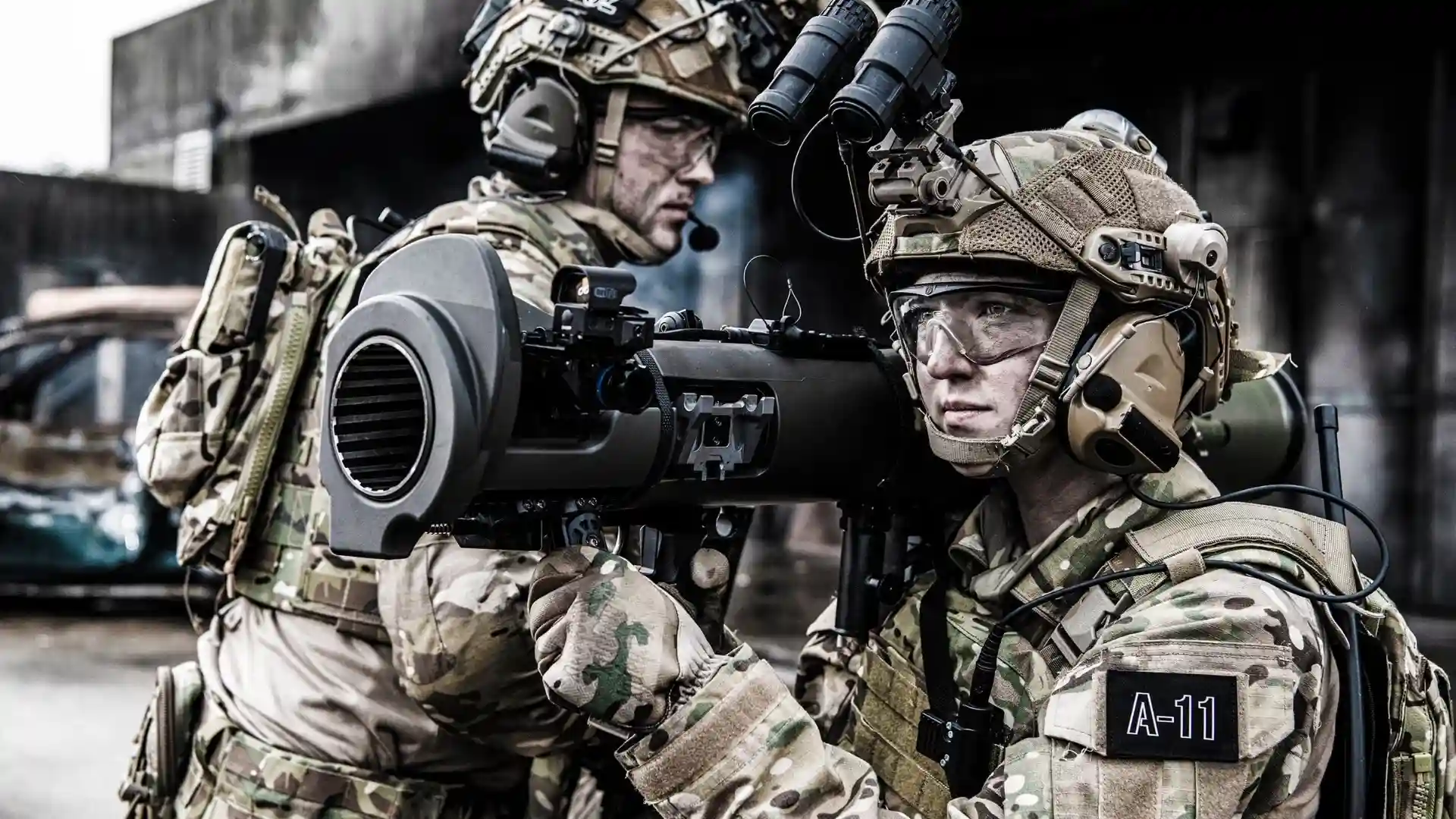
Lithuania’s Ministry of National Defence announced on November 10, 2026, that the Lithuanian Armed Forces have taken delivery of the final Carl-Gustaf M4 84 mm recoilless weapons and spare parts due under a EUR 14 million contract with Sweden’s Saab, closing out an acquisition signed at the end of 2024. The first equipment ordered under a separate 10-year agreement with Saab Dynamics AB, concluded in May 2026, has also arrived in the country.
The deliveries extend a capability Lithuania has fielded since the 1990s and has modernized step by step since January 2022, when Vilnius joined a Saab framework agreement for the Carl-Gustaf M4 variant. An initial batch of Carl-Gustaf M4 RD launchers under the 2024 contract entered service in December 2025, allowing a phased integration. The handover comes as Lithuania prepares to host a permanently stationed German armored brigade.
Carl-Gustaf M4 Contract Structure: Launchers, Adapters, and Outdoor Trainers
The May 2026 agreement with Saab Dynamics AB covers additional Carl-Gustaf M4 launchers, spares, and training equipment. According to the ministry, its value may reach approximately EUR 58 million if additional envisioned contracts are concluded. Saab valued the initial order at SEK 460 million, roughly EUR 42 million, with deliveries planned from 2026 to 2029 and options collectively worth up to SEK 640 million. Neither party has disclosed the number of launchers involved.
The training component carries real weight. The contract includes sub-caliber adapters, which let crews fire low-cost training ammunition through the M4 instead of expending full-caliber 84 mm rounds, and Carl-Gustaf Outdoor Trainers for simulated field engagements. Both are expected in early 2027. For a conscript and reserve-heavy force, cheaper repetitions build gunner proficiency without drawing down war stocks.
Vilnius paired the purchase with an industrial cooperation contract worth approximately EUR 17 million, also signed with Saab Dynamics AB in May. Minister of National Defence Robertas Kaunas said that alongside equipment purchases, the ministry is investing “in Lithuania’s defence industry, our economy, and technological capacity.” He added that the cooperation builds national competencies in munitions storage, logistics, engineering solutions, and security technology. Ammunition is bought separately, through a Swedish Defence Materiel Administration (FMV) framework shared with Estonia and Latvia.
Weight, Sights, and Ammunition: How the M4 Compares to the M3
The Carl-Gustaf M4 is a reusable, man-portable 84 mm rifled recoilless weapon designed to defeat armored vehicles, neutralize personnel in the open or behind cover, and support unit maneuver with smoke and illumination rounds. Saab specifications indicate a weight of under 7 kg and an overall length below 1 m, compared with roughly 10 kg and 1,065 mm for the M3 and 14.2 kg and 1,130 mm for the original M2 export model. Publicly available data attribute the savings to a titanium barrel liner, a carbon-fiber casing, and a redesigned venturi.
The weight figure is the operationally relevant one. A lighter launcher lets the two-soldier team of gunner and loader carry more rounds and displace faster after firing, a survivability factor on a battlefield where persistent drone surveillance punishes static firing positions. The M4 also integrates a shot counter for maintenance tracking and is built for compatibility with intelligent optics, including Saab’s FCD 558 fire control device.
Manufacturer data indicate the rocket-assisted HEAT 551 round is effective to 700 m against armor, while the HE 448 high-explosive round paired with a fire control device extends direct-fire reach to roughly 1,500 m. Saab’s newer HEAT 758 tandem-charge round is designed to defeat explosive reactive armor. The ministry has not specified which ammunition types Lithuania holds. The US Army fields the M4 as the M3E1, and Saab reports the Carl-Gustaf family in service with more than 40 countries.
Analysis: The Lithuanian program reflects a layered Baltic approach to anti-armor depth, in which reusable recoilless weapons absorb the volume of close engagements while guided missiles such as the Javelin are reserved for targets that justify their cost. Cheap training rounds and reusable launchers give the Land Forces a sustainable rate of fire against the armored and mechanized formations Russia could mass near the Suwałki Gap. The 10-year contract horizon, tied to local work in munitions storage and logistics, shows Vilnius treating anti-armor capacity as a long-term sustainment question rather than a one-off buy.
The next milestones are the arrival of sub-caliber adapters and outdoor trainers in early 2027 and the remaining M4 deliveries through 2029. Whether the agreement reaches its full EUR 58 million ceiling depends on follow-on contracts the ministry has not yet detailed. The total number of M4 launchers in Lithuanian service, the ammunition mix, and the specific work packages under the EUR 17 million industrial cooperation contract remain undisclosed.