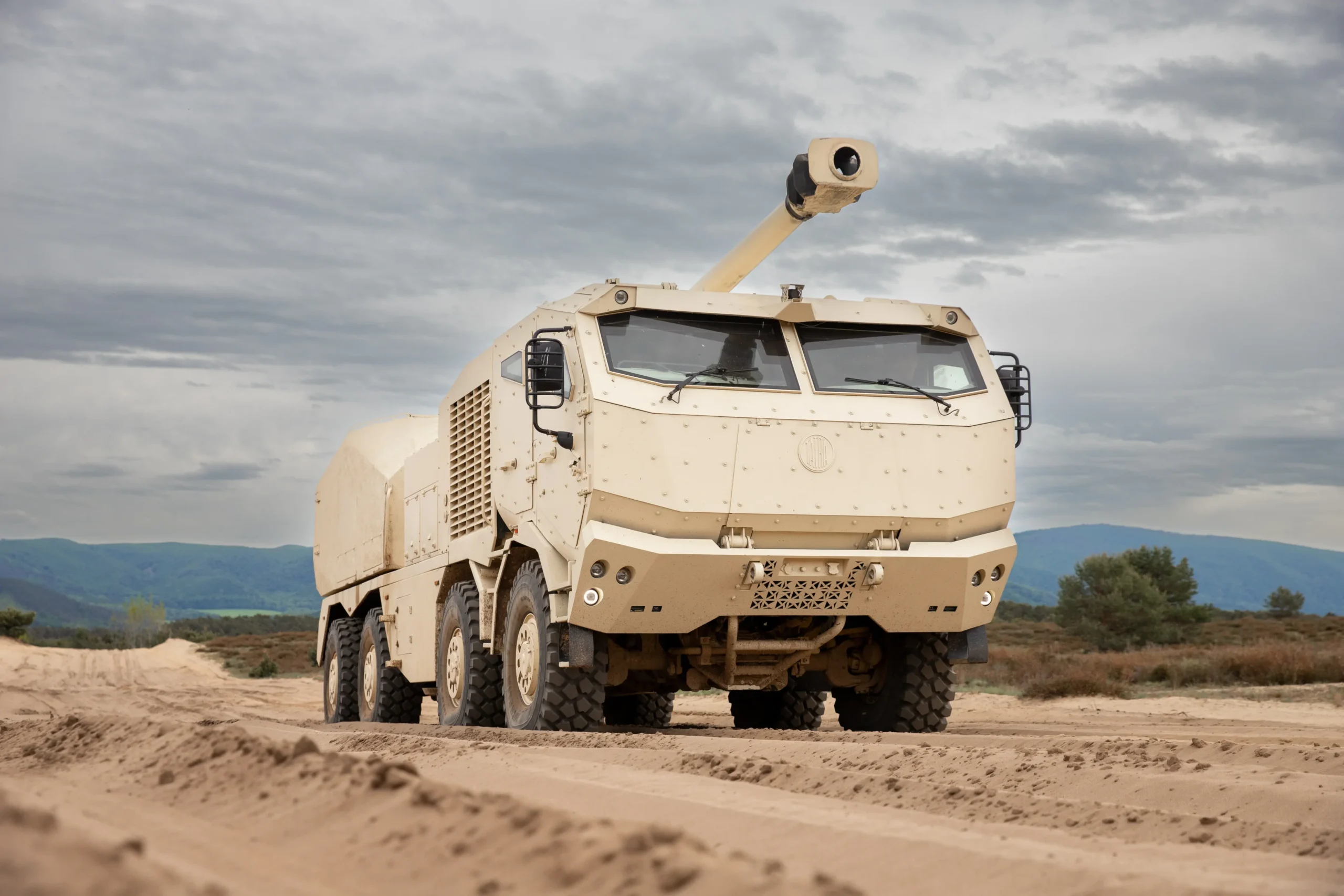
Latvia’s Ministry of Defence, the government of Slovakia, and Czech prime contractor Tatra Defence Systems (TDS) signed a trilateral agreement on September 30, 2026, to supply Morana 155mm self-propelled wheeled howitzers and multiple-launch rocket systems to the Latvian National Armed Forces. TDS parent Czechoslovak Group (CSG) values the package in the hundreds of millions of euros, with financing planned through the European Union’s Security Action for Europe (SAFE) loan instrument. First deliveries are expected in 2027.
The signing completes a reversal in Riga’s artillery program. Latvia signed a letter of intent with Sweden in June 2025 for 18 BAE Systems Bofors Archer systems and approved that purchase in January 2026. On September 15, 2026, the Cabinet of Ministers switched to Morana after the ministry judged Archer too costly and too slow for Latvia’s approved plans. Latvian tube artillery currently rests on M109A5Ö tracked howitzers bought from Austria in 2017, and indirect fire ranks among the priority projects in a record 2026 defense budget of €2.16 billion, or 4.91% of gross domestic product.
Morana Howitzer Specifications: 155mm L/52 Gun on Tatra 8×8
Excalibur Army, a CSG subsidiary, unveiled the Morana at Eurosatory 2022 as a 155mm descendant of the Czechoslovak 152mm DANA wheeled howitzer. Its layout departs from most truck-mounted guns: the armored crew cab sits forward, the powerpack behind it, and an unmanned turret at the rear of a Tatra Force 8×8 chassis. Slovakia’s ZŤS ŠPECIÁL manufactures the 52-caliber weapon system.
Manufacturer data credit the Morana with a maximum range of 41.5 km. A fully automatic loader handles both projectiles and propellant charges from 45 rounds carried on board, allowing six rounds in the first minute after the gun is laid, and the system supports Multiple Rounds Simultaneous Impact (MRSI) fire. Direct fire reaches 5 km by day and 3 km at night. Publicly available specifications indicate the gun can open fire within 40 seconds of halting, and an independently powered turret keeps the gun operable if the vehicle engine stops.
Open-source figures give an engine output of roughly 600 hp (447 kW), an automatic transmission, a central tire inflation system, and a road speed of up to 90 km/h, with the 2022 demonstrator weighing about 32.5 tonnes. Three crew members (commander, gunner, and driver) operate the system from a cab protected to STANAG 4569 Level 2. An M109A5-series howitzer needs six, a material saving for a small force, and the short emplace-and-displace cycle targets the counter-battery threat that has shaped artillery survival in Ukraine.
Maturity is the open question. Unlike established designs such as the M109, Archer, and CAESAR, Morana is a new system: its prototype appeared publicly only in 2022, and the manufacturer was still conducting firing tests in the summer of 2026. Latvia is entering the platform’s life cycle early.
Rocket Launchers, Slovak Components, and the SAFE Funding Model
Neither the Latvian ministry nor CSG has named the rocket artillery system or disclosed quantities for either platform. CSG’s current Tatra-based rocket portfolio centers on the 40-tube, 122mm RM-70 Vampire, which the manufacturer credits with ranges of up to 40 km, but no official source has linked it to the Latvian requirement. Caliber will matter: Latvia already ordered six M142 High Mobility Artillery Rocket Systems (HIMARS) under a December 2023 contract, firing the 227mm Guided Multiple Launch Rocket System family. The howitzers and launchers will share a common Tatra platform, consolidating spares, training, and maintenance.
Slovak industry carries much of the technically critical work. Beyond the gun, Slovak firms will supply superstructures, other components, and the Morana’s fire control system. Other elements will be manufactured and assembled in Latvia with Czech and Slovak support, backed by a Latvian lifecycle maintenance base. Latvian partner companies have not been named.
The contract rides on an existing contractual vehicle. TDS holds a framework agreement with the Slovak Ministry of Defence, signed in December 2025, covering up to 1,289 Tatra Force vehicles in 24 configurations with a ceiling of about €1.03 billion and explicitly open to other EU and NATO states; the Czech Republic is in talks to join. SAFE, a €150 billion EU loan facility, finances common procurements involving at least two participating states, while purely national contracts qualified only if signed by May 30, 2026. Bratislava’s signature on the Latvian agreement appears designed to meet that requirement. Latvia’s SAFE allocation stands at roughly €3.5 billion, of which €524.7 million arrived as pre-financing on August 28, 2026.
Analysis: Riga traded platform maturity for price, schedule, and industrial return, and SAFE made that trade easier to justify. Archer is in service with Sweden, the United Kingdom, and Ukraine; Morana is still completing testing. By routing the buy through a Slovak framework, Latvia gains EU-backed financing, a domestic workshare, and a single truck family for tube and rocket artillery. For CSG, the deal turns the Tatra Force framework into a procurement channel on NATO’s northeastern flank. The risk is schedule concurrency: if qualification or production slips, the delivery-speed argument behind the switch erodes.
The next milestones are disclosure of the contract value, quantities, and rocket system, the naming of Latvian industrial partners, and the first SAFE-funded payments. The 2027 delivery target will test whether Morana’s development pace matches the procurement timeline, while a formal Czech accession to the Slovak framework would show how far the model extends.