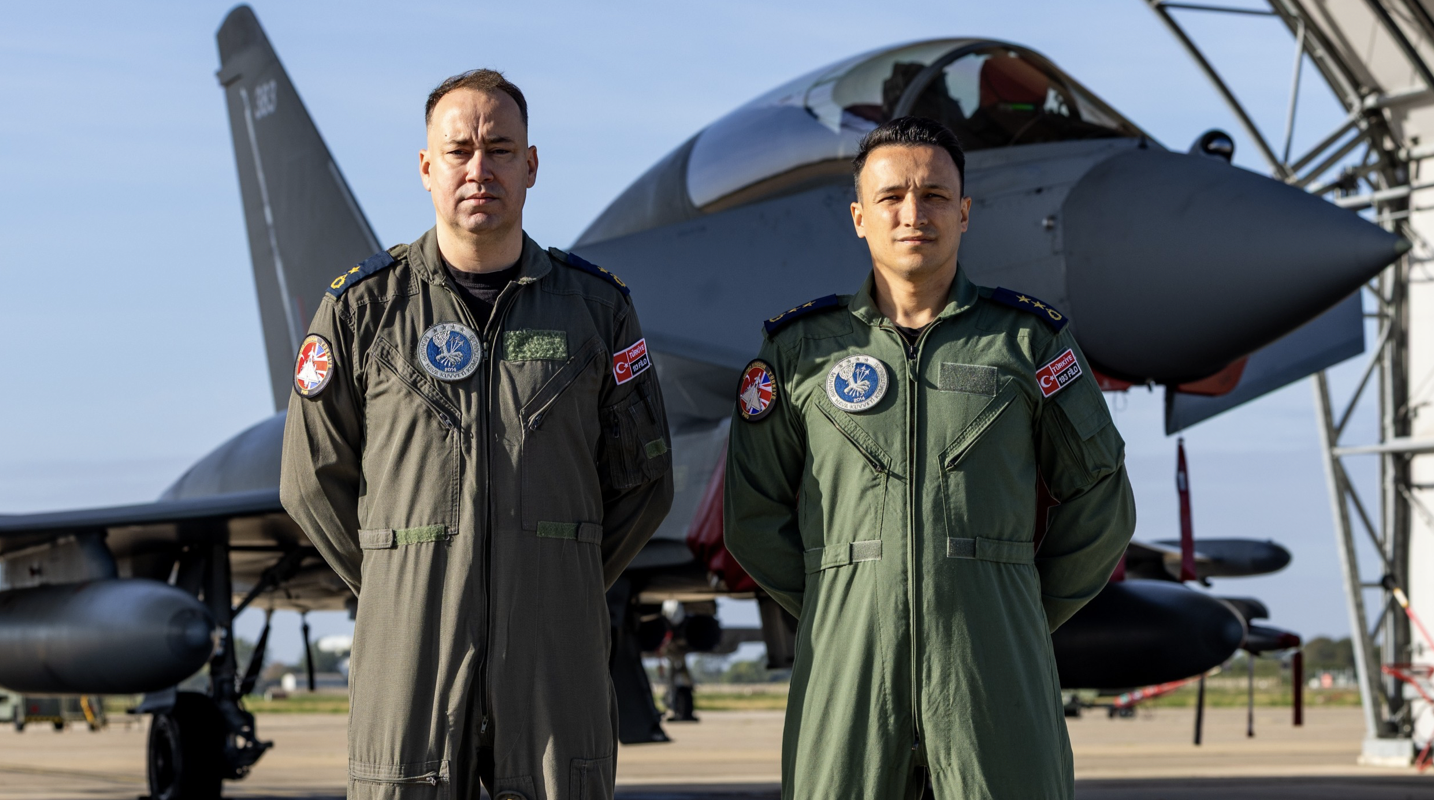
Türkiye has begun Typhoon pilot training in the United Kingdom: the first two Turkish Air Force pilots are converting onto the Eurofighter at RAF Coningsby in Lincolnshire, the Royal Air Force (RAF) said on September 27, 2026. They are training with 29 Squadron, the RAF’s Typhoon Operational Conversion Unit, under the contract for 20 new-build aircraft that Ankara signed on October 27, 2025. BAE Systems is due to deliver the first Turkish jets in 2030.
Ankara turned to the Typhoon after prolonged F-16 negotiations with Washington and its 2019 removal from the F-35 program over the purchase of Russia’s S-400 air defense system. Analysts describe the order as a stopgap between an aging F-16 fleet and the domestic KAAN fifth-generation fighter, which is still in prototype testing. Türkiye has never operated the Typhoon, so the instructor and maintenance pipeline now forming at Coningsby is the first concrete step toward flying it.
Typhoon Pilot Training at RAF Coningsby: Course Structure and Timeline
The RAF describes both pilots as experienced combat aviators. Conversion runs for up to nine months, followed by three months of instructor training. Group Captain Batu, who directs the Türkiye Programme Management Office, said the first weeks cover Typhoon systems and UK military airspace procedures before the first sortie. After graduating, the pilots will remain with 29 Squadron as instructors until Türkiye receives its first new aircraft in 2030.
The Ministry of National Defense said the training process opened in August and that Turkish Air Force pilots had finished terminology training before starting flight training. A ministry team also inspected maintenance facilities at Coningsby from September 15 to 17. If the course began in August, the stated lengths put the end of conversion no later than May 2027 and instructor qualification no later than August 2027. That is arithmetic, not an official schedule.
The two pilots lead a larger cohort. Under separate UK arrangements, the RAF is to train 10 Turkish instructor pilots and nearly 100 maintenance technicians at Coningsby, so the Turkish Air Force can eventually run its own conversion unit. Turkish trade reporting expects that unit at Eskişehir, a basing choice not yet officially confirmed.
Publicly available specifications indicate the pilots are converting onto a twin-engine, canard-delta fighter, 15.96 meters long, powered by two Eurojet EJ200 turbofans rated at about 90 kilonewtons each with reheat. Top speed is near Mach 2, and 13 hardpoints carry up to about 9,000 kilograms of stores. The Turkish package includes the MBDA Meteor ramjet air-to-air missile, whose stated range exceeds 100 kilometers, and reportedly Brimstone ground-attack missiles. Industry reporting, citing a program source, indicates the new aircraft will be Tranche 4+ jets with Leonardo’s European Common Radar System (ECRS) Mk 0 active electronically scanned array (AESA) radar; the final configuration is unconfirmed.
Where the Typhoon Contract Stands: Production, Deliveries, Interim Jets
Türkiye and the United Kingdom signed the government-to-government agreement in Ankara on October 27, 2025. BAE Systems values the contract for 20 aircraft plus a weapons and integration package at £5.4 billion. The UK government has put the wider package at up to £8 billion, and the RAF now cites more than £8 billion. A separate training and support agreement followed in London on March 25, 2026, covering spares, support equipment, simulators, electronic warfare capabilities and technical support for the first three years of service. Its value was not officially disclosed; trade reporting places it between £2.5 billion and £2.6 billion, which would reconcile the £8 billion headline.
Production has started. BAE Systems said in its first-half results, published July 30, 2026, that manufacturing of the Turkish aircraft is under way in the UK and across the Eurofighter partner nations. Defense Minister Yaşar Güler has set deliveries at six aircraft in 2030, eight in 2031 and six in 2032.
The interim fleet is behind schedule. Ankara plans to take 12 used Tranche 3A aircraft from Qatar and 12 from Oman, for a 44-aircraft target. Güler said in December 2025 that the Qatari jets would arrive in early 2026, and Turkish media pointed to late February. The ministry then said the project was focused on training and infrastructure, and as of late September no delivery had been publicly confirmed. The Omani jets, which retain mechanically scanned Captor-M radars, are due to be modernized with AESA radar and Meteor capability by 2028, according to Güler.
Analysis: The course moves Türkiye closer to operating the Typhoon, but only on the personnel side of the program. Instructors and technicians will be qualified years before the first new airframe arrives, which lowers the risk that people rather than aircraft delay entry into service. The fleet timeline has not moved: the ex-Qatari jets are the only route to Turkish-flown Typhoons before 2028, and they are late. A fleet mixing Qatari Tranche 3A jets, modernized Omani jets and new Tranche 4+ aircraft will also add sustainment and training complexity.
Four markers matter: the arrival and basing of the first ex-Qatari aircraft, the start of maintenance courses at Coningsby, the end of the first pilots’ conversion around May 2027, and Omani jet modernization by 2028. The 2030 first delivery remains the fixed point. The new-build radar standard and any move beyond 44 aircraft, which Turkish press reports have put as high as 56, remain undecided.