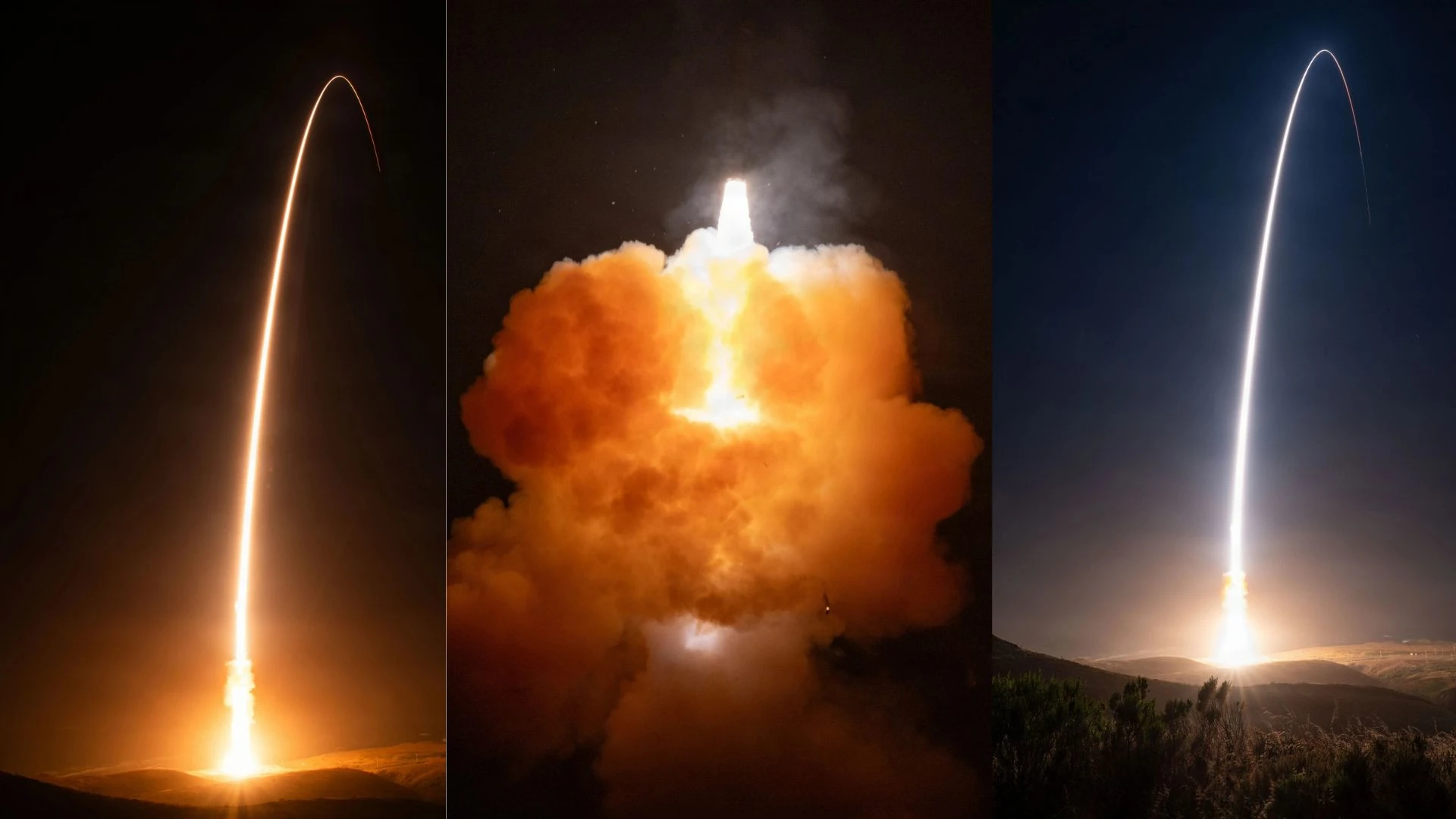
The U.S. Air Force will launch an unarmed LGM-30G Minuteman III intercontinental ballistic missile (ICBM) from Vandenberg Space Force Base, California, in a window that opens at 11:01 p.m. Pacific Time on November 17, 2026, and closes at 5:01 a.m. on November 18. The Air Force Global Strike Command (AFGSC) test, designated Glory Trip 257 (GT 257), will lift off from the northern portion of the installation, according to the base.
The timing puts the launch on the opening day of the 33rd Asia-Pacific Economic Cooperation (APEC) Economic Leaders’ Meeting in Shenzhen, China, where the window corresponds to 3:01 p.m. to 9:01 p.m. local time on November 18. On November 19, President Donald Trump, Chinese President Xi Jinping and Russian President Vladimir Putin are set to hold their first trilateral meeting on the summit sidelines, with nuclear arms control expected to dominate the agenda nine months after the New Strategic Arms Reduction Treaty (New START) expired without a successor. Vandenberg addressed the overlap in its launch notice: “This routine test, designated Glory Trip 257, was scheduled years ago, and is not in response to world events.”
Glory Trip 257: How the Minuteman III ICBM Test Is Flown
AFGSC plans Glory Trips roughly five years in advance and does not conduct them on short notice, according to the command. The stated purpose of the program is to validate and verify the effectiveness, readiness and accuracy of the weapon system. Test missiles are drawn from the operational fleet of about 400 alert ICBMs in silos across Montana, North Dakota and Wyoming. Crews pull the missile from its silo, truck it to Vandenberg and reassemble it there, with the 377th Test and Evaluation Group overseeing the event.
Publicly available specifications indicate the LGM-30G is a three-stage, solid-propellant missile measuring 59.9 feet (18.3 meters) long and 5.5 feet (1.67 meters) in diameter, with a launch weight of about 79,432 pounds (36,030 kilograms). The Air Force credits it with a range beyond 6,000 miles and a burnout speed near 15,000 mph, roughly Mach 23. The NS-50 Missile Guidance Set provides inertial guidance, while the operational force carries either the W78 warhead in the Mk12A reentry vehicle or the W87 in the Mk21 Safety Enhanced Reentry Vehicle. The deployed fleet is configured with one warhead per missile, although the airframe retains a multiple reentry vehicle capability.
Test reentry vehicles carry telemetry packages instead of warheads and typically travel about 4,200 miles to the Ronald Reagan Ballistic Missile Defense Test Site at Kwajalein Atoll in the Marshall Islands. The Air Force has not disclosed the payload configuration for GT 257. GT 255, flown on March 3, 2026, delivered two test reentry vehicles to the Kwajalein target area. GT 256 followed on May 20, and GT 254 flew on November 5, 2025.
Aging Minuteman III Fleet Bridges the Delayed Sentinel Program
The Minuteman III entered service in 1970, and the Government Accountability Office (GAO) has reported that the Air Force told Congress in 2021 the missile would reach the end of its service life in 2036. Delays to its replacement, the Northrop Grumman LGM-35A Sentinel, have moved that horizon; Air Force officials have said the older missile could remain in service until 2050. In April 2026 Senate testimony, Gen. Dale White said the Pentagon allocates more than $2 billion a year to operate and sustain the Minuteman III.
Sentinel breached Nunn-McCurdy cost thresholds in 2024, with the Pentagon’s Cost Assessment and Program Evaluation office estimating a restructured program at $141 billion, an increase of roughly 81 percent. The Pentagon certified the program to continue in July 2024 but rescinded its Milestone B approval. On February 17, 2026, the Air Force said it expected to complete the restructure and regain Milestone B by the end of 2026, with initial capability in the early 2030s. A February 2026 GAO report placed Sentinel’s first flight test in March 2028, although the Air Force has said it plans a first launch from a test pad in 2027. Until the new missile and its rebuilt silos are fielded, Glory Trips remain the primary means of verifying the legacy force, with two to three launches per year and more than 300 flown over the program’s history.
Analysis: The overlap stems from long-range test scheduling rather than signaling, but intent will not determine how the launch is received. A Minuteman III flight hours before the first three-way leaders’ discussion on nuclear weapons is likely to be read in Beijing and Moscow as evidence that Washington will keep its land-based leg credible while Sentinel slips. The test underlines a structural asymmetry: China is fielding new solid-propellant ICBM silo fields, according to Pentagon assessments, while the U.S. ground leg rests on a 1970-vintage missile that must be stretched toward 2050.
AFGSC typically confirms results in a post-launch release. Open questions include whether GT 257 will carry one or multiple test reentry vehicles, whether the launch will be commanded from the Navy E-6B Mercury airborne launch control system as GT 254 was, and whether any delegation raises the test in Shenzhen on November 19. For Sentinel, the next decision point is the restructured Milestone B, still targeted before the end of 2026.