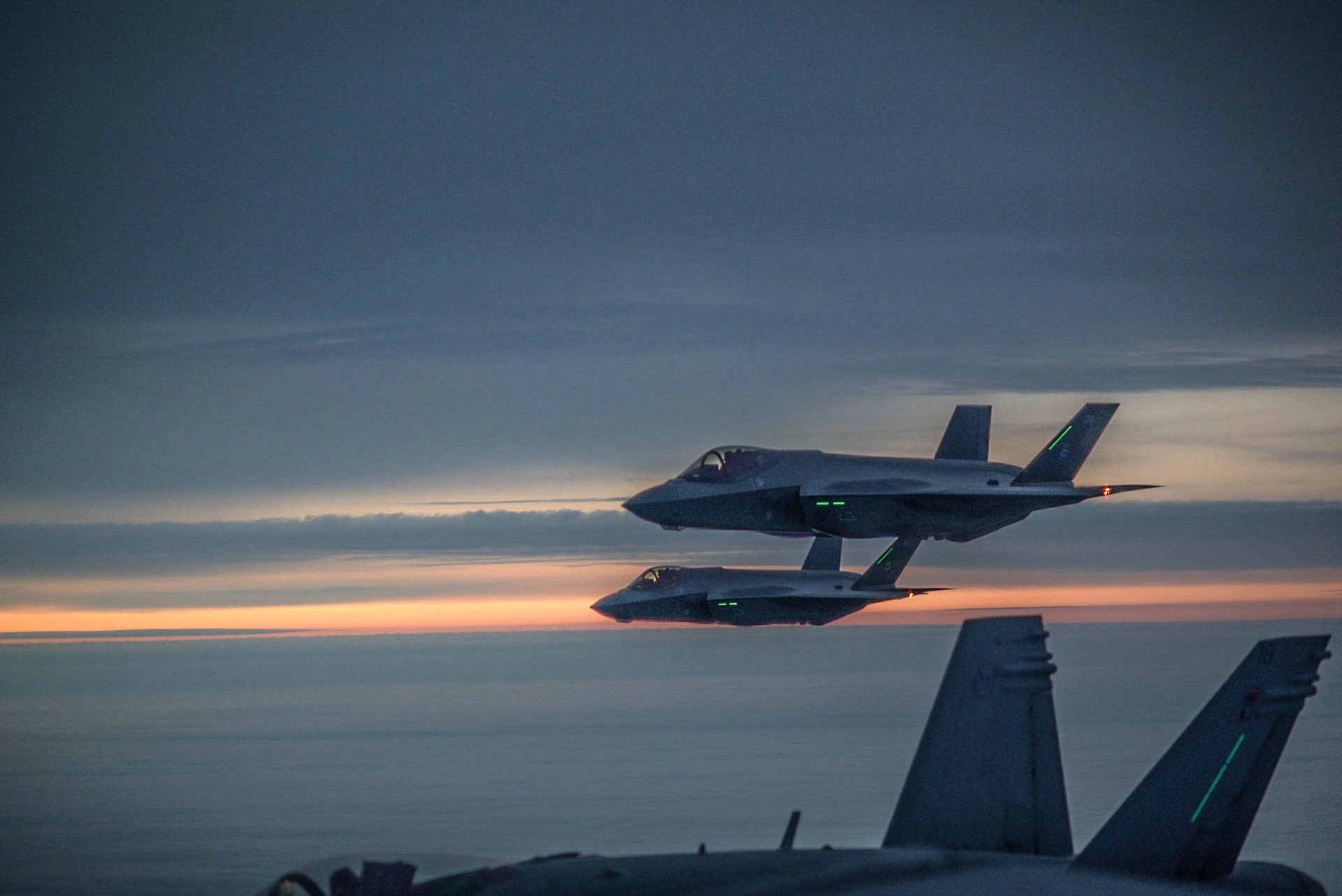
Two more Finnish Air Force F-35A Lightning II fighters, JF-509 and JF-511, landed at Lapland Air Wing in Rovaniemi at 5:56 p.m. local time on October 23, 2026, according to the Finnish Air Force. The arrival completes Finland’s second F-35A ferry delivery and brings the in-country fleet to four.
Helsinki selected the F-35A in December 2021 under the HX fighter program, a roughly €10 billion effort covering 64 aircraft to replace the F/A-18C/D Hornet fleet in service since 1995. The first in-country pair, JF-510 and JF-512, reached Rovaniemi on September 18, 2026, while the first eight, JF-501 through JF-508, remain at Ebbing Air National Guard Base, Arkansas, for training. The Finnish Air Force targets full operational capability (FOC), together with final Hornet retirement, in 2030.
Finnish F-35A Ferry Flight Reunites JF-511 at Lajes Field
JF-509 departed Lockheed Martin’s production facility in Fort Worth, Texas, on October 20, 2026. The ferry formation staged through Lajes Field on Terceira, in Portugal’s Azores archipelago, where JF-511 joined it for the final leg to Lapland.
JF-511 had flown with the first ferry formation in September but remained in the Azores to repair what the Finnish Air Force described as a minor avionics fault, then waited for the next available transatlantic movement. That first formation left Fort Worth on September 15 and delivered only JF-510 and JF-512. The fault was minor, yet the aircraft sat at Lajes for about five weeks because its onward movement depended on the next scheduled ferry package.
Ferry formations often combine aerial refueling tankers with fighters from other nations, the Finnish Air Force noted, because tanker support on long transatlantic legs is organized most efficiently for multi-aircraft packages. The service did not identify the tanker type or any foreign aircraft that accompanied this flight.
The custody chain follows Foreign Military Sales (FMS) procedures. The US government accepts each aircraft at the factory, at which point ownership transfers to Finland while custody stays with the United States. Washington holds decision authority and responsibility for planning and executing the ferry flights, and control passes to Finland only once the aircraft lands on Finnish soil.
JF-511 also carries squadron heritage markings. In keeping with Finnish Air Force tradition, the outer surfaces of its vertical stabilizers display the Visentti (wisent) emblem of Fighter Squadron 11 (Hävittäjälentolaivue 11, HävLLv 11), the Lapland Air Wing unit receiving the first in-country jets.
TR-3 Standard and Block 4 Roadmap for Lapland Air Wing
Finland’s aircraft come from Lockheed Martin production Lots 17 through 22 and are delivered in the Technology Refresh 3 (TR-3) configuration, which adds a new integrated core processor, expanded memory and a panoramic cockpit display to host Block 4 capabilities. Finnish officials have not specified which software release the delivered jets carry, a relevant unknown given the TR-3 software delays that slowed F-35 deliveries worldwide in 2023 and 2024.
Publicly available specifications indicate the F-35A is powered by a single Pratt & Whitney F135-PW-100 turbofan producing about 43,000 lb (191 kN) of thrust in afterburner. It carries 18,250 lb (8,278 kg) of internal fuel for a combat radius above 590 nautical miles (1,093 km) without external tanks. The sensor suite pairs the Northrop Grumman AN/APG-81 active electronically scanned array radar with the AN/AAQ-40 Electro-Optical Targeting System and the AN/AAQ-37 Distributed Aperture System, and the conventional takeoff variant integrates a four-barrel 25 mm GAU-22/A cannon with 182 rounds.
Against the Hornet, the gain lies less in speed than in persistence and sensing. Finland shares a 1,340 km border with Russia, and internal fuel combined with a fused sensor picture lets a small number of aircraft hold combat air patrols farther from Rovaniemi, toward the approaches from the Kola Peninsula, while sharing track data with ground-based air defense and allied aircraft. Finland is also acquiring up to 150 AGM-88G Advanced Anti-Radiation Guided Missile-Extended Range (AARGM-ER) rounds, valued at approximately $500 million, timed to the F-35A introduction.
Finnish industry carries part of the sustainment load. Patria assembles F-35 forward fuselage sections at Halli in Jämsä and, on September 3, 2026, presented the first F135 engine assembled at its new Linnavuori facility in Nokia, a sustainment hedge for a country that plans to hold alone until allied reinforcements arrive.
Analysis: The JF-511 episode exposes the structural constraint in Finland’s transition. Under FMS, Helsinki owns its jets from the factory gate but does not control when they cross the Atlantic; ferry timing depends on US decisions, tanker availability and multi-aircraft formations. With Lapland Air Wing expected to be F-35 combat-capable and to stop flying the Hornet in 2028, delivery cadence, more than aircraft performance, now sets the pace of Finnish air power on NATO’s northern flank. Four jets in Rovaniemi form a training nucleus, not a combat force. The indicator to watch is whether ferry movements scale beyond pairs.
JF-509 and JF-511 now enter airworthiness and acceptance inspections conducted by Finnish Air Force and Finnish Defence Forces Logistics Command personnel. Each aircraft that passes receives an individual airworthiness certificate and then becomes available for flight training. Maintenance training at Rovaniemi is scheduled to begin in late 2026 under US-trained Finnish instructors. The Finnish Air Force has not announced the date or size of the next ferry flight, and the Karelia Air Wing at Rissala is due to begin receiving F-35As in 2028.