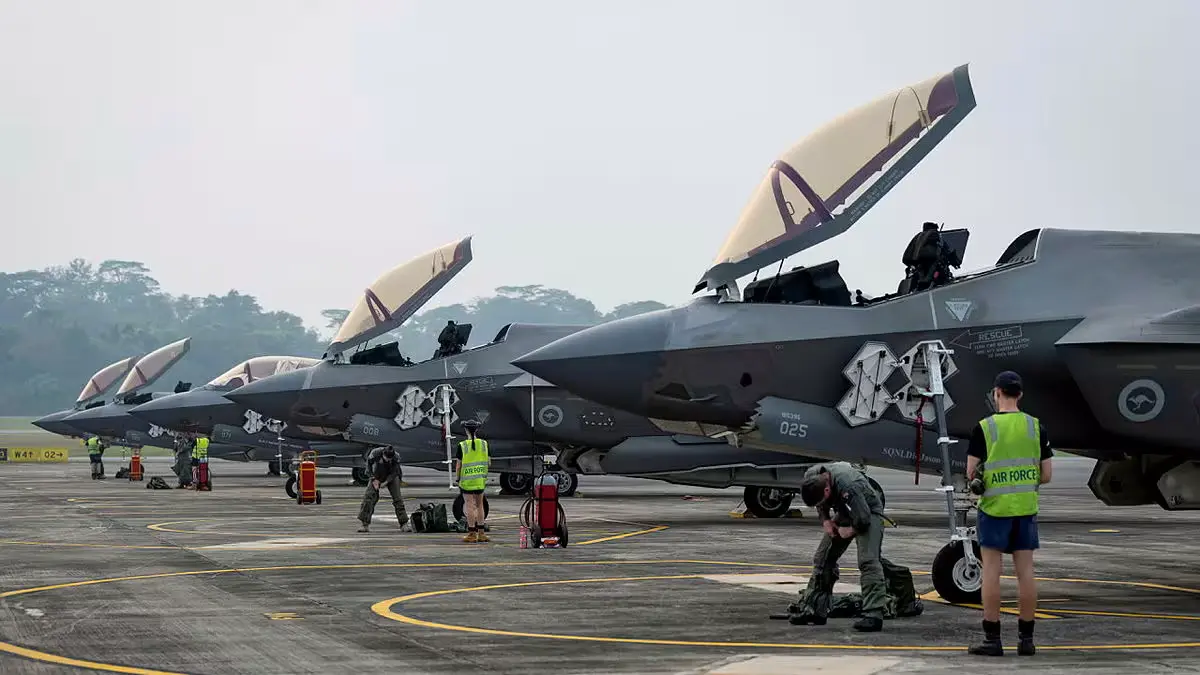
Royal Australian Air Force (RAAF) F-35A Lightning II fighters from No. 3 Squadron (3SQN) flew defensive and offensive counter-air missions from Paya Lebar Air Base, Singapore, during Exercise Bersama Lima 2026, operating in mixed formations with Republic of Singapore Air Force (RSAF) F-15SG and F-16C/D fighters and refueling overwater from an RSAF A330 Multi-Role Tanker Transport (MRTT), the RAAF said on October 27, 2026.
Bersama Lima is the annual flagship exercise of the Five Power Defence Arrangements (FPDA), the security framework linking Australia, Malaysia, New Zealand, Singapore and the United Kingdom since 1971. Singapore hosted this year’s iteration from October 5 to 23; the Singapore Ministry of Defence (MINDEF) reported approximately 1,900 personnel, 42 aircraft, seven ships and one submarine across the combined force. It also came as the RSAF prepares to accept its first F-35s, giving the partners a live venue to rehearse fifth- and fourth-generation integration.
RAAF F-35A Counter-Air Missions From Paya Lebar Air Base
3SQN’s flying program centered on defensive counter-air (DCA) and offensive counter-air (OCA) missions alongside other participants. MINDEF said six Australian F-35As took part, and Australia’s contingent of around 220 Australian Defence Force (ADF) personnel also included P-8A Poseidon maritime patrol aircraft and the replenishment ship HMAS Stalwart with its embarked MH-60R helicopter. The RAAF has not disclosed how many sorties the F-35As generated.
Each sortie began the day before launch with mission planning and rehearsals. On mission day, crews from the participating nations attended a combined multinational brief before RAAF pilots held their own element brief and met the maintenance team. After recovery, pilots passed aircraft observations to maintainers, then returned to the debrief to capture lessons for the next flight.
“We’ve been flying as part of mixed formations with those jets,” said a 3SQN pilot identified only as FLTLT Max. “I think it’s really obvious to me that we’re aligned in how we do things, and an exercise like this is just great in increasing that interoperability.”
Publicly available specifications indicate the F-35A, the conventional takeoff and landing variant of the Lockheed Martin Joint Strike Fighter, is powered by a single Pratt & Whitney F135-PW-100 turbofan producing roughly 43,000 lbf in afterburner, carries about 18,250 lb of internal fuel and has a combat radius above 590 nautical miles on internal fuel. Its counter-air toolkit pairs the Northrop Grumman AN/APG-81 active electronically scanned array (AESA) radar with the AN/AAQ-37 Distributed Aperture System and the AN/ASQ-239 electronic warfare suite, while four AIM-120 AMRAAMs ride in the internal bays in a low-observable air-to-air configuration. In DCA and OCA scenarios, that combination lets the F-35A act as a forward sensor and shooter, sharing tracks with non-stealthy partners over Link 16.
Tanking was a key enabler. The F-35A refuels through a dorsal boom receptacle rather than a probe, so overwater sorties depended on the RSAF MRTT’s boom. The RAAF flies its own KC-30A, a variant of the same Airbus A330 MRTT, easing tanking from a partner fleet.
How F-35A Formations Integrate With RSAF F-15SG and F-16 Fleets
The RSAF’s F-15SG is a Singapore-specific derivative of the Boeing F-15E Strike Eagle, fitted with the AN/APG-63(V)3 AESA radar, according to publicly available information. The RSAF’s F-16C/D fleet has been modernized under an upgrade program that added an AESA radar and updated mission systems. Both types bring large external weapons loads and long endurance to a formation; the F-35A brings low observability, passive detection and sensor fusion.
Mixed formations built on that division of labor are a standard construct among F-35 operators: the stealth fighter pushes forward to detect and target threats, while fourth-generation fighters carry additional missiles behind it. Rehearsing it with a partner requires common brevity, shared rules of engagement and compatible datalink procedures, which the multinational briefing cycle was built to exercise.
The timing matters for Singapore. The city-state has ordered 20 F-35s (12 F-35Bs and eight F-35As) in a package valued at US$4.06 billion according to a US Department of War report. Its first aircraft are due at a US training base by the end of 2026, with basing in Singapore expected around 2029. Flying alongside RAAF F-35As at home gives RSAF crews and planners direct exposure to fifth-generation mission planning before their own jets arrive at Tengah Air Base.
Sustaining Forward-Deployed F-35A Operations in Equatorial Conditions
Generating those sorties fell to 3SQN’s deployed maintainers. Aircraft technician LACW Lillian Aboody Fischer described the flightline routine: arriving roughly an hour before flight time to remove the red ground-safety gear, power up the aircraft and support the pilot through start. After each mission, the team marshalled jets into parking positions, assisted with shutdown and inspected the airframes.
“When the jets get back, we check them over, make sure no damage has happened during flight,” she said. Bersama Lima was her first international deployment.
Operating from Paya Lebar meant adapting to equatorial heat and humidity while relying on ground support equipment shipped from Australia. Hot, salt-laden air adds load on aircraft cooling, avionics and low-observable surface maintenance, making the detachment a test of expeditionary sustainment as much as of tactics. According to the RAAF, 3SQN has deployed crews and jets to Singapore across successive aircraft generations since 1969, giving newer personnel institutional knowledge of those conditions.
Analysis: Bersama Lima 26 shows the FPDA’s air component shifting toward a mixed fifth- and fourth-generation force. By the end of the decade, three of the five members, Australia, the United Kingdom and Singapore, will operate F-35s, while Malaysia and New Zealand will not. That makes the arrangement’s value increasingly dependent on bridging fleets with different sensor, datalink and signature profiles, a problem solved through repeated live integration rather than doctrine. For Australia, forward-deploying F-35As to Singapore and tanking from a partner MRTT reflects the closer coordination with regional partners that its 2026 National Defence Strategy, released in April, ties to the collective security of the Indo-Pacific.
The next milestone is the RSAF’s first F-35 delivery to its US training base, expected by the end of 2026. The RAAF has not published sortie rates or mission-capable figures from the deployment, and Bersama Lima 2027 dates have not been announced.