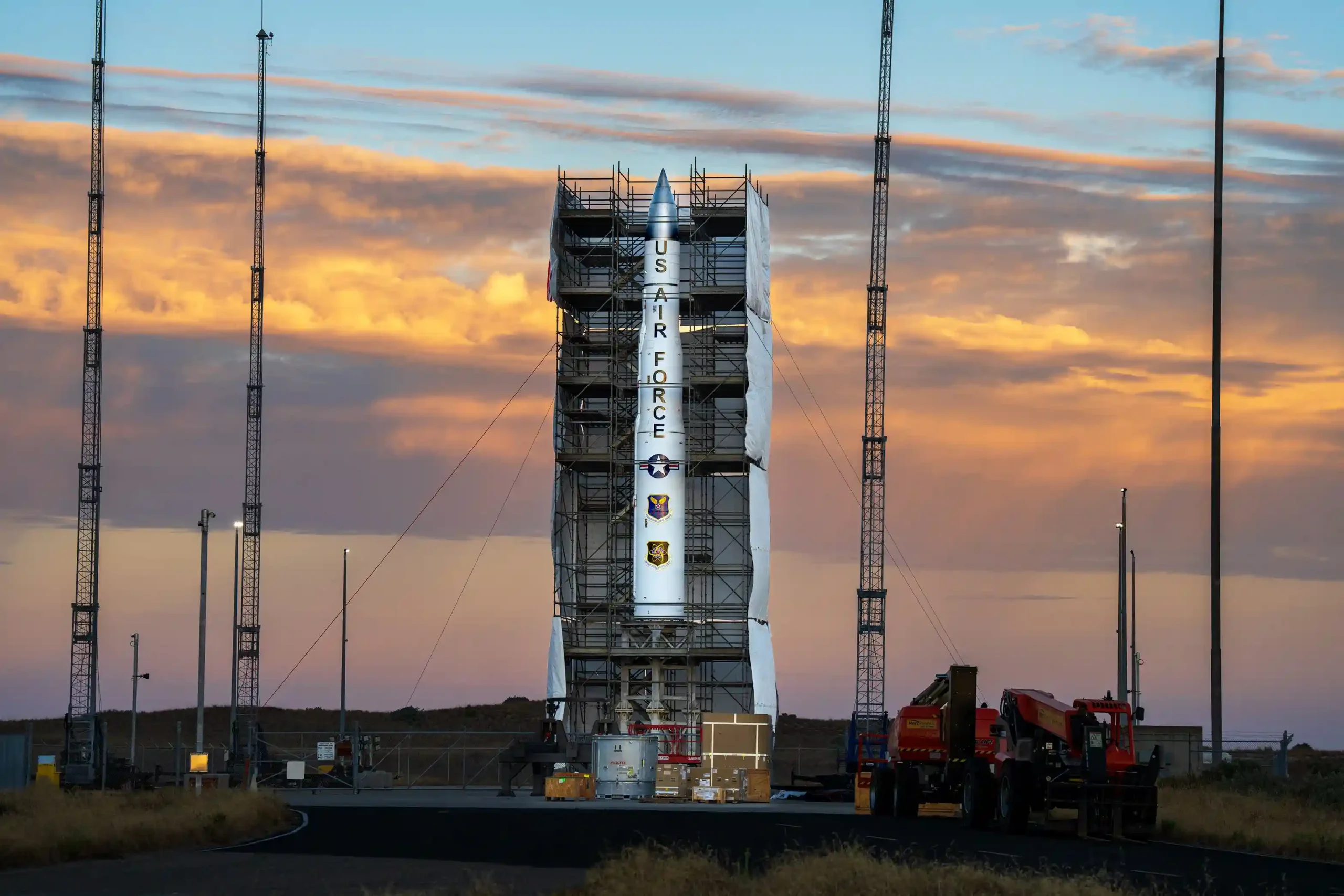
The Air Force Nuclear Weapons Center has awarded Accenture Federal Services LLC of Arlington, Virginia, a $151,462,808 firm-fixed-price task order for intercontinental ballistic missile (ICBM) FENCES engineering services, the Pentagon announced on October 27, 2026. The sole-source order, awarded October 23 under the General Services Administration’s Alliant 2 government-wide acquisition contract, carries a $228 million ceiling and runs through June 30, 2030, with all work performed at Hill Air Force Base, Utah.
The award arrives as the LGM-35A Sentinel, the Air Force’s replacement for the LGM-30G Minuteman III, nears the end of a restructure imposed after its critical Nunn-McCurdy breach. In July 2024, the Pentagon certified the program to continue, rescinded its Milestone B approval and estimated its cost at $140.9 billion. The Air Force now targets a new Milestone B decision by the end of 2026, a first missile pad launch in 2027 and initial capability in the early 2030s.
ICBM FENCES Task Order Structure: Price, Ceiling, and Funding
The order, FA8204-27-F-B001, covers the engineering, development, security, and operations of what the contract notice calls tailored FENCES. The Air Force has not publicly expanded the FENCES acronym, and the announcement offers no technical detail on the system’s architecture, classification level or user base.
The gap between the $151.46 million firm-fixed-price value and the $228 million ceiling leaves about $76.5 million of headroom, reserved for future in-scope special project requirements that the service has not identified. Across a period of performance of roughly 44 months, the base value averages about $41 million per year.
Funding at award is thin. The Air Force obligated $6,720,480 in fiscal 2026 research, development, test and evaluation (RDT&E) funds, roughly 4.4 percent of the base value. Because RDT&E appropriations remain available for obligation for two years, fiscal 2026 dollars can still be committed through September 30, 2027, even though the order number carries a fiscal 2027 designation. The balance must be obligated in later increments. The use of RDT&E rather than operation and maintenance money also places the work on the development side of the ICBM portfolio, not routine sustainment.
The contracting route also stands out. Alliant 2 is a multiple-award vehicle designed for competition among its holders, so a sole-source order requires a fair-opportunity exception under federal acquisition rules. The announcement does not specify which exception the Air Force invoked.
Accenture’s Sentinel Fences Lineage and the Hill AFB Software Push
Accenture is the incumbent. In October 2022, the company received a $9,691,132 option modification to contract FA820422F0001 for Sentinel Fences Continuous Engineering Services, adding full-time equivalent staff at Hill through July 27, 2023, on fiscal 2023 RDT&E funds.
The new order’s four-part scope of engineering, development, security and operations mirrors the DevSecOps model the Department of the Air Force has pushed across its software enterprise. That model fits Sentinel, which the Air Force designed as a modular weapon system intended to absorb upgrades over a service life expected to run to about 2075.
The shift in wording from Sentinel Fences in 2022 to ICBM FENCES in 2026 may reflect the Nuclear Weapons Center’s August 2024 merger of its Minuteman III and Sentinel directorates into a single ICBM Systems Directorate. The notice does not say whether the new order extends to Minuteman III systems.
Hill also hosts the physical anchor for Sentinel software work. The Nuclear Weapons Center broke ground there on January 19, 2023, on a Software Mission Assurance Center, a shared workspace where government and contractor software developers support Sentinel’s modular design over its life cycle. The announcement does not link the FENCES order to that facility.
Analysis: At $151.46 million, the order represents roughly one-tenth of 1 percent of Sentinel’s $140.9 billion estimate, but it addresses the layer where nuclear modernization schedules are most exposed: the engineering and security of the environments in which mission software is built, tested and fielded. If FENCES supports the software environments its DevSecOps-style scope suggests, its maturity will shape how quickly Sentinel code can move through cybersecurity and nuclear surety reviews. Pairing a sole-source, firm-fixed-price award with $76.5 million in unpriced ceiling signals that the Air Force prizes incumbent continuity ahead of Milestone B and expects requirements to grow before 2030.
The next decision point sits outside the contract. Gen. Dale White, the Air Force’s Critical Major Weapon Systems director, said in September that Sentinel remained on track for Milestone B, which the service targets by year-end; a favorable ruling would return the program to engineering and manufacturing development and could draw on the special-project headroom. Incremental funding actions, and any disclosure of what FENCES designates, will show how central the effort becomes before Sentinel’s 2027 pad launch.