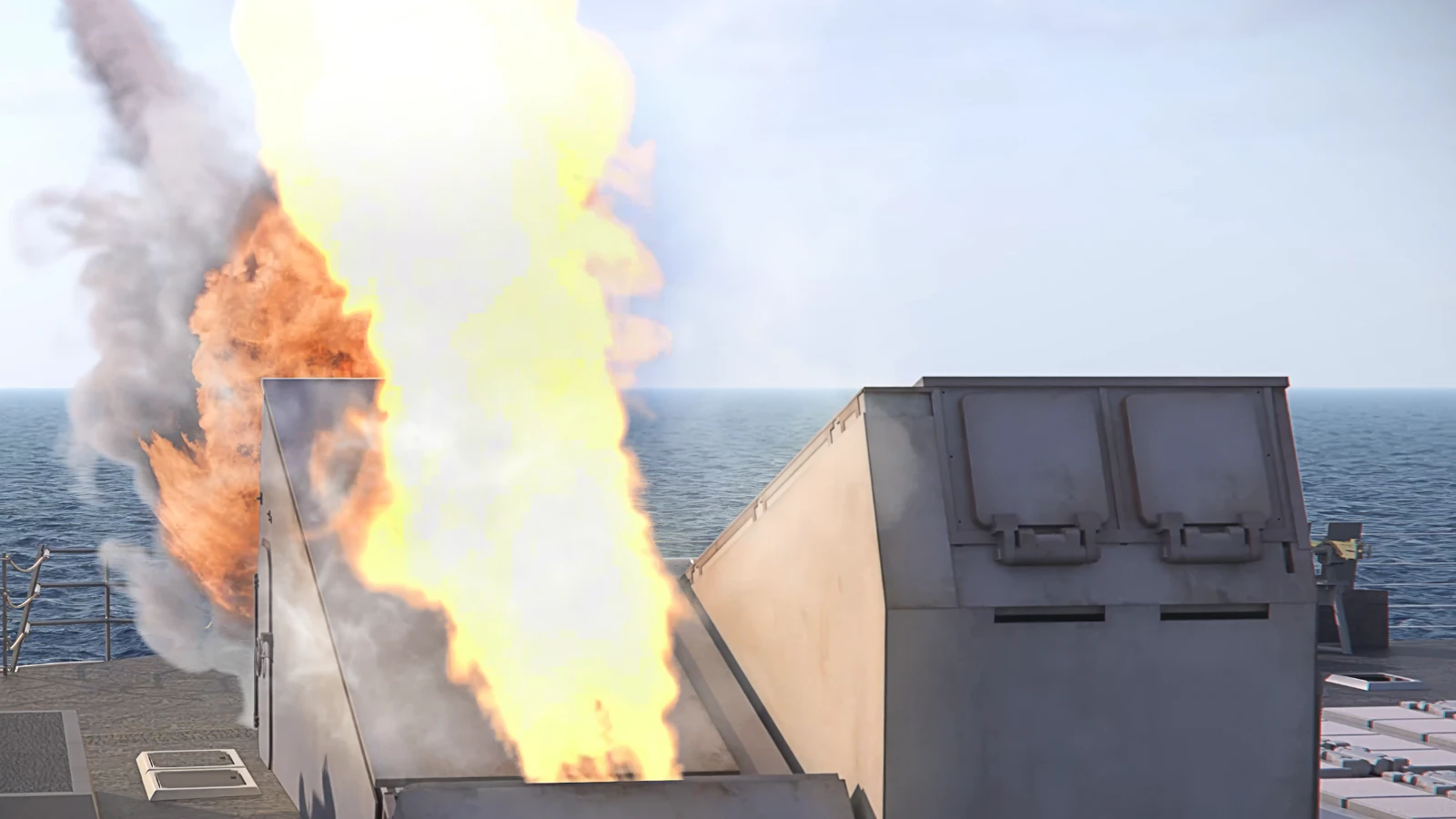
BAE Systems has completed the first live-fire test of its Adaptable Deck Launcher (ADL), a fixed-angle, deck-mounted missile launcher built on Mk 41 Vertical Launching System (VLS) hardware and designed around Evolved SeaSparrow Missile (ESSM) Mk 25 Quad-Pack canisters, the company announced on October 27, 2026. The announcement, datelined China Lake, California, did not disclose the test date, the range used, the missile variant fired or the number of rounds launched.
The launcher was developed under a Department of War contract for the NATO SeaSparrow Project Office (NSPO), the 12-nation consortium that manages ESSM development and production. BAE Systems did not identify the contract vehicle or its value. In July 2023, the company received a $37 million Department of Defense Ordnance Technology Consortium (DOTC) award to design the Next Generation Evolved SeaSparrow Missile Launch System (NGELS), a fixed-angle deck launcher derived from the ADL concept and intended to bring ESSM Block 2 to aircraft carriers and amphibious ships. The test also arrives as the U.S. Navy pushes to rearm warships without returning to port, a priority sharpened by sustained missile expenditure in the Red Sea since late 2023.
How the Adaptable Deck Launcher Reuses Mk 41 VLS Hardware
Instead of occupying below-deck volume, the ADL houses encanistered missiles in a low-elevation enclosure on the weather deck and fires them at a fixed angle. BAE Systems has described the enclosure as minimizing radar signature and providing armored protection against ballistic threats. Launch control runs through the existing Mk 41 electronics suite, so the system shares the logistics chain and spares that already support the Navy’s cruisers and destroyers. BAE Systems is the mechanical design agent for the Mk 41 family and also produces the Mk 25 canister, which packs four ESSMs into a single cell.
Company product literature lists two variants. The Tactical Length Launcher measures 284 inches long, 152 inches wide and 121 inches high and weighs 18,100 pounds. The Strike Length Launcher, sized for longer rounds, measures 318 inches long and 133 inches high and weighs 20,250 pounds. A single module draws 40 kilowatts of 440-volt, 400-hertz three-phase power and 10,000 BTU per hour of cooling, while the Mk 41-based launch control electronics add 4,300 pounds. BAE Systems has not confirmed which configuration fired.
Company literature describes a modular design that allows any number of launch cells to be configured; with a Mk 25 Quad Pack in each cell, every cell holds four ESSMs. The release credits the ADL with expedited reloading at sea using standard shipboard equipment. Keeping canisters at deck level, rather than lowering them into below-deck modules, is the likely enabler.
ESSM Block 2 for Carriers, Amphibious Ships and Medium USVs
The ADL’s primary payload is the RIM-162 ESSM. Publicly available specifications indicate a range beyond 27 nautical miles and a top speed above Mach 4. The Block 2 variant adds a dual-mode active and semi-active X-band seeker, which allows terminal engagement without the launch ship’s illumination radars, and the Navy delivered initial Block 2 rounds for Aegis ships in July 2022.
That seeker matters most on flat-deck ships. Aircraft carriers and big-deck amphibious ships fire ESSM from the eight-cell Mk 29 trainable launcher, which open-source reporting indicates has struggled to integrate the heavier Block 2 round; the Navy’s fiscal 2026 budget request includes work to modify Mk 29 launchers to support it. NGELS was presented in 2023 as the route to field Block 2 on those hulls using Mk 41 subsystems. BAE Systems has not stated whether the launcher tested is the NGELS prototype.
The company also says the ADL is optimized for unmanned warfare, with compact configurations suited to medium unmanned surface vessels. A deck-mounted module fits a small uncrewed hull more readily than a below-deck Mk 41 installation, but BAE Systems did not name a specific uncrewed program or explain how fire control would be handled. BAE Systems further claims the ADL doubles combat capabilities, without specifying a baseline or metric.
Analysis: The ADL is less about a new weapon than about where magazine depth sits on a ship. Fleet air defense capacity is bounded by VLS cells that are slow to replenish underway, and the Navy’s Transferrable Reload At-sea Method (TRAM), first demonstrated aboard the cruiser USS Chosin (CG 65) on October 11, 2024, still lowers canisters into below-deck cells. A launcher that reuses Mk 41 canisters, electronics and supply chains from the weather deck could add ESSM capacity to carriers, amphibious ships and uncrewed hulls without redesigning their interiors, and gives NSPO navies a common option for ships lacking VLS. Deck space, topside weight and blast management will decide how many hulls can actually host it.
Key unknowns remain the missile variant fired, whether a target was engaged and the contract’s value. The next indicators will be guided flight tests, a first shipboard installation and any procurement decision by the Navy or NSPO partners. No fielding timeline has been published.