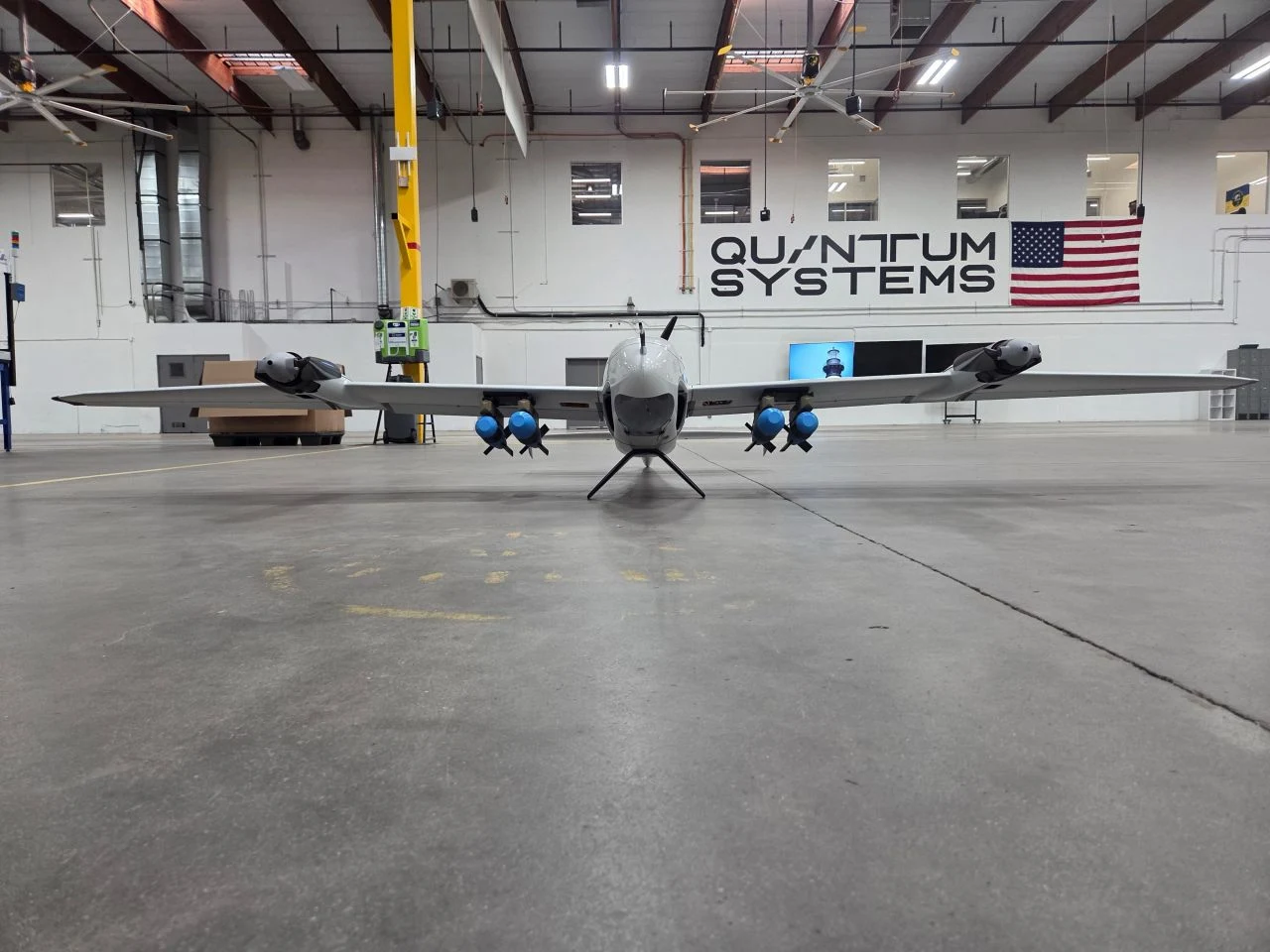
Quantum Systems has shown its Reliant long-range vertical takeoff and landing (VTOL) drone carrying a mixed load of 82 mm mortar rounds and 40 mm grenades on its wing hardpoints, moving a reconnaissance aircraft the company markets as a Group 2 platform into a direct-strike role. Dave Sharpin, chief executive of Quantum Systems Inc., the U.S. subsidiary of the German manufacturer, published the images on LinkedIn on October 28, 2026, describing a “mixed load out of 82mm and 40 mm munitions” and thanking partners from Orbital.
Reliant debuted at SOF Week in Tampa, Florida, in May 2024 as a long-range intelligence, surveillance and reconnaissance (ISR) platform, sitting above the short-range Twister and the mid-range Vector, the drone that built the company’s reputation in Ukraine. The hardpoint variant was developed for the U.S. market, where Quantum Systems has also presented Reliant as a carrier for the Archer first-person-view (FPV) attack drone built by Neros Technologies. A company spokesperson told the German defense outlet hartpunkt in October 2025 that hardpoints were not planned for European-market aircraft, but could be considered if the U.S. variant proved successful and interest was sufficient.
Reliant Drone Payload, Endurance, and Hardpoint Architecture
Quantum Systems announced an upgraded Reliant on July 27, 2026. The new generation uses a hybrid-electric power unit, raises payload capacity to 9 kg (20 lb) and carries a maximum takeoff weight of 45 kg (99 lb), up from the 33 kg listed on the company’s 2025 technical sheet. Endurance exceeds 10 hours, cruise speed is about 25 m/s (90 km/h), and the aircraft tolerates 15 m/s winds while launching from a 10 m by 10 m clearing.
The 2025 technical sheet lists a 160 km datalink range with AES-256 encryption, three NVIDIA Jetson Orin processors for onboard AI and a 4.3 m wingspan, against 3.9 m for the 2024 launch configuration. Mission payloads include electro-optical and infrared turrets, laser designators, synthetic aperture radar, signals intelligence and electronic warfare packages, and satellite communications modules. Reliant runs on the company’s MOSAIC UXS multi-vehicle control software and, according to the company, is built on a European supply chain with no Chinese components and no International Traffic in Arms Regulations (ITAR) restrictions.
The operational value lies in pairing those sensors with munitions on one airframe. An aircraft that can loiter for 10 hours, detect and designate a target, then release ordnance compresses the find-fix-finish cycle into a single sortie without a handoff to a separate strike asset.
Mixing 82mm Mortar Rounds and 40mm Grenades on One Airframe
The two calibers serve different target sets. The 82 mm round is the Soviet-pattern medium mortar caliber, distinct from the NATO-standard 81 mm, and remains in service with Ukrainian and Russian forces, where tail-kitted 82 mm rounds are widely reported as a common bomber-drone munition. Publicly available data puts a typical 82 mm high-explosive round at roughly 3 to 3.3 kg. A 40 mm low-velocity grenade weighs about 0.23 kg, so several can be carried and released individually against personnel or light vehicles.
Against a 9 kg payload ceiling, two 82 mm rounds would absorb most of the available capacity, although Quantum Systems has not stated whether hardpoint stores count against that figure. The rounds in the photographs appear painted blue, the NATO color code for practice ammunition, which suggests inert stores. Sharpin did not disclose the release mechanism, whether the munitions drop ballistically or use glide kits, the targeting workflow, the nature of Orbital’s contribution, or whether live drops have taken place.
Analysis: The armed Reliant reflects a wider shift in which long-range ISR drones absorb part of the strike mission once reserved for loitering munitions. Gravity-dropped mortar rounds and grenades cost a fraction of a purpose-built loitering munition, and a reusable carrier spreads its airframe cost across many sorties. The caliber choice also matters: 82 mm aligns the configuration with Ukrainian and former Warsaw Pact ammunition stocks rather than the 81 mm rounds fielded by U.S. forces, an apparent tension for a variant pitched to American buyers.
Quantum Systems has offered Reliant to the German military and to U.S. customers, but no buyer has been announced for the armed configuration. The next indicators are confirmation of live release trials, disclosure of the weapons-release hardware, and any adaptation of the loadout to 81 mm ammunition for U.S. and NATO users.