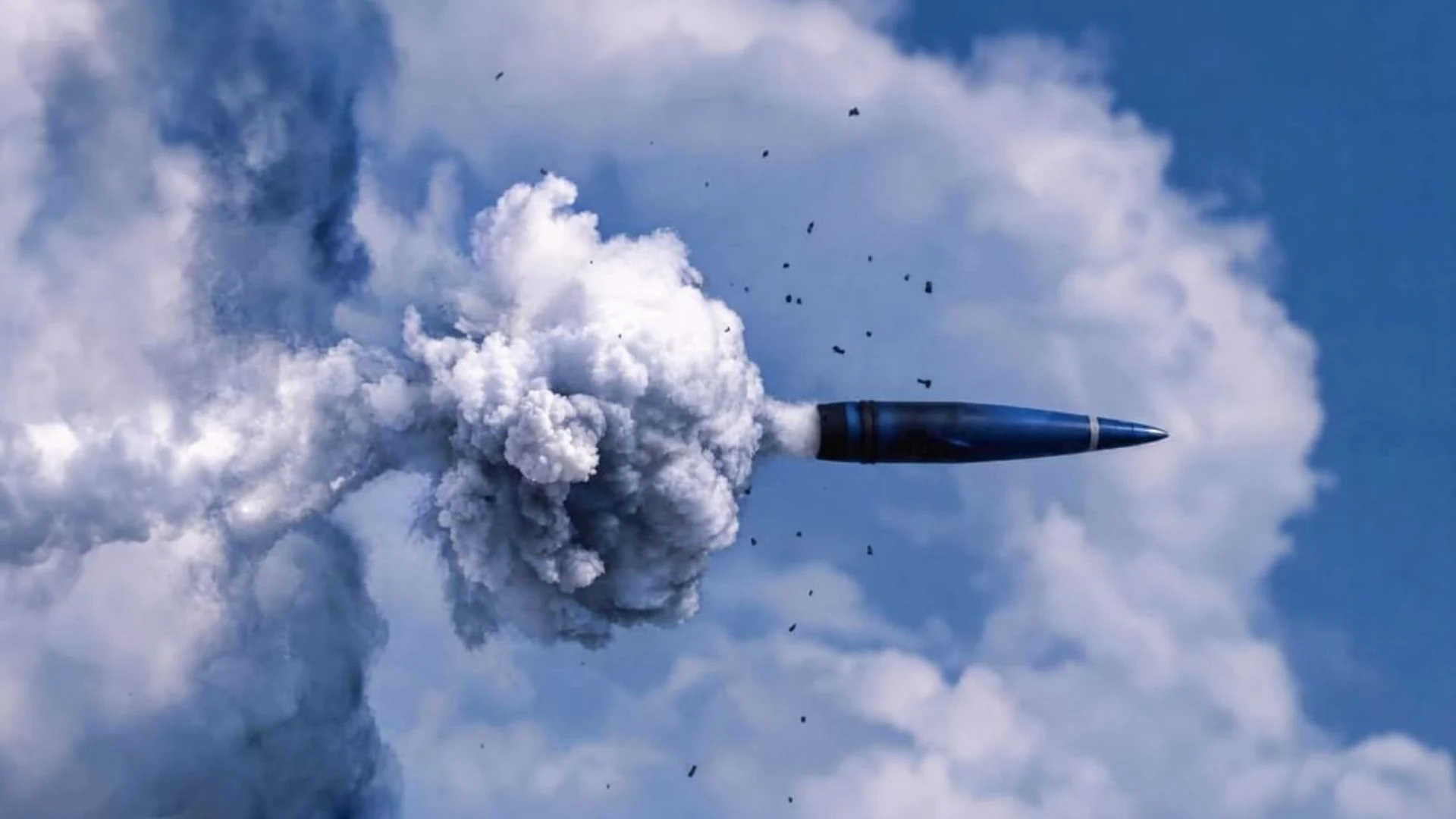
EDGE Group’s munitions subsidiary LAHAB has completed the first dynamic firing test of its 155mm Extended Range Full Bore (ERFB) artillery projectile, a round designed and produced in-house in the United Arab Emirates (UAE), the Abu Dhabi-based group announced on October 28, 2026. All rounds, fired from a 52-caliber barrel, held their predicted trajectories and impacted within the target area, with consistent grouping and tight dispersion, according to the company.
The trial is the first milestone toward qualification under HAZEEM, an EDGE program to develop an entirely UAE-made range of artillery ammunition. LAHAB, the UAE’s only medium- and large-caliber munitions manufacturer, has more than 25 years of production behind it, with a published portfolio spanning grenades, artillery munitions, and aerial munitions. A 155mm extended-range shell designed in-house moves the company into the most heavily consumed munition category in land warfare.
EDGE 155mm Ammunition Test Validates JBMOU Compatibility and Ballistics
The firing tested three objectives, each of which EDGE said was met: compatibility with weapons built to the Joint Ballistics Memorandum of Understanding (JBMOU) standard, agreement between predicted and measured chamber pressures and points of impact, and the structural integrity of the projectile’s components. Saif Al Dahbashi, president of EDGE’s Missiles & Weapons division, said the result moves the design “from the drawing board to demonstrated performance.”
The JBMOU, agreed by the United States, the United Kingdom, France, Germany, and Italy, sets a common 23-liter chamber for 155mm guns, with 52-caliber barrels such as that of Germany’s PzH 2000 as the modern long-range benchmark. Compatibility with that standard is the commercial entry point: it opens the round to a large share of the modern 155mm launchers in service with NATO and partner forces.
ERFB designs use a long, slender ogive and a full-bore body to cut aerodynamic drag compared with legacy M107-pattern shells. EDGE has not disclosed range, muzzle velocity, projectile mass, or explosive fill. Published data on comparable extended-range 155mm rounds indicates about 32 km from 52-caliber guns with a standard hollow base and about 41 km with a base-bleed unit; EDGE has not said whether a base-bleed variant is planned.
The deep intrusion fuze well is the more consequential design choice. It accepts longer fuzes, including proximity and multi-option types, and course-correcting kits of the M1156 Precision Guidance Kit type are built to fit a NATO-standard deep intrusion fuze well, giving the shell a path to precision use without a new body.
From Arena Testing to STANAG 4224: The HAZEEM Qualification Path
The next phase is arena testing, in which static detonations in an instrumented range measure fragment count, mass distribution, and velocity to quantify lethality. Qualification will follow against Military Standard (MIL-STD) requirements and NATO Standardization Agreement (STANAG) 4224, the alliance’s safety and suitability for service evaluation standard for large-caliber ammunition above 40mm. EDGE described qualification as the next major milestone toward demonstrating Safety and Suitability for Service.
Several data points remain undisclosed: the test date and range location, the number of rounds fired, the gun used, the qualification schedule, and planned production capacity.
Analysis: Since 2022, 155mm shells have been the clearest bottleneck in Western ammunition supply, as demand from Ukraine exposed thin production lines and long order books. For the UAE, a domestic design reduces exposure to allocation decisions made by foreign suppliers, and EDGE framed HAZEEM in exactly those terms, with Al Dahbashi saying customers are no longer dependent on other nations’ production priorities. The harder test is energetics. Shell bodies can be machined at scale; propellants and high explosives are where Western supply chains have choked. LAHAB’s October 2024 agreement with Türkiye’s ASSAN Group explicitly targeted a reliable supply chain for energetic materials, and HAZEEM’s credibility as a sovereign program will rest on whether fills and propelling charges are also produced in the UAE. Pursuing STANAG 4224 signals export intent toward NATO-aligned customers.
Arena testing is the next scheduled step, followed by MIL-STD and STANAG 4224 qualification. EDGE has published no timeline for either phase, no production rate, and no launch customer. The indicators to watch are range and accuracy data from future firings, confirmation of a base-bleed variant, and whether HAZEEM extends to propelling charges and fuzes, which will determine how much of the round is genuinely UAE-made.