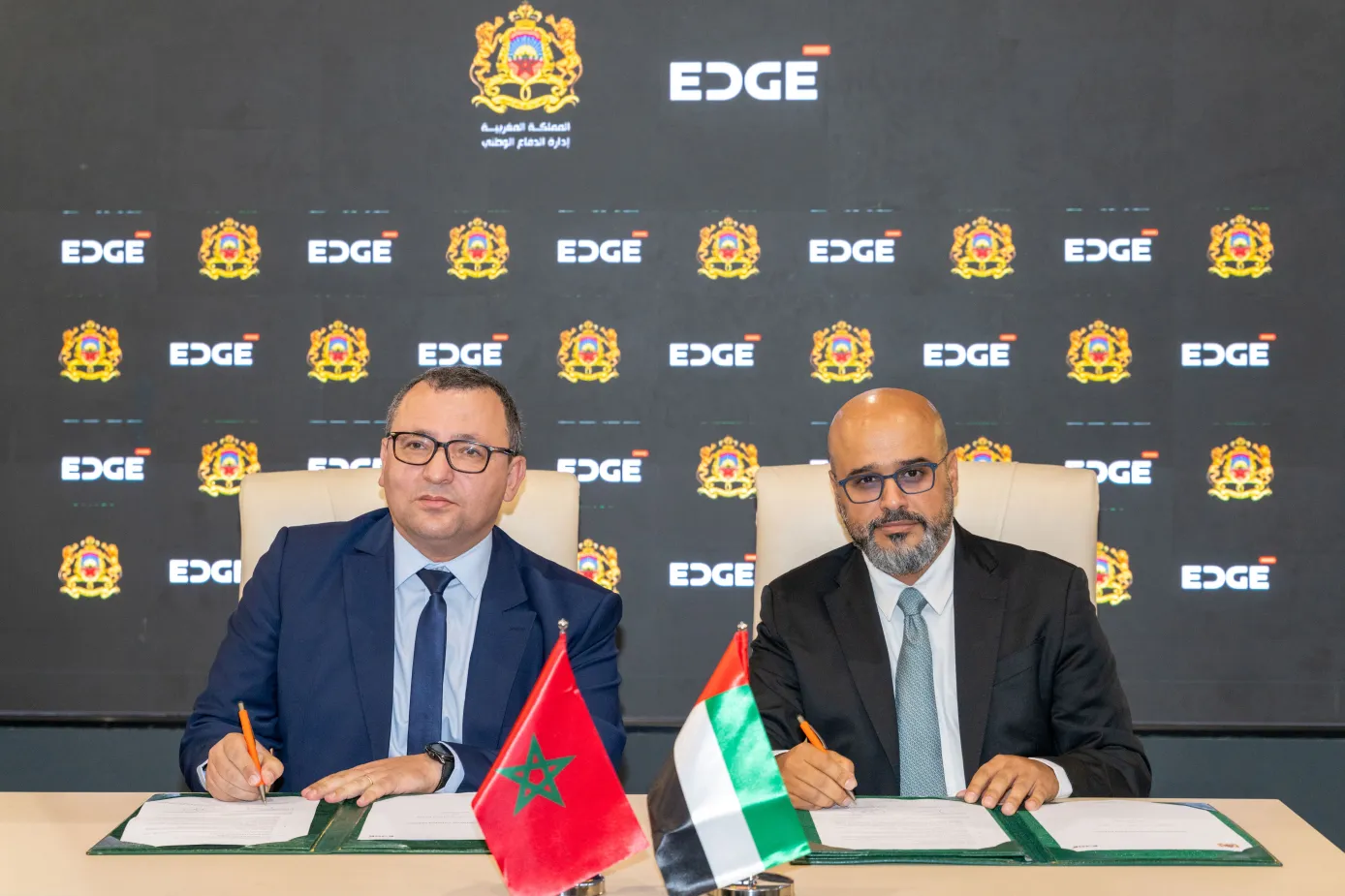
EDGE Group has signed a memorandum of understanding (MoU) with Morocco’s National Defense Administration (ADN), the body that oversees defense procurement for the Royal Armed Forces (FAR), to identify opportunities for local production of small arms and aeronautical engines in the Kingdom. The Abu Dhabi-based group announced the agreement on October 9, 2026, at the Marrakech Air Show, and said production would run through partnerships with Moroccan companies. The announcement points to two EDGE entities: small arms maker CARACAL and propulsion specialist POWERTECH.
The MoU lands as Rabat moves its defense industrial strategy from legislation to production. Law 10-20, in force since mid-2021, set up a licensing regime for the manufacture and trade of defense equipment, weapons, and ammunition, and a decree adopted in June 2024 created two dedicated defense industrial acceleration zones. In November 2025, Abdellatif Loudiyi, the minister delegate in charge of the ADN, told lawmakers that ten projects had been authorized, worth $260 million and more than 2,500 direct jobs, with the zones due to open to investors before the end of 2026.
How the EDGE Group Morocco MoU Builds on CARACAL’s Licensing Model
The document is a framework, not a production contract. EDGE has not disclosed a value, a timeline, production volumes, or the Moroccan companies involved, and it has not specified which CARACAL weapons fall within scope. Hamad Al Marar, EDGE’s managing director and chief executive, described the group’s approach as “built on knowledge exchange, local production, and technology transfer” and singled out Morocco as a key partner in Africa.
CARACAL’s export record points to the likely template. In April 2025, CARACAL and India’s ICOMM opened a small arms complex in Hyderabad under a licensing and technology transfer deal covering the CAR 816 close-quarters battle rifle in 5.56x45mm NATO, the CAR 817 assault rifle in 7.62x51mm NATO, and the CARACAL EF and F GEN II pistols in 9x19mm. In Malaysia, Ketech Asia began with CAR 816 assembly in Pahang under a 2023 agreement, then moved to manufacturing key rifle components under a follow-on deal signed in February 2025. Indonesia’s PT Pindad agreed in 2021 to produce barrels and other components.
The progression runs from final assembly to component manufacturing as local suppliers qualify. Applied to Morocco, that path would shorten resupply lines for FAR individual weapons and give Moroccan firms entry into barrel and receiver machining, the processes that carry most of a rifle line’s manufacturing know-how. EDGE has not said whether the FAR plans to adopt a CARACAL service weapon.
POWERTECH Turbojet and Piston Engines Enter Morocco’s Localization Agenda
The propulsion strand is the less conventional half of the agreement. EDGE launched POWERTECH on February 12, 2025, to develop aero engines and complete propulsion systems, with the group’s own unmanned and autonomous platforms as a core customer. Publicly available specifications indicate a UAE-developed turbojet family rated at 450 N and 1,000 N of continuous thrust for drone and missile applications, and piston engines rated at 10, 80, and 145 horsepower, developed at the company’s research facility in Italy and aimed primarily at high-end surveillance drones. A turbofan in the 4,700 N thrust class is in development.
That portfolio spans persistent intelligence, surveillance, and reconnaissance (ISR) aircraft and jet-powered expendable airframes, two segments where engine supply sets the pace of production. POWERTECH chief executive Marian Lubieniecki said in September 2026 that the company is open to technology transfer and localized production. That stance fits Moroccan procurement rules, which now include an industrial compensation mechanism encouraging ADN suppliers to invest locally and transfer technology. EDGE has not said whether the Moroccan scope covers engine assembly, component manufacturing, or maintenance, repair, and overhaul (MRO).
Analysis: The MoU pairs a mature, low-risk localization product with a strategically harder one. Rifle assembly is a proven CARACAL export formula and a realistic early win for Moroccan subcontractors. Engines are harder: propulsion remains a leading import dependency for drone-building nations, and even partial local production would give Rabat some control over the subsystem that dictates UAV range, endurance, and unit cost. For EDGE, Morocco extends its India and Malaysia localization model into North Africa, where Tata Advanced Systems’ WhAP 8×8 plant at Berrechid, opened in September 2025, set a benchmark of 35 percent local content at launch, rising to 50 percent. The test is whether Morocco’s supplier base can meet aerospace-grade quality standards for engine parts, a far higher bar than small arms production.
No milestones have been made public. The next indicators will be the naming of Moroccan industrial partners, definitive licensing or production agreements under Law 10-20, and any ADN procurement order for CARACAL weapons or POWERTECH engines. Morocco’s two defense acceleration zones, expected to open before the end of 2026, are the most likely home for any production line that results.