HII reported record third-quarter revenue of $3.5 billion on October 29, 2026, up 10.8% year over year, as $32.4 billion in new contract awards pushed the Newport News, Virginia-based shipbuilder’s year-to-date bookings to $43.1 billion. Net earnings rose 49.7% to $217 million, or $5.48 per diluted share, and the company raised its fiscal 2026 shipbuilding revenue guidance to between $10.5 billion and $10.7 billion, from $10.2 billion to $10.4 billion previously.
The quarter captured the long-delayed submarine award the Navy finalized on July 29, 2026: approximately $76.6 billion in contract modifications to General Dynamics Electric Boat and HII’s Newport News Shipbuilding covering nine Block VI Virginia-class attack submarines (SSN 814 to SSN 822), material for a tenth hull, five Build II Columbia-class ballistic missile submarines (SSBN 828 to SSBN 832), and shipyard infrastructure funding. President and CEO Chris Kastner said the quarter’s awards “have now secured approximately 90 percent of our expected shipbuilding revenue through 2030.”
HII Third Quarter Results: Submarines and Carriers Lift Newport News
Newport News Shipbuilding generated $1.91 billion in third-quarter revenue, up 18.1% from $1.62 billion a year earlier, on higher submarine and aircraft carrier volumes. Segment operating income climbed 65% to $132 million, and margin expanded 196 basis points to 6.9%. The company attributed the gain primarily to contract adjustments and incentives on the Virginia-class program, alongside higher throughput on both nuclear lines.
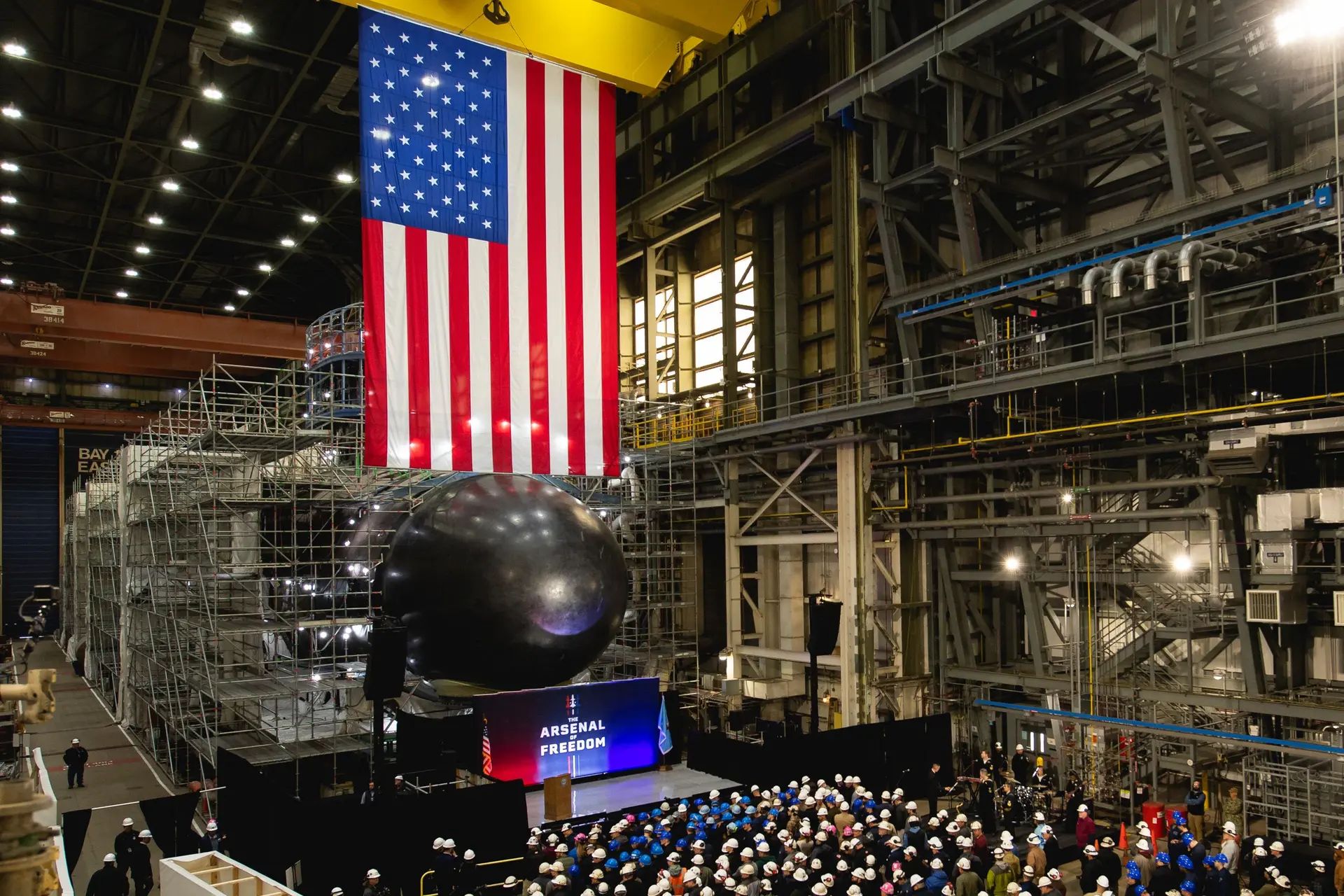
Under the Block VI structure, Newport News serves as delivery yard for six of the nine Virginia-class boats, while Electric Boat remains prime contractor on both submarine programs. The Columbia-class work keeps the yard on the critical path for the sea-based leg of the nuclear triad. Each Columbia carries 16 vertical launch tubes for the UGM-133 Trident II D5 missile, and lead boat District of Columbia (SSBN 826) is slated to deliver in 2028.
On the carrier line, the Navy took preliminary acceptance of John F. Kennedy (CVN 79), the second Gerald R. Ford-class carrier, on September 29, 2026, after acceptance trials concluded on August 15. The ship is roughly 99% complete, with four of its 11 Advanced Weapons Elevators still in final testing, and formal delivery is projected for spring 2027. Newport News also received a long-lead materials contract for the planned carrier CVN 82; HII did not disclose its value.
Ingalls Margin Slips as Surface Combatant Performance Weighs on Results
Ingalls Shipbuilding in Pascagoula, Mississippi, posted $876 million in revenue, up 5.8%, driven by higher amphibious assault ship volumes. Profitability moved the other way: segment operating income fell 9.2% to $59 million, and margin contracted 112 basis points to 6.7%, which HII attributed primarily to lower performance on surface combatants. Combined, the two shipyards produced $2.79 billion in quarterly revenue at a 6.9% shipbuilding operating margin, above the reaffirmed full-year range of 6.0% to 6.5%.
The yard’s quarterly milestones centered on production capacity rather than deliveries. Ingalls christened the Arleigh Burke-class guided missile destroyer George M. Neal (DDG 131) and erected the first grand block built by distributed shipbuilding partners on Thad Cochran (DDG 135). It also extended its distributed shipbuilding model, which shifts module fabrication to outside yards and manufacturers, to amphibious ships.
Automation is the second lever. Ingalls signed performance-based production agreements with Path Robotics and GrayMatter Robotics to accelerate automation across Navy shipbuilding programs, and launched an intelligent mechanized automated welding pilot with South Korea’s HD Hyundai Heavy Industries.
ROMULUS and Lionfish Push Mission Technologies Margin to 9 Percent
Mission Technologies revenue was essentially flat at $792 million, up 0.6%, as growth in Unmanned Systems offset lower Global Security volumes. Segment operating income more than doubled to $71 million, lifting margin 464 basis points to 9.0%, on a milestone achievement in Unmanned Systems and higher equity income from nuclear and environmental joint ventures. EBITDA margin reached 11.9%, against 7.8% a year earlier, and the division recorded a 2.4x book-to-bill ratio.
The division also won a $2.2 billion contract to advance US surveillance and intelligence capabilities for the Western Hemisphere; HII has not identified the customer or detailed the scope. In maritime autonomy, the Navy ordered 10 ROMULUS unmanned surface vessels under the Medium Unmanned Surface Vessel (MUSV) program, following an at-sea evaluation phase completed with partners Applied Intuition, Greenroom Robotics and Rodi Marine.
ROMULUS runs on HII’s Odyssey Autonomous Control Solutions software, and hulls are built through a distributed model, with ROMULUS 151 in production at Breaux Brothers in New Iberia, Louisiana. The Navy also exercised an option year for Lionfish Small Unmanned Undersea Vehicle (SUUV) production, and HII expanded its unmanned production facility by 25% to meet rising global maritime demand.
Analysis: With roughly 90% of shipbuilding revenue through 2030 under contract, HII’s constraint has shifted from orders to execution, and the execution numbers are mixed. Newport News margin gains rest largely on Virginia-class incentives and contract adjustments, while Ingalls margin is eroding on surface combatants. Cash is the sharper signal: third-quarter free cash flow recovered to $429 million, from $16 million a year earlier, but nine-month free cash flow still stands at negative $182 million, cash fell from $774 million at the end of 2025 to $387 million, and contract liabilities dropped from $1.22 billion to $780 million as customer advances unwound. Meeting the reaffirmed $500 million to $600 million full-year free cash flow target requires $682 million to $782 million in the fourth quarter alone, a direct test of how quickly new submarine funding converts into cash at the yard.
Next milestones include formal CVN 79 delivery in spring 2027, the first ROMULUS hulls under MUSV, and fourth-quarter cash generation against a cumulative fiscal 2026 and 2027 free cash flow target of $1.2 billion to $1.3 billion. Mission Technologies guidance holds at $3.0 billion to $3.2 billion in revenue, with segment margin raised to approximately 6% from 5%. Open questions remain on HII’s share of the $76.6 billion submarine award and the value of the MUSV contract.