China is pushing its arms sales to Africa into higher-end categories, with air-defense systems, armed drones and electronic warfare equipment entering inventories once supplied mainly by Russia and Western governments. Norinco Yitian-L short-range air-defense systems appeared in a Malian military convoy in April 2026, Burkina Faso released footage of a Chinese surface-to-air missile system firing on September 1, 2026, and Ivory Coast confirmed on August 10, 2026, that it operates Wing Loong II armed drones.
Mali and Burkina Faso ended defense cooperation with France after their military takeovers, remain subject to restrictions on US security assistance, and have turned to Moscow for military support and to Beijing for hardware as they fight jihadist insurgencies. Stockholm International Peace Research Institute (SIPRI) data released March 9, 2026, show China supplied 22% of sub-Saharan Africa’s major arms imports in 2021-2025, ahead of Russia at 12% and Türkiye at 11%.
China Arms Sales Move Into Air Defense Across the Sahel
Defense intelligence firm Janes identified the four vehicles seen in the Malian convoy as Yitian-L systems built by China North Industries Group Corporation (Norinco), moving without missiles and with their radars folded. Mali signed the contract with Norinco in September 2024.
The Yitian-L, the lightweight member of the Yitian family, mounts four TY-90 infrared-homing missiles and an X-band 3D search radar on a Dongfeng Mengshi 4×4 tactical vehicle, half the eight-round load of the original Yitian and the Yitian II, both carried on wheeled armored personnel carriers. Norinco credits the radar with an 18-kilometer detection range and the TY-90, originally a helicopter air-to-air missile, with a 6-kilometer maximum range and a 4-kilometer ceiling. That envelope makes it a point-defense weapon for maneuver columns and bases against helicopters, low-flying aircraft and drones.
Burkina Faso’s system sits a tier higher. Janes assessed the launch canisters in the presidential footage as consistent with Norinco’s Sky Dragon 30, and the accompanying radar has been identified as an IBIS-150 3D target-designation set, although Ouagadougou has not confirmed either designation. Norinco advertises the Sky Dragon 30 as an infrared-guided interceptor reaching 30 kilometers in range and 18 kilometers in altitude; publicly available specifications credit the IBIS-150 with detection out to roughly 130 kilometers. If confirmed, that gives Burkina Faso a medium-range layer with five times the reach of Mali’s TY-90s.
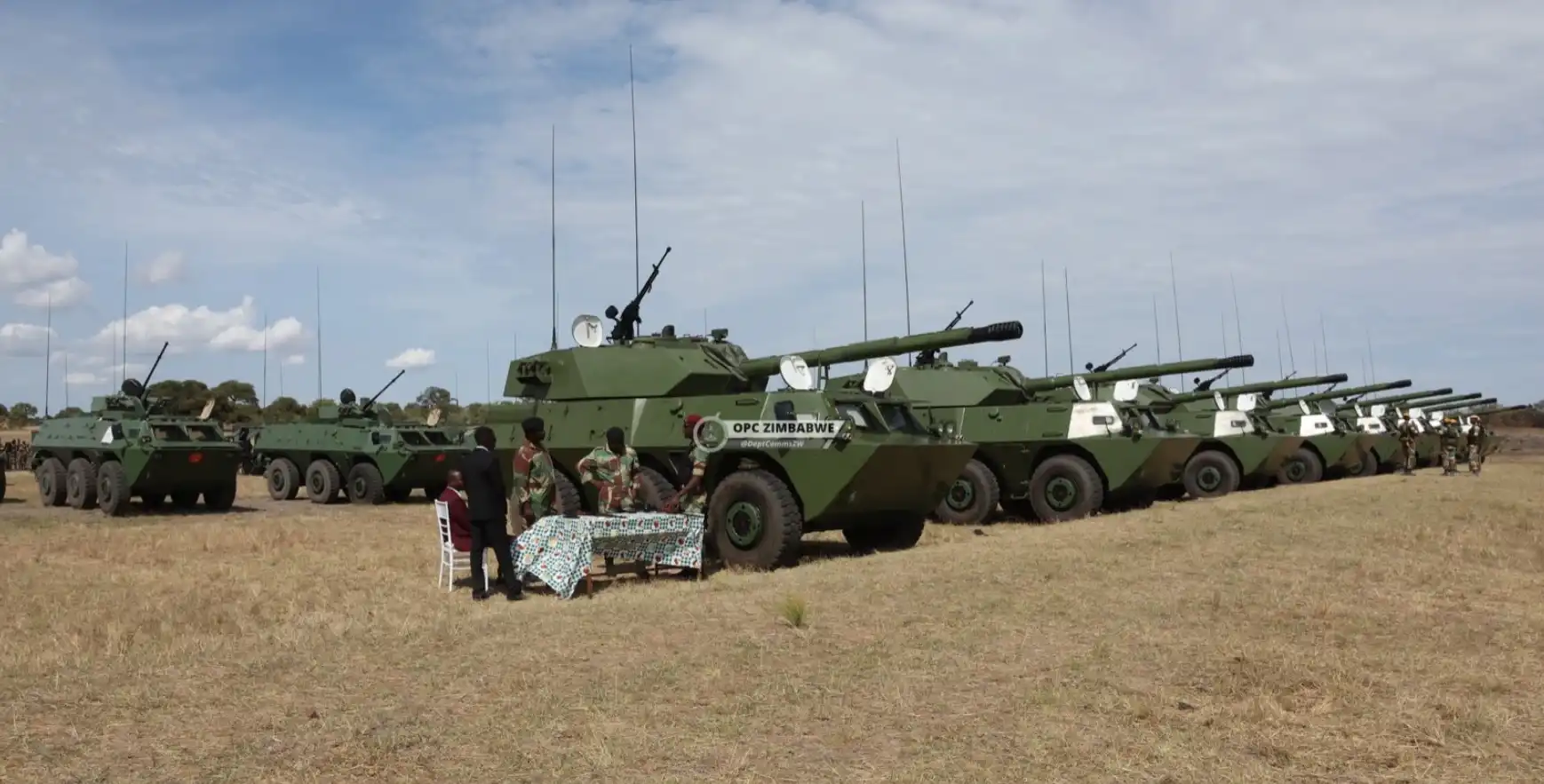
It follows Chinese ground deliveries to Burkina Faso in 2024 and 2025, including VN22B and WMA301 fire-support vehicles, WZ-551 armored personnel carriers, SR5 rocket launchers and PLL-05 120 mm self-propelled gun-mortars.
Wing Loong II Armed Drones Extend China’s Reach Beyond the Sahel
Chinese drones are also reaching states with close Western ties. Ivory Coast’s armed forces released video on August 10, 2026, showing two Wing Loong II medium-altitude, long-endurance (MALE) aircraft at Bouaké Air Base, delivered under a June 2024 contract with China National Aero-Technology Import and Export Corporation (CATIC), the export arm of Aviation Industry Corporation of China (AVIC). Ivory Coast is the second West African operator of the type after Nigeria.
CATIC lists the Wing Loong II with a 200-kilogram internal payload, up to 480 kilograms of external stores and endurance of up to 20 hours; publicly available specifications indicate an 11-meter length and a 20.5-meter wingspan. For Abidjan, that means persistent surveillance and strike coverage along its northern border with Mali and Burkina Faso, the axis along which jihadist violence threatens coastal West Africa. Algeria, Morocco and Egypt already fly Wing Loong-family drones.
Liselotte Odgaard, a senior fellow at the Hudson Institute, told the South China Morning Post (SCMP) that these appearances signal “more than just an expanded catalogue.” In her assessment, many African states cannot readily obtain comparable armed drones from the United States or Europe, and Chinese manufacturers bundle training, maintenance and financing with the hardware. She expects armored vehicles, trucks and artillery to remain the bulk of Chinese deliveries by volume. No specific Chinese electronic warfare system delivered to an African customer has been publicly identified.
How Norinco Is Building a Sustainment Network in West Africa
Norinco is pairing sales with support infrastructure, starting with a regional office in Dakar, Senegal, opened in 2023. In Nigeria, the Nigerian Army-Norinco Comprehensive Service Centre at the Armoured Corps base in Bauchi was commissioned in April 2025 and began full operations on August 27, 2026. Nigerian officials say it will handle maintenance up to level 4 on Norinco-supplied equipment, a fleet that includes VT4 main battle tanks and ST1 8×8 fire-support vehicles in Nigerian service since 2020.
Continent-wide SIPRI figures temper the picture. Africa’s major arms imports fell 41% between 2016-2020 and 2021-2025, and the United States led suppliers to the continent with 19%, ahead of China at 17%, Russia at 15% and France at 8.3%. Sub-Saharan imports, by contrast, rose 13%. Katarina Djokic, a researcher with SIPRI’s arms transfers program, told the SCMP that African deliveries were too small to move China’s overall export totals and that price drove purchases even among states with good Western relations. David Shinn, a former US ambassador to Burkina Faso and Ethiopia, told the newspaper that China had displaced Russia as the top supplier to sub-Saharan Africa and would sell to any government not under United Nations sanctions.
Analysis: The qualitative shift matters more than market share. Air-defense batteries, MALE drones and depot-level maintenance centers bind operator training, missile resupply and spare parts to Chinese suppliers for a decade or more. In the Sahel, the pattern suggests a division of labor rather than rivalry: Russia’s Africa Corps provides personnel and operational support while Beijing fills hardware gaps Moscow cannot cover during the Ukraine war. For Washington and Paris, the contest now lies in coastal states such as Ivory Coast and Nigeria, where Chinese packages compete on price and availability.
Burkina Faso has not disclosed missile quantities, and Mali’s Yitian-L vehicles have not yet been shown with missiles loaded. The Nigerian Air Force examined the Sky Dragon system during a 2025 visit to China, making Abuja a candidate for Chinese medium-range air defense. SIPRI’s next trends release, expected in March 2027, will show whether the shift toward higher-end systems registers in delivery volumes.