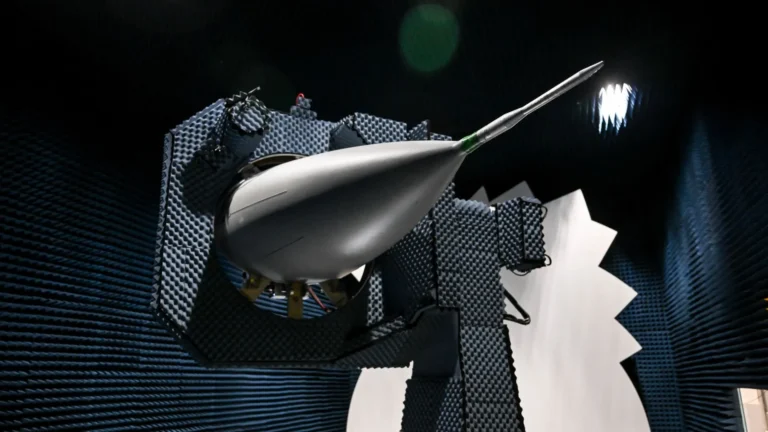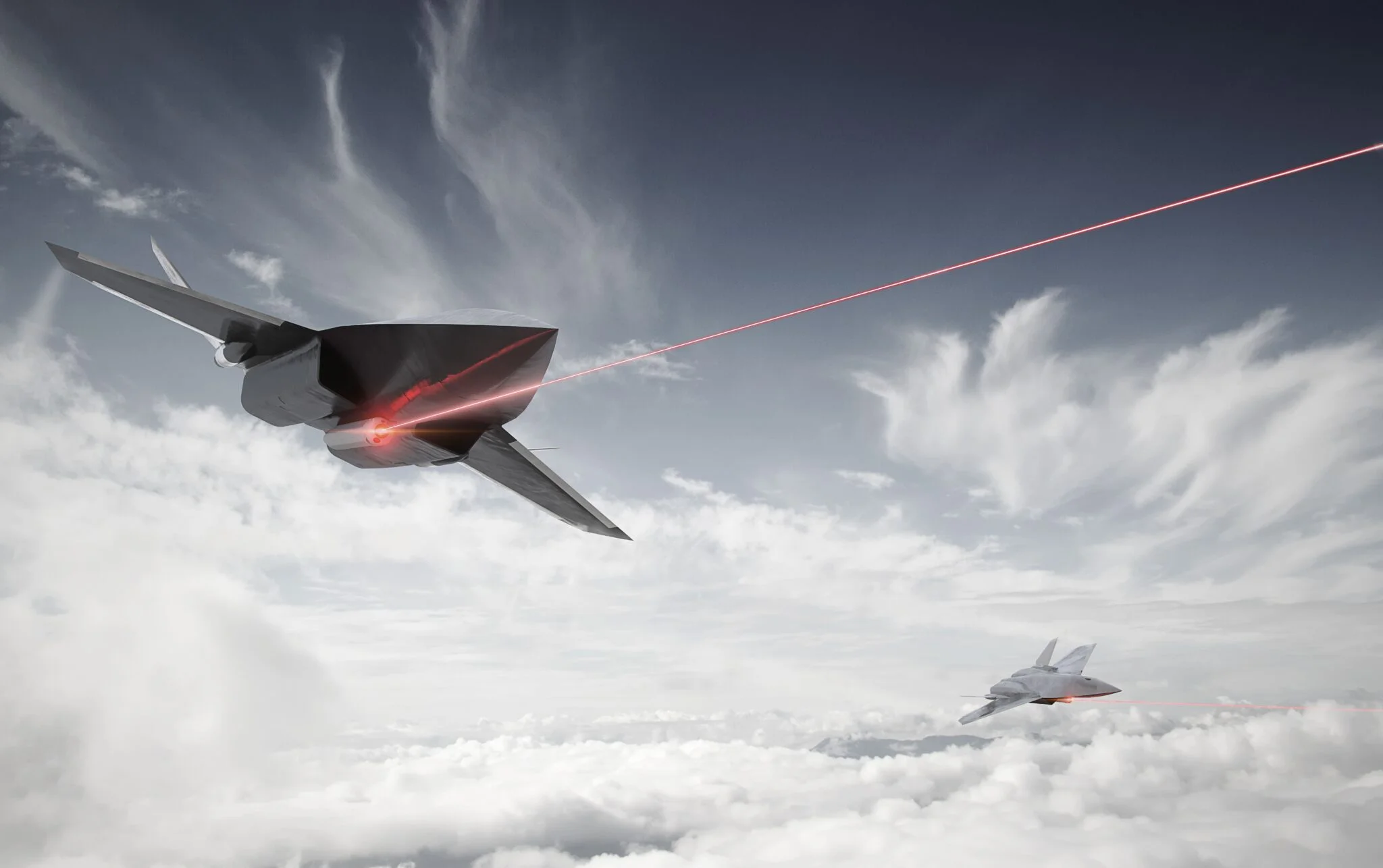
Germany’s Federal Office of Bundeswehr Equipment, Information Technology and In-Service Support (BAAINBw) has contracted MBDA Deutschland to build a demonstrator for an airborne high-energy laser (HEL) weapon, the company announced on November 2, 2026. The effort will test whether a laser weapon can work aboard aircraft and lay the groundwork for a future German Air Force (Luftwaffe) capability, with drones and cruise missiles named as primary targets.
The award gives Germany a dedicated airborne track alongside its naval laser program, which entered development in July 2026, and arrives five months after Berlin and Paris abandoned the New Generation Fighter at the core of the Future Combat Air System (FCAS). MBDA disclosed neither the contract value nor the schedule or carrier platform. It did confirm that core components of the so-called Laser-Pod must be designed from the outset for later flight operations, so hardware built for ground trials can migrate to an aircraft.
MBDA Airborne Laser Pod: Power, Size, and 2031 Flight Test Target
MBDA Deutschland managing director Thomas Gottschild told the German daily Die Welt that the contract was awarded in spring 2026 and covers a roughly three-year effort to build the technological foundations. Essential components will be built and tested first, with flight testing of the airborne demonstrator planned for 2031. Gottschild estimated that operational deployment could follow in the early to mid-2030s and said the project originated in the FCAS program.
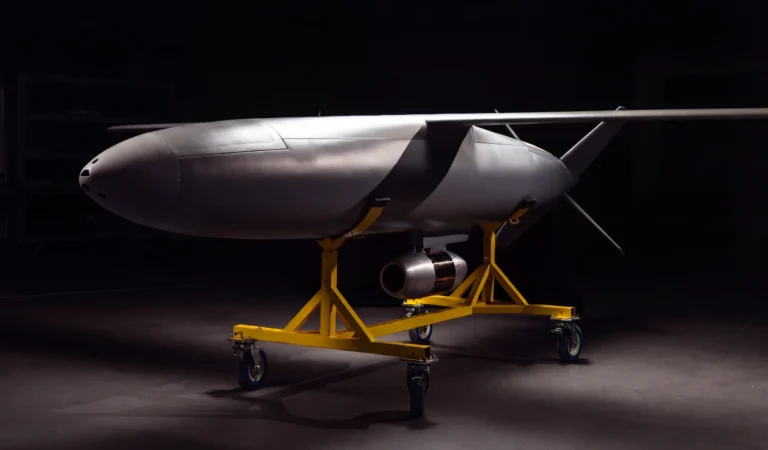
The initial concept is a pod carried beneath an aircraft fuselage. Its first-iteration size has been described as comparable to a Taurus KEPD 350 cruise missile; publicly available specifications put that weapon at 5.1 meters long and roughly 1,400 kilograms. A store in that class would compete with fuel tanks and heavy munitions for load-bearing stations on any fighter-sized carrier, a trade that will weigh on platform selection.
Reported figures put the laser source at up to 10 kilowatts, half the up-to-20-kilowatt output of the naval demonstrator MBDA tested with Rheinmetall. That output is adequate against small unmanned aircraft at short range. Defeating cruise missiles at useful standoff distances is generally assessed to require substantially more power, which marks the 2031 article as a pathfinder for beam control, power and thermal management rather than a final effector. The design is also meant to exclude US components, an ITAR-free approach that keeps future integration and export decisions in German hands.
From SHiELD to Elbit: Lessons From Earlier Airborne Laser Efforts
MBDA itself describes airborne lasers as the most demanding discipline in laser weaponry, citing constraints on size, weight and resistance to flight conditions. Vibration, large temperature swings, onboard power generation and degraded beam transmission through fog or heavy rain compound the challenge.
The US experience illustrates the risk. The Air Force Research Laboratory (AFRL) ran the Self-Protect High Energy Laser Demonstrator (SHiELD), with Lockheed Martin developing the laser, Northrop Grumman the beam control and Boeing the pod. A pod with the SHiELD shape was flight-tested in 2019, and a ground-based surrogate laser shot down air-launched missiles at White Sands Missile Range that same year. The fighter flight demonstration, first planned for 2021, slipped to fiscal 2024, and the Air Force closed the program in May 2024 without ever installing a laser pod on a fighter.
Israel took a narrower route. In June 2021, the Israel Ministry of Defense’s Directorate of Defense Research and Development, Elbit Systems and the Israeli Air Force intercepted several drones over the Mediterranean using a high-power laser mounted on a light aircraft, at a range of about 1 kilometer. MBDA’s stated target set of drones and cruise missiles sits closer to that counter-UAS emphasis than to SHiELD’s goal of defeating incoming air-to-air and surface-to-air missiles.
Naval Laser Heritage and Sovereign Supply Chains Behind the Program
MBDA’s laser credentials rest largely on the maritime domain. Under an earlier BAAINBw contract, MBDA and Rheinmetall Waffe Munition integrated a Laser Weapon Demonstrator scalable to 20 kilowatts aboard the F124 frigate Sachsen in June 2022 and trialed it for nearly a year across six test campaigns, firing more than 100 live shots. MBDA handled tracking, the operator console and the link to the command system; Rheinmetall the laser weapon station, beam guidance, cooling and integration.
Across 28,000 nautical miles at sea and subsequent use at the Bundeswehr Technical Center for Weapons and Ammunition (WTD 91) in Meppen, the demonstrator fired more than 1,000 successful shots against air, sea and land targets, according to the companies. On July 9, 2026, BAAINBw contracted their working group, ARGE HEL, to develop an operational naval laser weapon for service by 2029.
Tracking is the most transferable piece: the naval system concentrates its energy on a spot a few centimeters across, according to its developers, a precision that becomes far harder to sustain from a maneuvering airframe. MBDA stresses German supply chains and national system competence, noting that laser technology has been a German research priority since 2019 and is designated a national key technology under the federal government’s security and defense industry strategy.
Analysis: The contract is less about putting a laser on a Luftwaffe aircraft this decade than about securing a sovereign directed energy pathway into Germany’s next combat air ecosystem. With the FCAS fighter pillar gone and MBDA among the eight companies in the Airbus-led Team Gen 6 industrial alliance, an ITAR-free laser pod gives Berlin a counter-drone and self-protection module it can integrate into a national, GCAP-linked or other sixth-generation path without US export licensing. SHiELD’s fate shows the downside: a well-funded program can stall on power, cooling and beam control long before flight. A 10-kilowatt-class flight article in 2031 would trail Israel’s airborne intercepts by a decade, so its value lies in maturing those enabling technologies on German terms.
Key unknowns remain the contract value, the test aircraft and the power growth path toward cruise missile defense. Upcoming markers include ground trials of flight-representative components, any Luftwaffe requirement linking the pod to Team Gen 6, and the naval system’s 2029 service target, a gauge of how quickly German industry can field a laser.