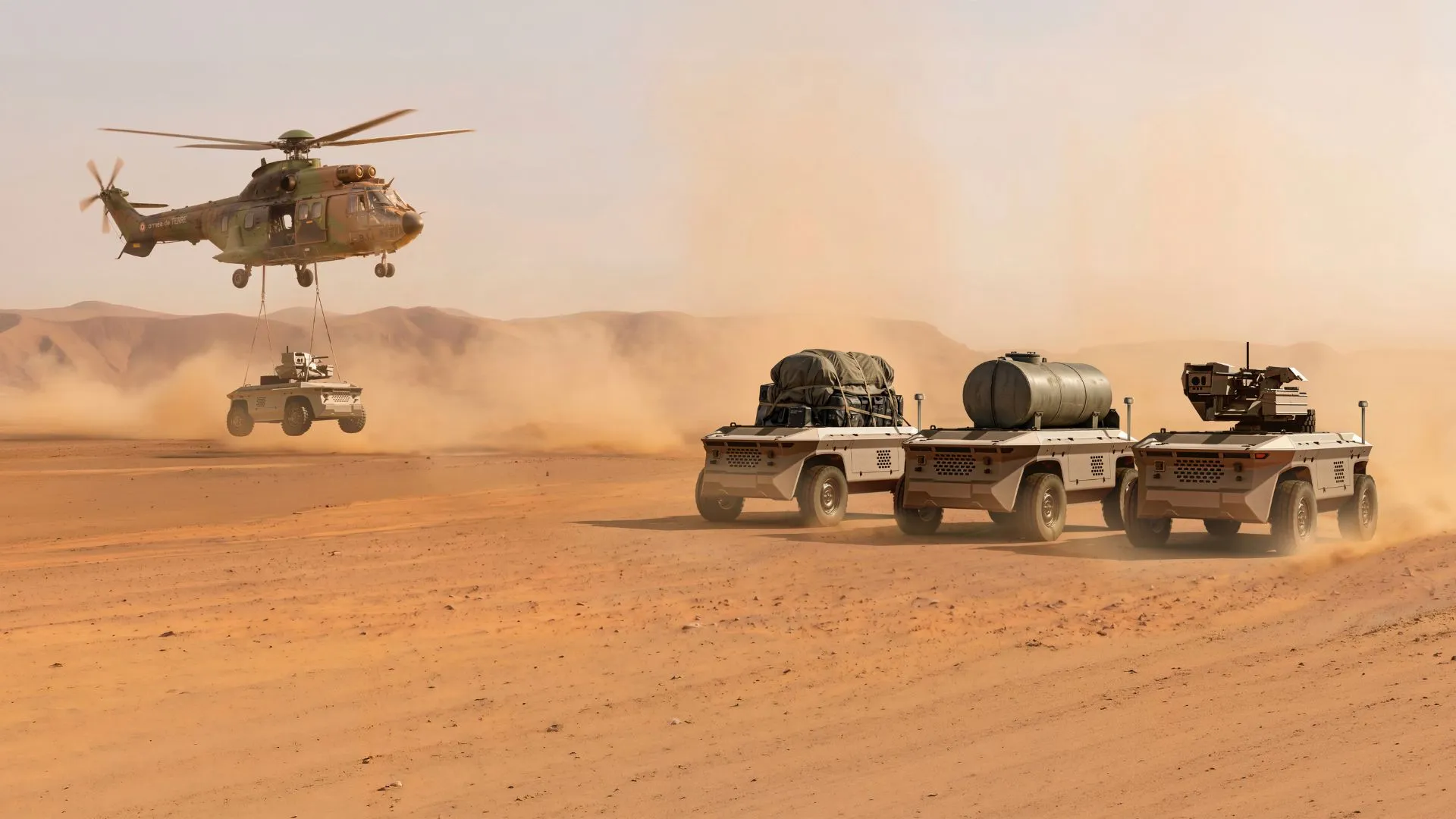
Renault Group and Belgian industrial group John Cockerill unveiled Forefront Concept on November 3, 2026, a remotely operated unmanned ground vehicle (UGV) built around four-wheel drive, four-wheel steering and two electric motors. The platform targets a range of approximately 400 kilometers and a payload of up to one tonne, and it will take part in several exercises and trials with the French armed forces in the coming weeks, according to the two companies.
The reveal turns into hardware a ground robotics effort Renault first acknowledged in March 2026, when the carmaker confirmed it was testing ground robots with both military and civilian potential. It is the latest step in Renault’s return to defense work since the Ministry of the Armed Forces approached the carmaker, after the Chorus long-range drone program with Turgis Gaillard and the 4 TROOP hybrid 4×4 developed with Thales. The partnership also closes an industrial loop: John Cockerill Defense acquired French military vehicle maker Arquus from Volvo in July 2024, and Arquus is the former Renault Trucks Defense, which left Renault’s orbit in 2001.
Forefront Concept UGV Mobility, Range and Payload Targets
The Forefront Concept UGV combines a dual electric motor powertrain with all-wheel drive and all-wheel steering, a layout the companies say delivers high mobility, tight maneuverability and strong off-road performance across all terrain types. Four-wheel steering matters most where a robotic mule earns its keep: narrow forest tracks, rubble-strewn urban ground and confined logistics areas where a conventional wheeled vehicle needs multipoint turns.
Electric drive also makes the platform silent in operation, reducing its acoustic signature during Intelligence, Surveillance and Reconnaissance (ISR) tasks or resupply runs near the front. The roughly 400-kilometer range is a target figure and can be extended with a range extender whose type has not been disclosed. The one-tonne payload is also a target, and would place Forefront in the medium UGV class, able to carry ammunition, supplies or a mission module.
The companies list logistics support, ISR, counter-drone operations, fire support and evacuation among military uses, alongside civil protection, logistics and work in hazardous environments. Key data remains unpublished: dimensions, weight, top speed, battery capacity, motor output, protection level, sensor suite and datalink architecture.
How Renault and John Cockerill Split the Engineering Work
Renault designed the mobile platform, drawing on modular architectures that reuse proven automotive components. The group applied design-to-cost and design-to-manufacturing principles from the earliest stages to cut development costs and lead times and support large-scale production. It also contributed more than 15 years of electrification experience in powertrains and batteries.
John Cockerill designed the remote-operation and autonomy functions and brought expertise in vehicle militarization, mission-system integration and operational support. The company said it developed modular, scalable remote operation and autonomy solutions intended to eventually allow fully autonomous operation while preserving system safety and security. For now, the platform is presented as remotely operated, with full autonomy stated as a goal rather than a delivered capability.
John Cockerill CEO Jean-Luc Maurange described the vehicle as built on a “modular, open and scalable robotic architecture” combining mobility, autonomy and tactical communications to reduce soldiers’ exposure to danger. Renault Group CEO François Provost presented the project as proof of what the carmaker’s industrial expertise can bring to a strategic sector.
Analysis: Forefront’s differentiator is industrial rather than technological. By pairing automotive-grade components and production engineering with a defense integrator that already owns France’s main military vehicle supplier, the partnership targets the gap between demonstrator and fleet. The model mirrors Chorus, where Renault supplies industrialization and its defense partner supplies mission systems. Its credibility will rest on figures neither company has released, unit cost and production rate, and on whether the remote-operation and communications stack holds up under electronic warfare pressure.
The immediate milestone is the series of exercises and trials with French forces scheduled for the coming weeks, which the companies say will refine the design based on operational feedback. No contract, procurement program, unit price or production timeline has been announced. Whether the trials feed a formal requirement from the Directorate General of Armament (DGA) will determine if Forefront moves from demonstrator to fielded system.