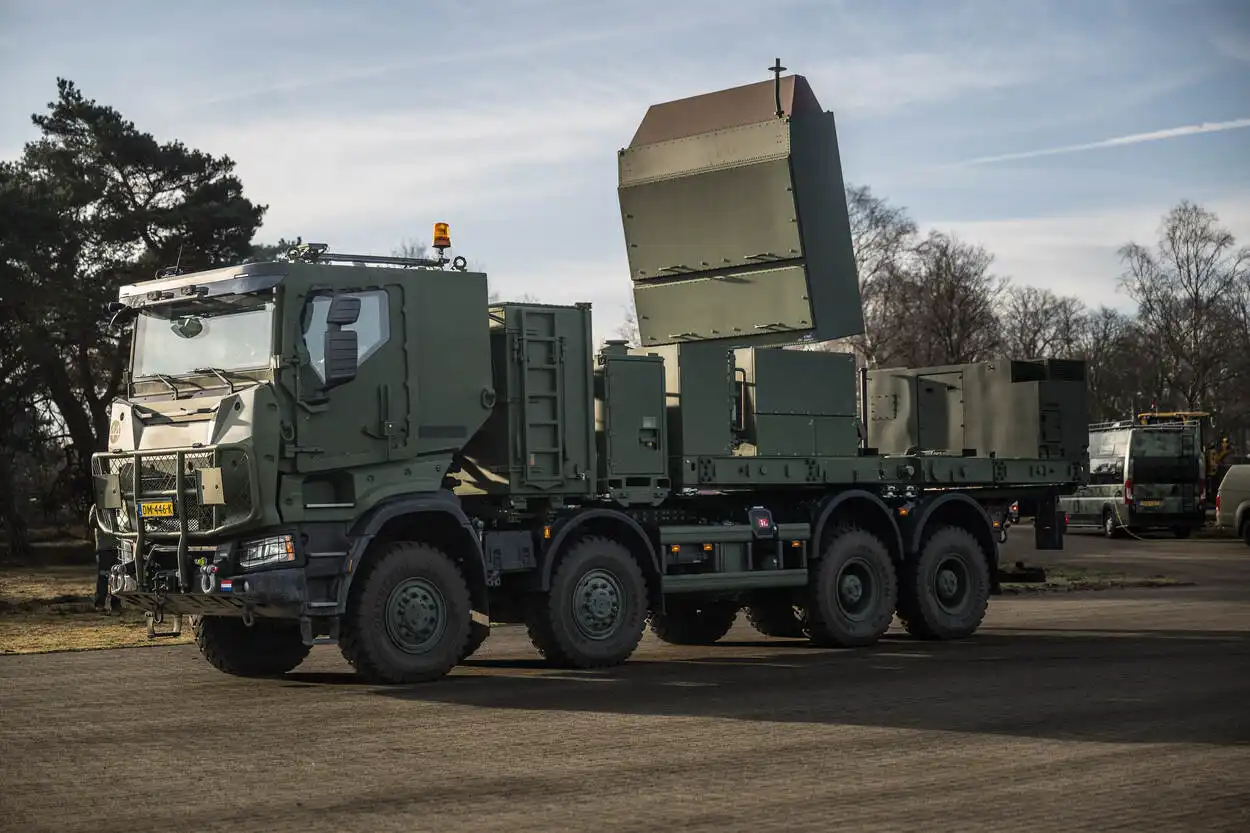
Thales will supply Ground Master 200 Multi-Mission Compact (GM200 MM/C) radars to Belgium as the sensor backbone of Blue Dome, the country’s new layered air-defense network, the company announced on November 10, 2026. The radar will be integrated with Kongsberg’s Fire Distribution Centre (FDC) and the National Advanced Surface-to-Air Missile System (NASAMS), creating a sensor-to-shooter chain that links detection, command and control, and Raytheon interceptors. Thales has not disclosed the number of radars, the contract value, or the delivery schedule.
The decision fixes the sensor layer of a program that has moved quickly since mid-2026. Belgium has operated without a ground-based air-defense capability of its own for roughly two decades. In July 2026, at the NATO summit in Ankara, Defence Minister Theo Francken announced a joint procurement with the Netherlands covering 10 NASAMS fire units, one of them for Luxembourg, and 20 Rheinmetall Skyranger 30 gun systems, a package valued at €3.1 billion including ammunition. As announced by Belgium, the package also covered 14 Thales GM200 radars and 54 Iveco command vehicles. On September 29, 2026, Kongsberg signed a contract worth NOK 10 billion (about $1.04 billion) with the Dutch defense procurement authority, which is buying NASAMS on behalf of the Belgian Air Force. Francken has said the first Belgian NASAMS unit is expected in the second half of 2027.
GM200 MM/C Specifications and Its Role in Blue Dome Air Defense
The GM200 MM/C is a 4D active electronically scanned array (AESA) radar developed and produced by Thales Nederland in Hengelo. It is the land derivative of the Thales NS200 naval radar and combines air surveillance, air defense, and weapon-locating missions in a single system. According to Thales, it detects, tracks, and classifies simultaneous threats ranging from small drones and loitering munitions to missiles, helicopters, low-flying aircraft, and rocket, artillery, and mortar (RAM) fire.
Publicly available specifications indicate S-band operation with gallium nitride (GaN) transmit/receive modules, 360-degree azimuth coverage, elevation up to 80 degrees, an instrumented surveillance range of up to 400 km, a weapon-locating range of about 100 km, and altitude coverage to 30,000 m. Thales says the radar deploys in under 60 seconds, fits in a standard 20-foot ISO container, and can be operated remotely within a network.
Those characteristics shape how Blue Dome will fight. A sub-minute encamp and decamp time lets a radar displace after emitting, reducing exposure to anti-radiation weapons and long-range fires, a lesson reinforced by the war in Ukraine. The weapon-locating function also gives Belgian commanders one sensor that can feed both the air-defense and fire-support chains. In many existing NASAMS batteries, the Raytheon AN/MPQ-64F1 Sentinel fills the sensor role; Belgium instead follows the Dutch path of pairing NASAMS with a European radar. Thales calls this the GM200 MM/C-NASAMS configuration, tailored to the FDC and to Raytheon’s AMRAAM missile.
Benelux Integration and the Growing European GM200 MM/C User Base
The Netherlands developed the GM200 MM/C requirement with Thales Nederland and received its first radar on February 14, 2024. Norway, Denmark, Sweden, and Lithuania have also ordered the system, giving Belgium access to an established user community for training, maintenance, and shared software updates.
Thales tied the decision to its Belgian footprint, noting that it employs more than 1,400 people across 12 sites in all regions of the country and plans to recruit more than 100 additional staff in 2026. Hervé Dammann, Executive Vice-President for Land and Air Systems at Thales, described the result as “a fully networked, sensor-to-shooter solution.” Thales did not detail any Belgian industrial share in the radars, which are built in the Netherlands, although Belgian firms including Thales Belgium were reported in July to be taking part in production.
Analysis: Belgium is not so much buying a national air-defense system as buying into a Dutch one. Common NASAMS fire units, a common FDC, and now a common radar mean Belgian and Dutch batteries can plausibly operate as a single Benelux network, with pooled logistics and a shared air picture feeding NATO Integrated Air and Missile Defence. That architecture shortens Belgium’s path back to a credible capability, but it also deepens reliance on Dutch procurement channels and on a single radar supplier. The GM200 MM/C covers the drone, cruise missile, and RAM threats Europe now prioritizes, yet a medium-range layer alone leaves Belgium without a ballistic missile defense answer.
Key unknowns remain the radar contract value and fielding timeline, which neither Thales nor Belgian Defence has disclosed, and whether all 14 GM200 radars announced in July will be MM/C units. The next milestone is delivery of Belgium’s first NASAMS fire unit in the second half of 2027, and whether radar deliveries align with it. Belgium has yet to choose a longer-range system for Blue Dome’s upper tier, with Patriot and SAMP/T under consideration, a choice that will determine how the GM200 MM/C network ties into ballistic missile defense sensors.